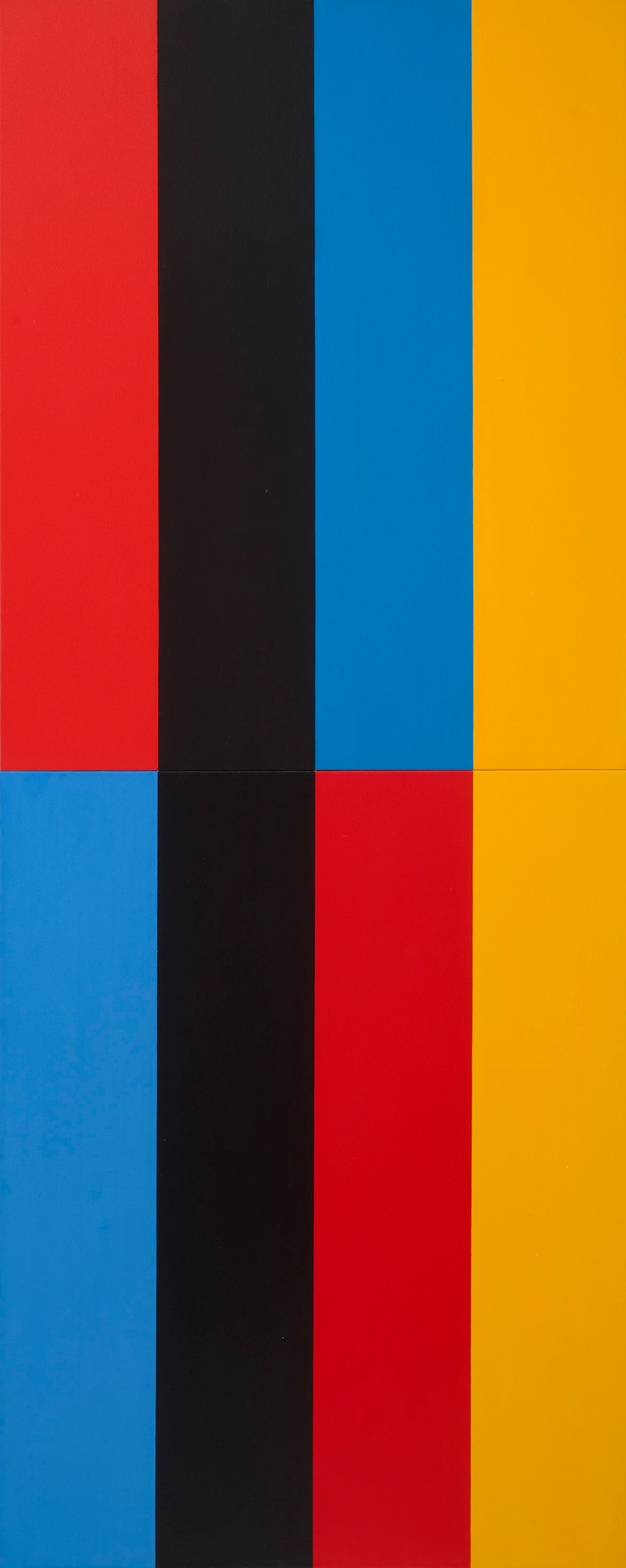
signed, titled and dated 1990 to the stretcher; titled and dated to a gallery label on the reverse
90 × 36 in (228.6 × 91.4 cm)
(including Buyer's Premium)
Costin & Klintworth Gallery, Toronto
Private Collection
Jaan Poldaas was born in Sweden to Estonian refugees and raised in Northern Ontario. Initially trained as an architect at the University of Toronto, he developed a geometric abstract painting practice grounded in experimentation and conceptual thinking. Beginning in 1972, Poldaas explored various methods of generating colour sequences through numerical, mechanical, and chance-based systems. Often outlining his approach in writing before beginning a painting, he established self-imposed rules for each body of work, drawing on mathematical principles, physical laws, and elements of chance to organize colour within structured, rectangular formats. In some cases, he even used dice or playing cards to determine compositional arrangements.
Known for his precision and rigour, colour is central to Poldaas's practice. While his paintings may appear minimal at first glance, they are highly controlled and deliberate, prioritizing optical experience over expression or narrative. His approach is distinctly analytical, examining how subtle shifts in colour and proportion shape visual perception. He consistently emphasized the flatness of the picture plane and the relationships between tonal variations.
This painting belongs to Poldaas's Vertical Composition series of 1990, a group of ten oil paintings, each measuring 90 by 36 inches and composed of varying arrangements of black, red, blue, and yellow rectangular bands. In 1991, two works from this series were included in the exhibition Abstract Practices at the Power Plant Contemporary Art Centre in Toronto. Paintings from the series are also held in the permanent collections of the Buffalo AKG Art Museum and the Art Museum of Estonia.
