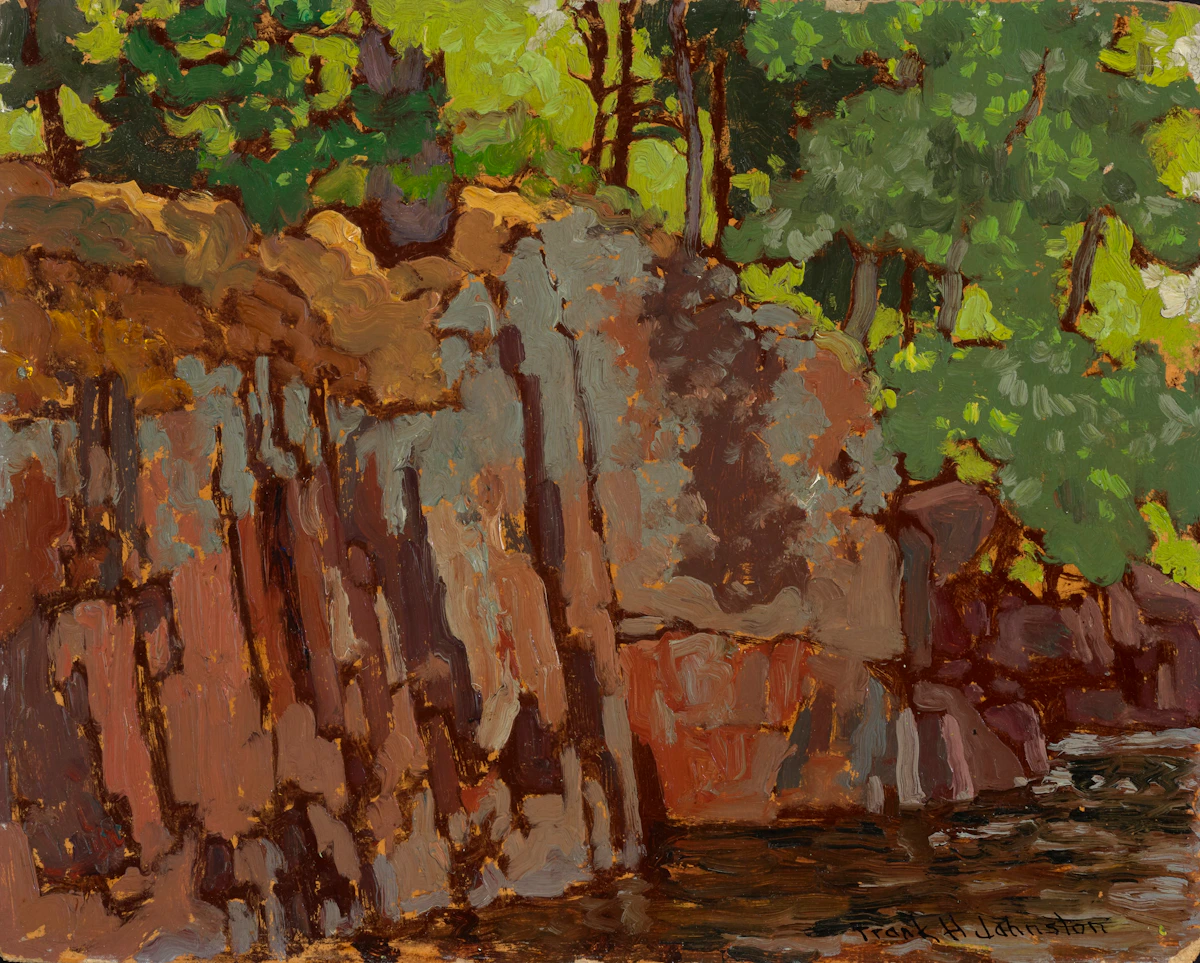
signed lower right; titled, dated 1921 and inscribed "$80.00" on the reverse
10.5 × 13.25 in (26.7 × 33.7 cm)
(including Buyer's Premium)
Collection of L. Bruce Pierce (no. 35)
Roberts Gallery, Toronto
Origine Beaux Arts, Montreal, 1971
Beam Canada Inc. (Canadian Club) through acquisition by Hiram Walker & Sons Ltd., Walkerville/Windsor
In the early years of the Group of Seven, Frank Hans Johnston, along with fellow Group members, made a number of painting expeditions to Ontario’s Algoma region on the northern shores of Lake Superior.
Johnston also looked westward and, in 1921, moved to Winnipeg, where he became principal of the city’s art school and director of its public gallery. Eric Brown, the director of the National Gallery of Canada, had encouraged Johnston to make the move. Johnston travelled to the Lake of the Woods, situated on the borders of Manitoba, Ontario and Minnesota. With its dense wilderness and thousands of small, rocky islands, the distinctive region provided ample inspiration for painting. Johnston would return each summer with his family, renting the same cottage on the shoreline. The artist produced a significant body of work depicting the picturesque cottage destination that is relatively uncommon within historical Canadian art. In doing so, he extended a visual record of the region established slightly earlier by Walter J. Phillips, one of the first artists to consistently chronicle these landscapes.
Significantly, Rocky Shore, Lake of the Woods was completed during the brief period while the artist was a member of the Group of Seven. With the lessons learned from his experiences in Algoma, Johnston applied a similar style and technique to his work in Lake of the Woods. The composition of this panel is filled with a brilliant patchwork of brushstrokes. The dense foliage crowning the rocky shore is illuminated with sunlight. Both immediate and precise, Johnston has captured the setting before him with vitality. Rocky Shore, Lake of the Woods marks an important early period for the artist. As Johnston settled in Winnipeg, his painterly style shifted toward more realistic and academic renderings of the landscape.
In January 1922, Johnston held an exhibition at the Winnipeg Art Gallery that included 326 artworks. He claimed that he had no disagreement with the Group of Seven, only that he wanted to remain independent when it came to exhibitions. He formally broke with the Group later that year. In 1925, Johnston changed his name to the more exotic first name of 'Franz' Johnston, and by 1927, he was back in Toronto, working as the principal at the Ontario College of Art.
Cowley Abbott is honoured to be offering the Canadian Club Brand Centre art collection, reflecting an important part of Windsor’s and Canada’s history.
Please click here for additional information on the Collection of Beam Canada (Canadian Club).
