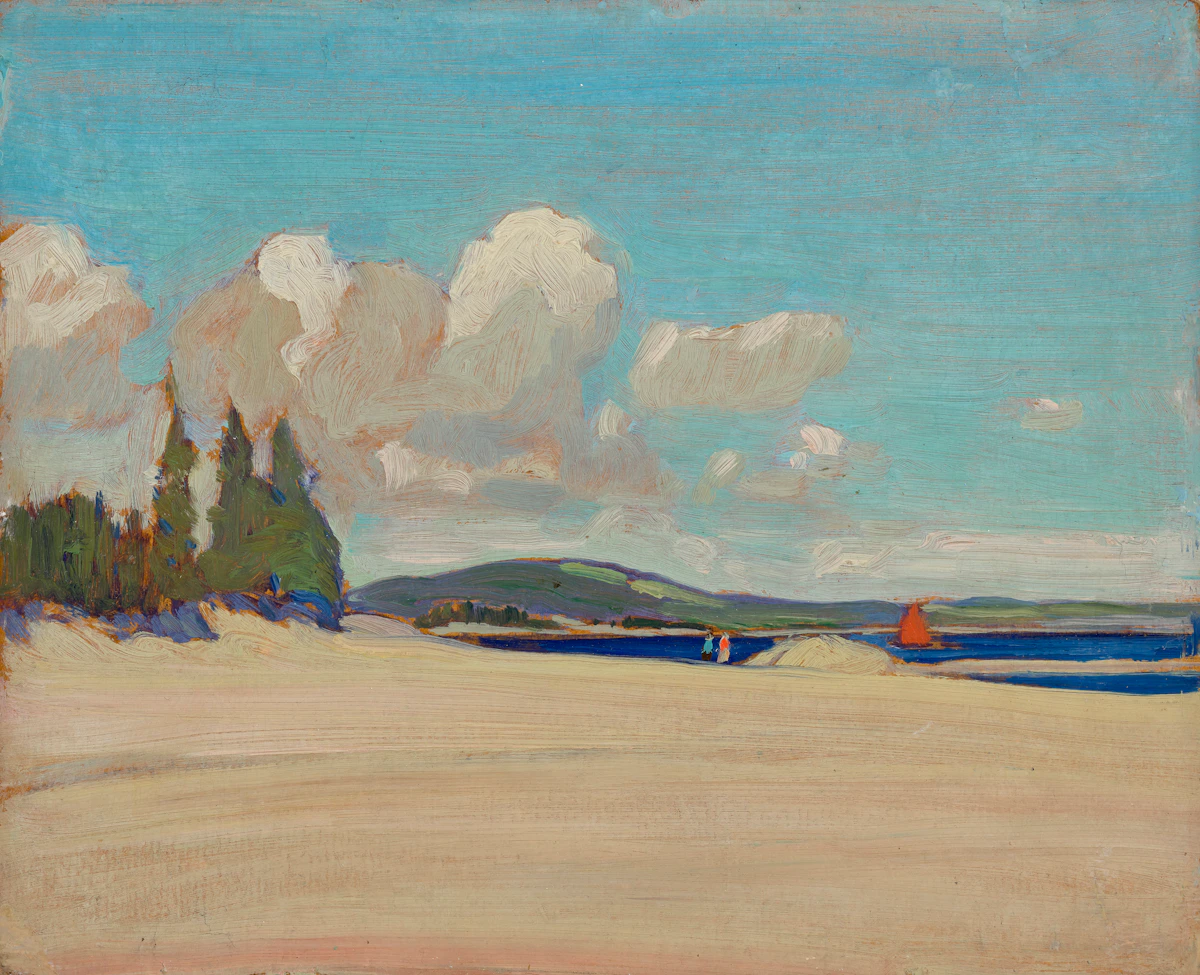
titled, dated 1922 and certified by Thoreau MacDonald (197[?]) and inscribed "The Sandy Stretch Petite Rivière" and "To Judy, Jan 16/56" on the reverse
8.5 × 10.5 in (21.6 × 26.7 cm)
(including Buyer's Premium)
Continental Galleries of Fine Art, Montreal, 18 June 1952
Origine Beaux Arts, Montreal, 1972
Beam Canada Inc. (Canadian Club) through acquisition by Hiram Walker & Sons Ltd., Walkerville/Windsor
Windsor Collects: 150 Years of Canadian Art, Art Gallery of Windsor, 19 July-28 September 1997, no. 61
Nancy Robertson, J.E.H. MacDonald, R.C.A., 1873-1932, Toronto, 1965, pages 11-12
Windsor Collects: 150 Years of Canadian Art, Windsor, 1997, no. 61, listed as loan of Hiram Walker & Sons Ltd. (an Allied Domecq Spirits & Wine Company)
During the early years of the Group of Seven, the landscapes of northern Ontario figured as their primary subject matter, though several members also painted in Nova Scotia. Arthur Lismer taught in Halifax from 1916 to 1919, while A.Y. Jackson and Lawren Harris also painted in the region periodically. J.E.H. MacDonald travelled to Nova Scotia in the summer of 1922, visiting fellow artist Lewis Smith and his sister Edith in the coastal village of Petite-Rivière. Situated southwest of Halifax, Petite-Rivière provided ideal sketching subjects for MacDonald. The village lies among rolling hills surrounding a river of the same name, and featuring an extensive sandbar. MacDonald sketched the sand bar repeatedly, working up his studies into the canvas Sea Shore, Nova Scotia, which was purchased by the National Gallery of Canada in 1923.
Petite Rivière, N.S. presents a simplified view of the same subject. Here MacDonald has concentrated painterly details across the middle of the picture. The foreground is occupied with an open, sandy expanse, depicted with subtle shifts in hue. The crimson sail and brightly coloured figures serve adeptly as focal points. Art historian Nancy E. Robertson observed, “On the Atlantic coast of Nova Scotia in 1922, MacDonald concentrated in his sketches on the long lines of the horizon repeated in the shore and the waves. In keeping with the simplicity of his subject and the subdued grey-blue of the sky and the sea, he restrained his handling.” MacDonald’s Nova Scotia paintings mark an important transition in the artist’s work, from the dense, textured brushstrokes of his Algoma canvases to the greater clarity of his Rocky Mountain compositions, which were to follow.
Cowley Abbott is honoured to be offering the Canadian Club Brand Centre art collection, reflecting an important part of Windsor’s and Canada’s history.
Please click here for additional information on the Collection of Beam Canada (Canadian Club).
