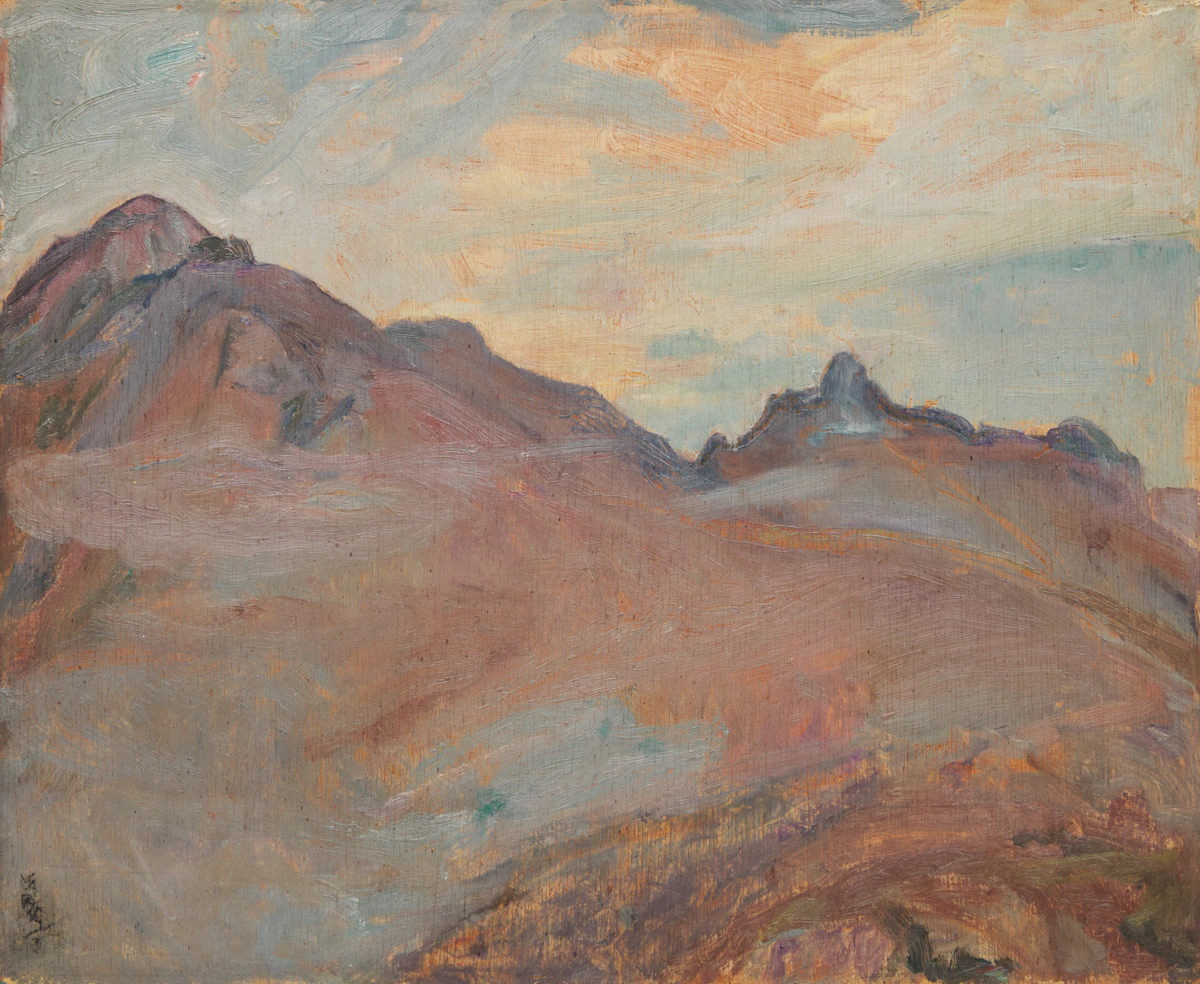
signed lower left; titled, Varley inventory no. 431 and inscribed "Mountain Scene, B.C." on the reverse
12 × 15 in (30.5 × 38.1 cm)
(including Buyer's Premium)
Origine Beaux Arts, Montreal, 1972
Beam Canada Inc. (Canadian Club) through acquisition by Hiram Walker & Sons Ltd., Walkerville/Windsor
Robert Stacey, "The Fabric of All Things Celebrating F.H. Varley," in Varley: a Celebration, Unionville, 1997, page 9
In 1920, Frederick Horsman Varley became a charter member of the Group of Seven. He was mainly a painter of portraits and figures in landscapes during these years, not a landscape painter like the other members of the Group. In the early part of the decade, Varley traveled to the Jasper area, often working alongside A.Y. Jackson. His Alberta works—especially from Jasper National Park—are increasingly expressive and emotionally charged, with swirling forms and dramatic colour, marking a shift away from the more structured compositions of some of his peers.
In 1926 Varley was offered a job in the recently established School of Decorative and Applied Arts in Vancouver and moved there with his family that fall. He was entranced by the landscapes of British Columbia and in the summer of 1927 he painted in Garibaldi Park with fellow teacher Jock Macdonald. They travelled by steamer and train, then trekked twelve miles ascending 2500 feet to the Taylor Meadows above Garibaldi Lake.
Ten of Varley’s mountain sketches were included in the Exhibition of Canadian West Coast Art Native and Modern at the National Gallery in Ottawa in December 1927. The artist remained in British Columbia through the late 1920s and early 1930s, producing many of his most expressive West Coast landscapes and portraits. By 1936, he left the province and returned to Toronto.
Varley’s time in British Columbia was a high point in his creative life. Between 1957 and 1967, he returned to British Columbia to make several sketching trips to the Kootenay Lake region in the company of his close companion, Kathleen McKay. Varley’s paintings of British Columbia from both the earlier and later years are highly atmospheric and focused on effects of light, often in a blue-green and violet colour palette. This is demonstrated in Evening Light, The Kootenays, with the soft, pastel brushwork in the mountains and the glowing sky. Robert Stacey remarked on the changes in Varley’s paintings, writing: “Inevitably, as his brushwork loosened yet grew more muscular, his palette broadened through the rich chromatic range of the ‘Varley colours’ – iridescent green‒mauve, ‘Chinese’ gold, fireweed pink, gentian purple.”
Cowley Abbott is honoured to be offering the Canadian Club Brand Centre art collection, reflecting an important part of Windsor’s and Canada’s history.
Please click here for additional information on the Collection of Beam Canada (Canadian Club).
