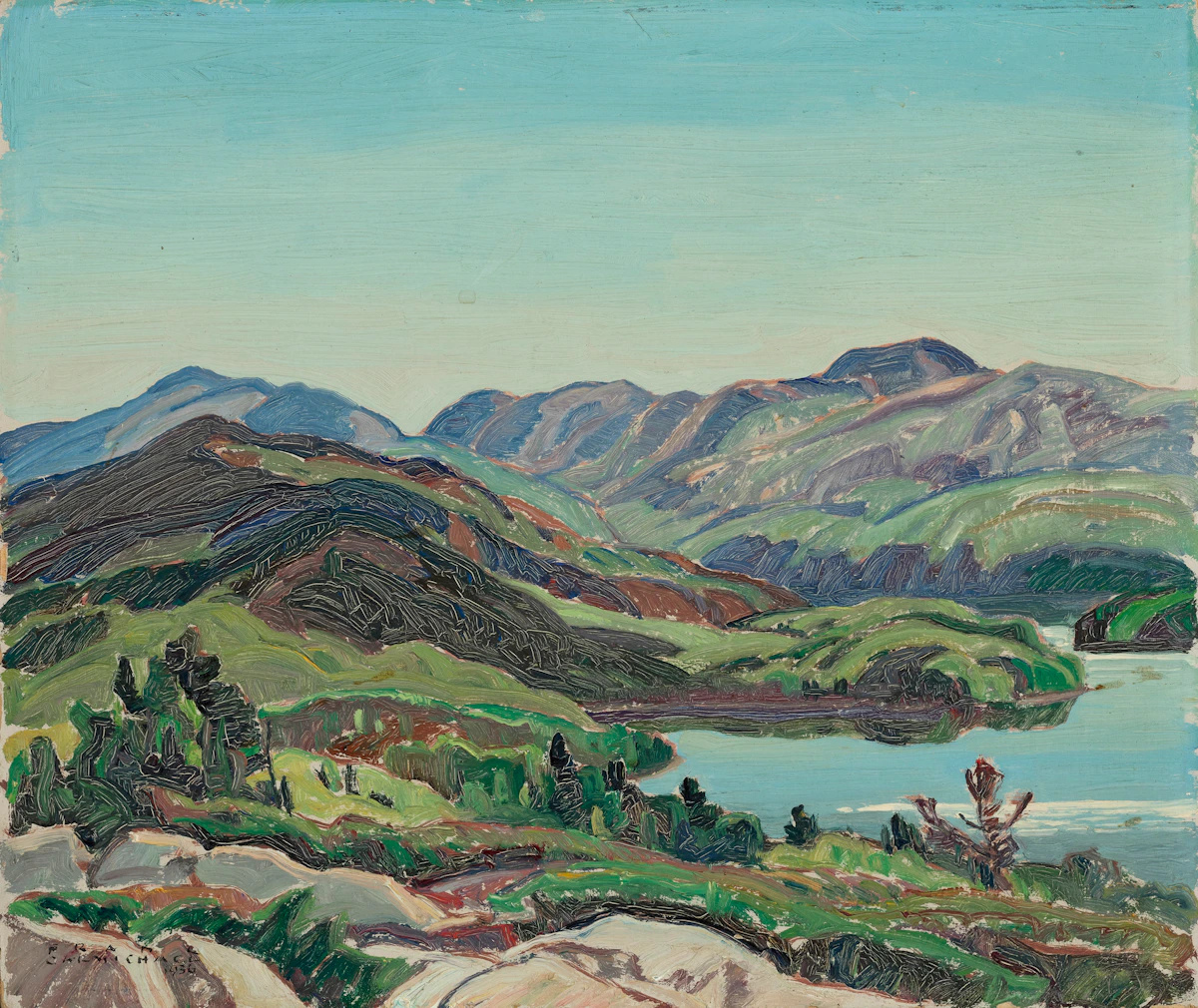
signed and dated 1936 lower left; signed, titled (twice) and inscribed "Cranberry Lake" on the reverse; titled on two labels on the reverse; titled on two labels on the reverse of the frame
10 × 12 in (25.4 × 30.5 cm)
(including Buyer's Premium)
Origine Beaux Arts, Montreal, 1972
Beam Canada Inc. (Canadian Club) through acquisition by Hiram Walker & Sons Ltd., Walkerville/Windsor
Exhibition of Little Pictures, Ontario Society of Artists, Art Gallery of Toronto, December 1936, no. 160
Department of Small Pictures, Canadian National Exhibition, Toronto, 27 August-11 September 1937, no. 339 as Still Morning
Megan Bice, Light & Shadow: The Work of Franklin Carmichael, Kleinburg, 1990, page 43
The oil sketch Still Morning, 1936, was painted one year after Frank Carmichael completed a new family cottage in La Cloche in 1935, a region that compelled him for nearly two decades, and where many artists joined him on sketching excursions. From then on, it was this area, north of Manitoulin Island near Whitefish Falls, Ontario, which was the focus of his attention as painter into the early 1940s. An inscription on the verso of this sketch in red crayon made by his wife, Ada Carmichael, confirms that he was looking onto Cranberry Lake, the same lake on which he built his cottage. Although he didn’t detail where he was precisely located to create this sketch, the curved peninsula in mid-ground may well be the sand beach where he and his family camped for many years before they built the cottage. His viewpoint looks down over a wide and shallow bay below, of which there is only one of such width on Cranberry Lake.
Carmichael was often quite thoughtful about the titles he chose for his paintings, including this one, Still Morning. The label on the verso in his handwriting from the 1937 Canadian National Exhibition, where it was shown for a second time after the 1936 OSA Little Pictures Exhibition, confirms that what commanded his attention was the essence of calm offered on a summer morning when the lake is so tranquil that not a ripple courses the water surface, and not the faintest of cloud formations can be found in the sky. There is little doubt that this was a summer landscape as Carmichael was particularly attentive to the many varieties of green to be found in forested landscapes in this season. Cranberry Lake is a long and narrow body of water protected by high ridges on both the north and south sides; as artist his vantage point looks from north to south, the distant hills beyond sharply contoured to evoke the rugged geological quartzite formations. Cranberry Lake is sufficiently sheltered that it can calm to mirror-like stillness, as he suggests with the mid-ground peninsula where the hills are perfectly reflected in the water below. For Carmichael, it was these precious moments which offered him seemingly endless subject matter as painter. Carmichael made several sketches of Cranberry Lake in 1936, including two in the National Gallery of Canada collection, Cranberry Lake (38413), and Hills, Cranberry Lake (38414), but this one is among the most contemplative of his efforts that year.
We extend our thanks to Catharine Mastin, PhD, art historian, curator, and Adjunct Member of the Faculty of Graduate Studies in Art History at York University for contributing the preceding essay. Catharine curated the exhibition Franklin Carmichael: Portrait of a Spiritualist, organized by the National Gallery of Canada, Ottawa, which toured Canada between 1999 and 2001.
Cowley Abbott is honoured to be offering the Canadian Club Brand Centre art collection, reflecting an important part of Windsor’s and Canada’s history.
Please click here for additional information on the Collection of Beam Canada (Canadian Club).
