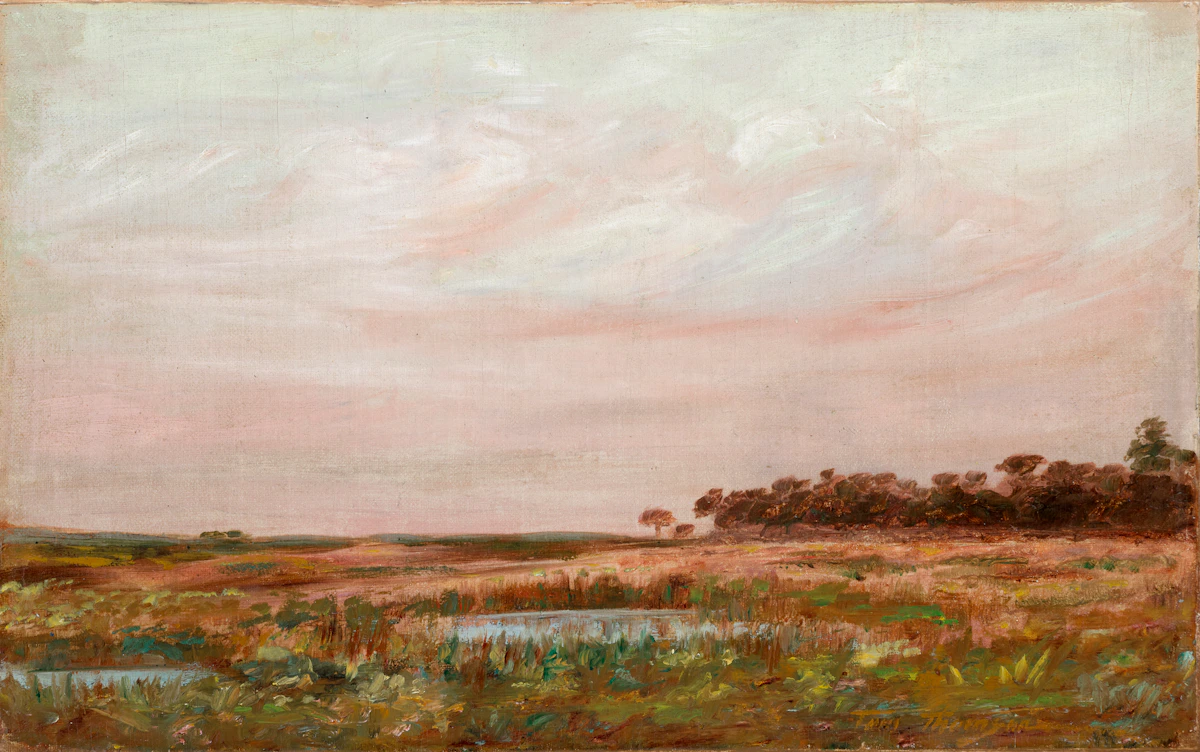
signed lower right; titled and dated 1911 to two labels on the reverse; catalogue raisonné no. 1911.16
8.5 × 13.5 in (21.6 × 34.3 cm)
(including Buyer's Premium)
McDowell Gallery, Toronto, 1978
Beam Canada Inc. (Canadian Club) through acquisition by Hiram Walker & Sons Ltd., Walkerville/Windsor
L.S. Harris, "The R.C.A. Reviewed", The Camps, vol. 1, no. 2 (December 1911), page 9 Letter from H.B. Jackson to Blodwen Davies, 5 May 1931
Letter from Stanley Kemp to Martin Baldwin, 21 November 1934, Tom Thomson Accession Files, Art Gallery of Ontario Archives
Harold Town and David Silcox, Tom Thomson: The Silence and the Storm, Toronto, 1977, reproduced page 40
Joan Murray, Tom Thomson Catalogue Raisonné, 2016, https://www.tomthomsoncatalogue.org/catalogue/entry.php?id=91, no. 1911.16
In Tom Thomson’s Marsh, Lake Scugog, the viewer sees a Tom Thomson poised to dive into a career as a painter. Here Thomson has confidently essayed the effect of a late afternoon sky on an expansive but simple landscape, proof that he already was regarding painting seriously. He got his first painting outfit in the spring of 1912, according to his friend H. B. Jackson.
The painting is surprisingly stark and trees, later, one of his favourite subjects, appear only in the distant background as a largely undifferentiated mass. Yet the technical handling of the sketch is accomplished and assured, especially for such a relative newcomer to oils as Thomson. In finding his way, Thomson has given the painting of the marsh a quiet, even, reverential beauty. Everything is understated, even perhaps the quiet luminosity of the sky.
At this time, Thomson was making regular sketching trips to places around and in Toronto. He likely chose to paint the marsh because the Scugog marshlands were known as a favourite fishing spot and fishing was dear to his heart and his family. He may have travelled to Port Perry, Ontario, to go there. That small town would have had inexpensive overnight accommodation.
A work related to the painting with much the same title, The Marsh, Lake Scugog, 1911 (Art Gallery of Ontario) was gifted by Thomson to a friend, Stanley Kemp, in the fall of 1913. In a letter from Stanley Kemp to Martin Baldwin, curator of the Art Gallery of Toronto, on 21 November 1934, Kemp recalls receiving the painting from Thomson in the fall of 1913, sharing “The picture is not his preliminary sketch but a later painting from the sketch. It depicts a marsh or swamp on the edge of Lake Skugog (or Scugog) with evening settling down."
Like Marsh, Lake Scugog, this larger canvas is equally simple and assured. Though painted more towards evening, it heralds a theme which would become in time one of the major parts of Thomson’s body of work, his sky studies.
At this time, Thomson was still working at Grip Limited, a leading photo-engraving firm in Toronto where he had, around 1906, been hired in the Design Department. The head of the department was J.E.H. MacDonald, who had become his mentor and inspiration, not only because MacDonald was an inspired designer trained extensively in Canada and in a top firm in London, England, Carlton Studios, but he was one of the few artists at Grip who actually sold their artwork. Besides such reasons, MacDonald was a kindly man who looked at the work members of the firm essayed on weekends and helpfully (and no doubt, hopefully) criticized it.
Another influential person at Grip Ltd. was the dynamic art director, A.H. Robson, who called together the members of the creative team and told them to sketch outdoors on weekends to get new imagery for their commercial work.
Thomson, like his fellow artists, obliged. One friend, another employee at Grip like Stanley Kemp, H.B. Jackson, recalled later that in 1911, “we visited Lake Scugog two or three times when Tom did some sketching” as they had more or less been told by Robson to do.
It is hard to realize now what an innovation sketching in Canadian nature was but in those long-ago days, landscape painting often was conventional and drawn from European models. Marsh, Lake Scugog is important because it is a Canadian subject with a distinct Canadian identity, a rarity at this date, proof that !omson was already among the vanguard artists of his period.
Lawren Harris, in reviewing the Royal Canadian Academy of Arts exhibition of 1911, wrote: “In each succeeding exhibition, one notices fresher, more vigorous and original work; not so much in choice of subject as in the spirit of the thing done.” Thomson embodied this spirit and became in time, for many Canadians, one of its most exciting exponents. But his introductory steps took place in paintings such as Marsh, Lake Scugog.
We extend our thanks to Joan Murray, Canadian art historian, for contributing the preceding essay.
Cowley Abbott is honoured to be offering the Canadian Club Brand Centre art collection, reflecting an important part of Windsor’s and Canada’s history.
Please click here for additional information on the Collection of Beam Canada (Canadian Club).
