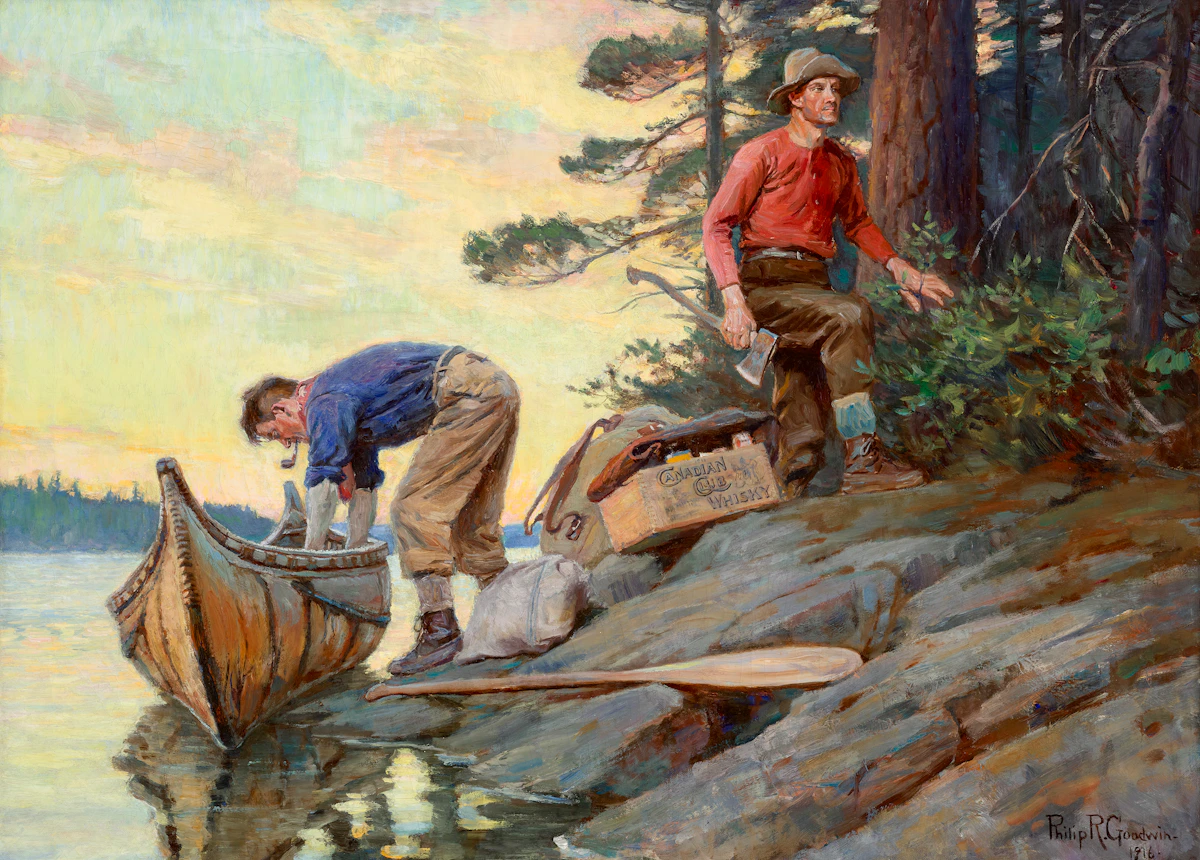
signed and dated 1916 lower right
24 × 33 in (61.0 × 83.8 cm)
(including Buyer's Premium)
Acquired directly from the Artist
Beam Canada Inc. (Canadian Club) through acquisition by Hiram Walker & Sons Ltd., Walkerville/Windsor
Larry Len Peterson, Philip R. Goodwin: America's Sporting & Wildlife Artist, Missoula, 2007, page 95
During the late nineteenth and early twentieth centuries, as the North American frontier rapidly industrialized and urban centres expanded, a profound cultural nostalgia for the untamed wilderness began to take root in the public imagination. At the forefront of this movement was Philip R. Goodwin, a preeminent figure of America’s “Golden Age of Illustration” and an unequalled chronicler of the sporting life. A prodigy who sold his first illustration to Collier's magazine, Goodwin trained under Howard Pyle, who also educated N.C. Wyeth, Maxfield Parrish, Harvey Dunn, and Frank Schoonover. He later shared a studio with artists who would define the visual vocabulary of the American West, including Charles Marion Russell and Carl Rungius. His exceptional ability to capture the thrill of outdoor adventure, wildlife, and the rugged archetype of the frontiersman earned him commissions from the era's most prestigious publications and figures, including the illustration of Jack London’s seminal novel The Call of the Wild and Theodore Roosevelt’s African Game Trails.
The Hudson Bay trading post site at Lake Temagami, Ontario, offered the perfect setting for Goodwin to photograph and sketch native people, animals, and the landscape. Upon his arrival, the region was home to native people, loggers, and trappers—hardly a tourist destination. Later, the railroad brought travellers eager to hike the trails or canoe the waterways. In 1909, Goodwin ventured to Twin Butte and Pincher Creek, Alberta, for a sketching trip. He then travelled west to the Canadian Rockies, boarding the Canadian Pacific Railroad in Montreal and telling his mother, “They say these mountains around here are as fine as anything up to Banff, but are not so much advertised.”
By 1915, Goodwin travelled less frequently and focused on studio work, drawing on his past experiences for reference. Building on his earlier explorations, he continued to choose subjects that interested him, and his ability to blend themes of friendship and wilderness earned widespread popularity. Most of his clients were advertisers who used his paintings for magazine and catalogue covers, posters, calendars, and prints. Advertisers were satisfied when he incorporated specific items such as rifles, fishing poles, or signboards. The presence of a Canadian Club Whisky crate indicates a probable commission, designed to resonate specifically with a Canadian audience.
To ensure his works met publishers’ expectations, Goodwin created watercolour sketches for review by the publisher’s art director before starting his canvases. He would then make corrections in response to feedback and proceed with the painting. Once the canvas was complete, it was sent to the publisher and assigned to a printer. Publishers especially sought yellow skies to express warmth, prompting further colour enhancement before printing. When these proofs received approval, they were produced in editions from a few hundred to several thousand. Today, Goodwin’s original oil paintings are rare. Often stored away after use, these works were frequently forgotten or destroyed during company moves or renovations. Thus, art historians rarely have the chance to compare the prints with the original paintings.
Camping—Canadian Club stands as a quintessential example of Goodwin’s mastery. It bridges the realms of fine art painting and commercial illustration. During this period, prominent outdoor equipment brands, firearms manufacturers like Winchester, and beverage companies often commissioned major artists. Their goal was to create evocative, narrative-driven images for calendars, posters, and print advertisements. These campaigns targeted an urbanized middle class of men who yearned for the primal escapism of hunting, fishing, and wilderness exploration. In this oil on canvas, Goodwin anchors the narrative with a remarkable piece of product placement: the iconic Canadian Club Whisky wooden crate resting on the rugged shoreline. The crate does not detract from the composition. Instead, it acts as a vital narrative prop, signifying both the reward after a gruelling day and the infiltration of refined comforts into the remote backcountry.
The composition is staged along a rocky, uneven shoreline, framed by the towering silhouettes of evergreens on the right, establishing a sense of geographic isolation. Goodwin presents an intimate, quiet moment of transition during the day, focusing on the division of labour between two seasoned outdoorsmen. On the left, a figure dressed in a rich cobalt-blue shirt bends over a traditional birchbark canoe, a pipe casually clenched in his teeth as he secures or retrieves their gear. To the right, his companion stands watchfully upon the rocks while holding an axe. Dressed in a vibrant crimson shirt that serves as the painting’s primary focal point, this figure gazes off into the distance, perhaps assessing the fading light or scanning for approaching wildlife. Their clothing—supple earth-toned trousers, heavy woollen socks, and sturdy leather boots—is rendered with a meticulous attention to detail that Goodwin’s core audience of seasoned sportsmen would have instantly recognized and admired. Goodwin’s technical execution in this painting elevates the commercial subject matter into a realm of atmospheric beauty. The artist uses an impressionistic handling of light and colour, shifting away from the strict realism often associated with standard commercial illustration. A luminous sky, rendered in thick impasto, dominates the background. Strokes of golden yellow, soft neutrals, and pale blue are applied with textured brushstrokes that capture the fleeting, incandescent glow of sunlight. The glassy surface of the lake mirrors these radiant tones. Vertical streaks of gold and yellow reflect upon the rippling water in the foreground. By juxtaposing the luminous expanse of the water and sky against the textures of the rocky foreground and the shadowy woods, Goodwin balances the dual nature of the wilderness: its transcendent beauty and its more unforgiving terrain.
The men in the present work are idealized embodiments of Roosevelt’s doctrine of “The Strenuous Life”, a speech delivered in 1899, championing outdoor exertion to maintain physical and moral fortitude. Through his use of colour, command of atmospheric light, and authentic detail, the artist immortalizes a fleeting moment of wilderness tranquility. The painting endures not merely as a fascinating artifact of early twentieth-century commercial art, but as a timeless celebration of the enduring human connection to the great outdoors.
Today, Goodwin’s paintings and prints are held by the Buffalo Bill Historical Center in Cody, Wyoming, as well as by other major American institutions, including the National Museum of Wildlife Art near Jackson, Minneapolis Institute of Art, the Stark Museum of Art, and the Smithsonian Institution. The Glenbow Museum in Calgary holds most of Goodwin’s collected works, along with the largest collection of works by his friend, Carl Rungius.
Cowley Abbott is honoured to be offering the Canadian Club Brand Centre art collection, reflecting an important part of Windsor’s and Canada’s history.
Please click here for additional information on the Collection of Beam Canada (Canadian Club).
