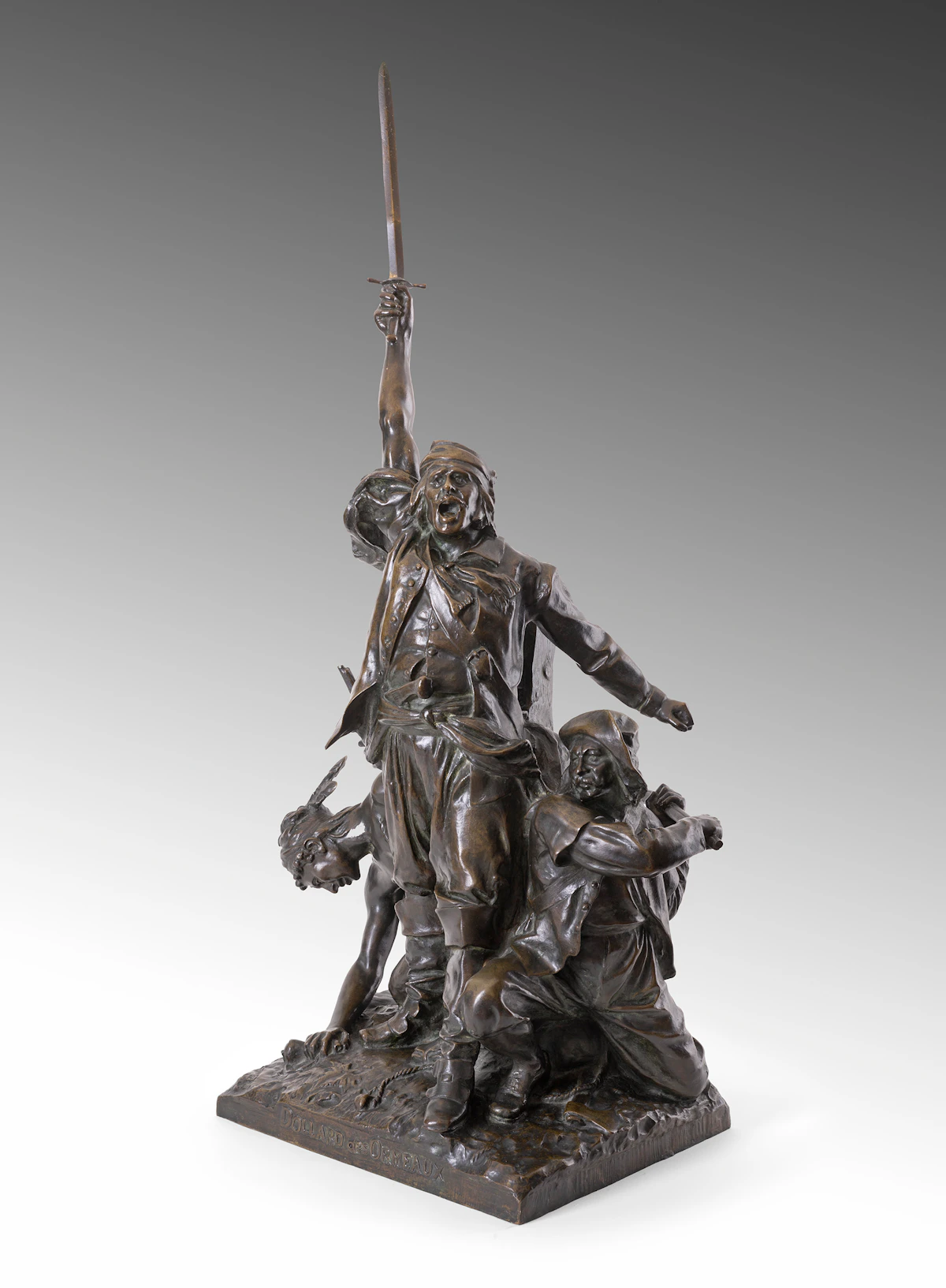
signed (incised), titled, dated 1916, inscribed "5" and with the foundry mark "Hohwiller Fondeur" on the base
36 × 13.5 × 11.5 in (91.4 × 34.3 × 29.2 cm)
(including Buyer's Premium)
Acquired from the Artist by Patrick Martin Wickham (1856-1937), Westmount, circa 1915
By descent to Dr. John C. Wickham, (1887-1961), Westmount, circa 1930
By descent to Elizabeth M. Wickham-La Prairie (1922-2020), Westmount/Gatineau, circa 1950
Estate of Elizabeth M. Wickham-La Prairie
Daniel Drouin, Louis-Philippe Hébert, Quebec, 2001, a similar work reproduced page 296
Louis-Philippe Hébert was a leading Canadian sculptor best known for his public monuments and bronze statuettes that helped shape the country’s identity in the late 19th and early 20th centuries. Drawing inspiration from Canadian history and literature, his work combines academic training with a lively, expressive approach to form and narrative. Some of his most recognizable monuments include Queen Victoria in Ottawa, Maisonneuve, Jeanne Mance, Monseigneur Bourget and Edward VII in Montreal, and six sculptures in front of the Quebec parliament in Quebec City.
Although Hébert’s legacy is more associated with public monuments than with private or retail settings, his body of work also includes a large number of statuettes, busts, medallions, and medals depicting both historical figures and his contemporaries—politicians, authors, wealthy financiers, clergy, and close friends.
In 1911 and 1912, Hébert was awarded three large contracts for public monuments that crowned his flourishing career. The work enabled him to go to Paris with his family late in 1911 for a final sojourn, which would conclude in the spring of 1914 with a visit to Italy. This bronze sculpture was completed in 1916, shortly after his return from Europe. It depicts Adam Dollard des Ormeaux, an iconic figure in the history of New France. Arriving in the colony in 1658, Dollard des Ormeaux was appointed the position of garrison commander of the fort of Ville- Marie (now Montreal). In this sculpture, the central figure raises his sword to the sky, encapsulating a moment of triumph in the battle of Long Sault, in May 1660.
A recurring historical subject of Hebert’s statuettes was characters in the history of New France and Indigenous peoples. In these smaller bronzes, Hébert moves away from the traditional focus on well-known figures in his public monuments. These works emphasize the figures’ actions and the dramatic quality he imbues them with, which often draws on early Canadian literature, particularly the poetry of Louis Fréchette. Dollard des Ormeaux was inspired specifically by Fréchette’s poem La Légende d’un Peuple.
The battle that Adam Dollard des Ormeaux waged with a handful of comrades against an entire Iroquois army in 1660 left its mark on the collective memory of Quebec society. The festivities in honour of his Long Sault exploit reached its peak during the 1920-1970 period and was celebrated in many ways, most notably the Fête de Dollard celebrated every year in Quebec on the same date as Victoria Day in the rest of Canada.
Dollard des Ormeaux and the Battle of Long Sault are an enduring part of French-Canadian culture, particularly in Quebec. Hébert was commissioned to create a bas-relief of Dollard des Ormeaux as a component of the ‘de Maisonneuve’ monument in Place D’Armes, Montreal. The monument was unveiled of July 1, 1895 to celebrate the 250th anniversary of the founding of the city in 1642.
This important sculpture is also in the collection of the Musée national des beaux-arts du Quebec, Quebec City, as well as in the collection of the National Gallery of Canada, Ottawa.
