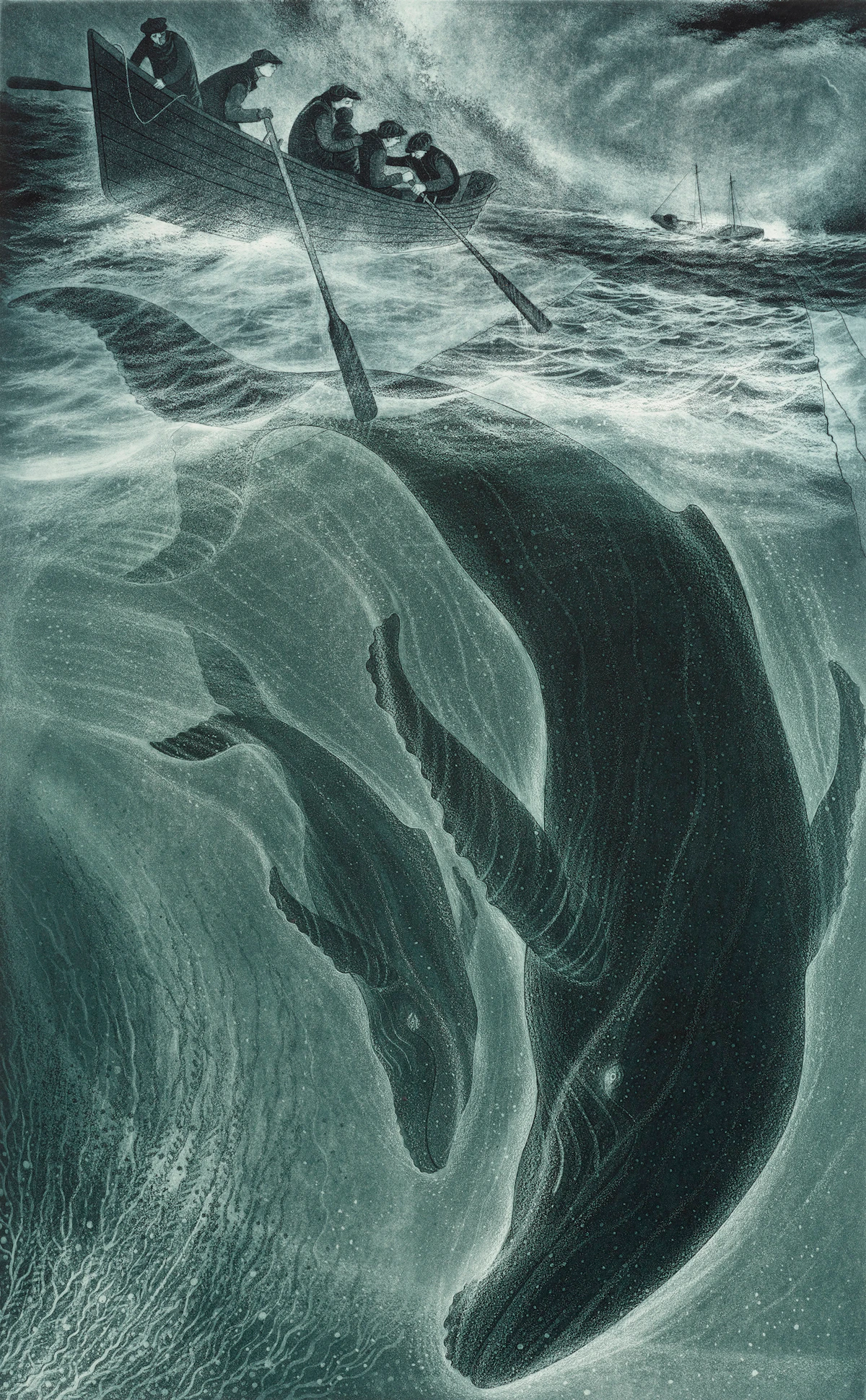
signed, titled, dated 1993 and numbered "AP IX/X" in the lower margin
31.75 × 19.75 in (80.6 × 50.2 cm)
(including Buyer's Premium)
Private Collection, Toronto
Consignor Canadian Fine Art/Cowley Abbott, auction, Toronto, 25 May 2017, lot 65
Private Collection, Toronto
William Gough, David Blackwood: Master Printmaker, Vancouver/Toronto, 2001, a similar work illustrated page 16
Katharine Lochnan, Black Ice: David Blackwood Prints of Newfoundland, Toronto, 2011, a similar work illustrated plate 61
David Blackwood came from a family with a long seafaring history. Growing up in Newfoundland, the artist spent his childhood summers fishing off the Labrador coast aboard his father’s schooner, the Flora S. Nickerson. Blackwood’s sharp focus on Newfoundland's history and culture positions his body of work in a unique space within the Canadian art historical dialogue. In his signature grand narrative style, Blackwood's Loss of the Flora Nickerson poses questions of one's scope and scale within their environment. The artist exploits the full expressive range of etching and aquatint to construct a layered, almost cinematic depth, guiding the viewer’s eye between the turbulent surface and the shadowed, immersive world below. The diagonal thrust of the lifeboat and its oars cut across the composition, creating a sense of instability that echoes the scene’s precariousness, while the whales’ softly modulated tonal fields contrast with the sharper, more agitated textures of the sea above. This interplay between line and tone underscores a tension between chaos and calm, reinforcing the emotional weight of the story as it unfolds.
The whale in the foreground arches protectively around the younger. In the distance, the Flora S. Nickerson is foundering in the unforgiving waters as its crew and passengers row to safety. The sorrow of the loss is ingrained in the solemn, down- turned expressions of the men aboard the lifeboat. Mirroring what is taking place below water, a father protectively holds his young boy above water. The sublime power of the composition highlights the notion of one's mortality within a moment of loss, compassion and comfort. Such technical sophistication is understood as central to Blackwood’s practice, where printmaking serves as a vehicle for translating personal memory into a collective visual language, preserving not only the event itself but also the psychological and emotional reverberations it carries.
