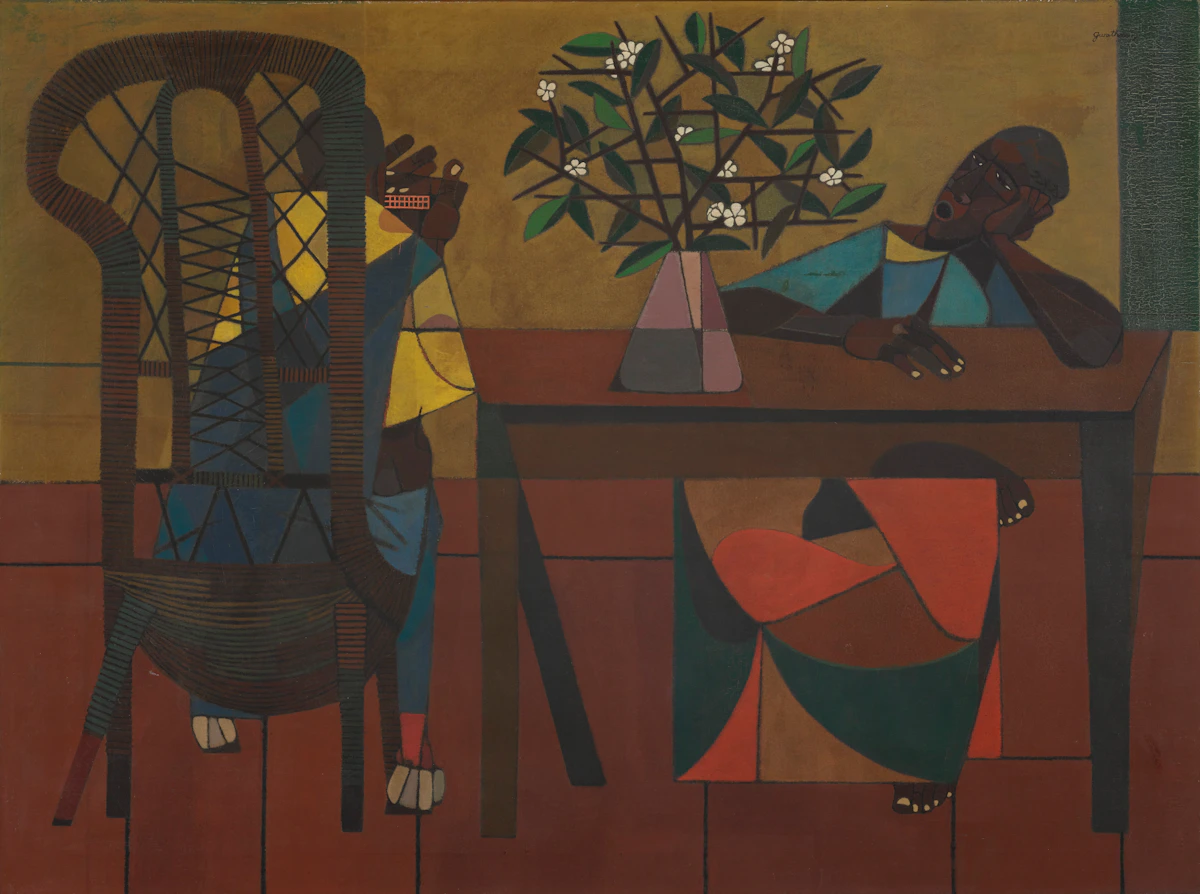
signed upper right; titled on a label on the reverse
30 × 40 in (76.2 × 101.6 cm)
(including Buyer's Premium)
Isaacs Gallery, Toronto
Private Collection, Toronto
Robert Gwathmey established himself as the first white American painter to depict African American subjects in a dignified manner, blending the rigour of European modernism with a commitment to social realism. Renowned for his depictions of rural African American life, Gwathmey developed a signature aesthetic characterized by flat, unmodulated planes of vivid colour bound by stark black outlines, a technique that often draws aesthetic comparisons to the luminous qualities of stained glass or the compartmentalization of Cubism.
In Tree Flowers and Mouth Organ Music, this geometric approach elevates a quiet, intimate moment into a striking composition. The scene is anchored by two figures around a small wooden table in an enclosed interior. On the left, a figure is seated in an elaborately rendered wicker chair, their hands raised to play the harmonica—the titular mouth organ. His companion sits opposite, leaning heavily on an elbow as if deeply absorbed in the music.
The visual rhythm of the canvas is driven by Gwathmey's interplay of colour, pattern, and line. The figures' clothing creates patchworks of vibrant hues, in blocks of golden yellow, cerulean blue, vivid red, and deep green. These sharply contrast with the more subdued, earthy ochres, browns, and siennas defining the background and the floor. At the centre, a stylized, geometric vase holds the "tree flowers." The plant's intersecting branches and delicate white blossoms act as a bridge between the two figures, echoing the angular fragmentation of their clothing while introducing a touch of natural vitality to the rigid interior.
Gwathmey's careful compartmentalization of form ensures his subjects are not reduced to simple anecdotes. The detailed wicker chair contrasts with the flat colour planes, creating a dynamic interplay of texture and depth. The work ultimately reflects on community, shared experience, and the significance of music in African American life.
