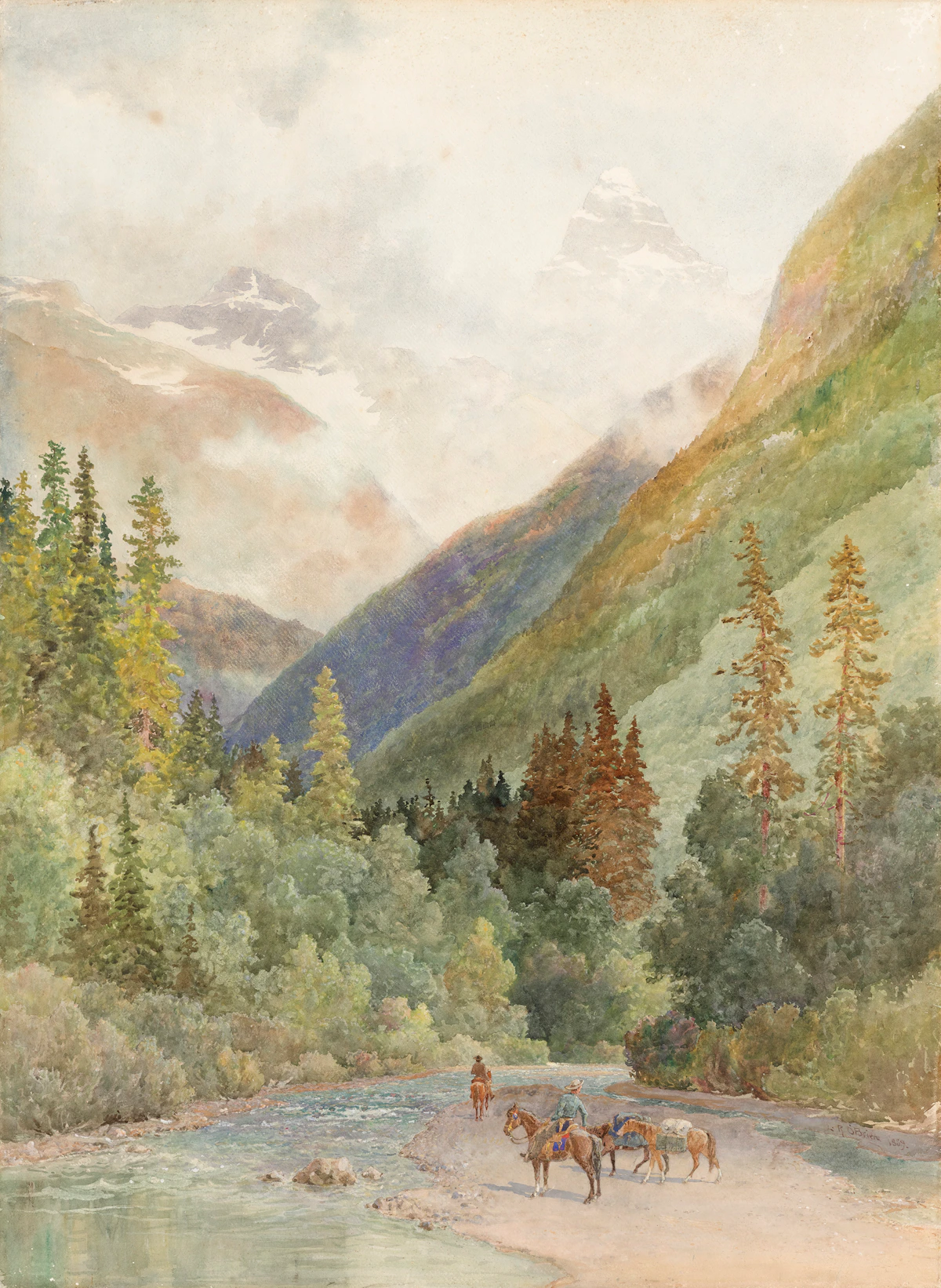
signed and dated 1889 lower right; titled on a label on the reverse; inscribed "A Ford on the Illecillawaet. Western descent of the Selkirk Range" on a label on the reverse
40 × 29.5 in (101.6 × 74.9 cm)
(including Buyer's Premium)
John Bryce Kay (1857-1952), Toronto/Victoria
By descent to Joanna Armour Richards, 1956
By descent to the present Private Collection, Australia
Possibly A Selection of Twenty-seven Water Colour Drawings, Illustrating Scenery in "The Rocky Mountains" and "Pacific Coast" British Columbia. By L.R. O'Brien, Esq. President of the Royal Canadian Academy, Thomas McLean's Gallery, London, from 22 June 1889
Lucius O’Brien Exhibition, Matthews Brothers, Toronto, from 10 December 1892, no.1 as The Greak Peak of the Selkirks at $400
14th Annual Exhibition, Royal Canadian Academy of Arts, Art Association of Montreal, from 1 March 1893, no. 235 as The Great Peak of the Selkirks at $250
The Canadian Department of Fine Art, World's Columbian Exposition, Chicago, 1 May-30 October 1893, no. 177 at $350
Lucius O'Brien was the most prominent Canadian artist of his generation, yet he did not become active in Toronto’s art circles until 1873, at the age of forty, when he joined the newly established Ontario Society of Artists. He became vice-president of the society the following year and was chosen to be the first president of the Canadian Academy of Arts in 1880.
The nationalist landscape movement of the 1860s to the 1890s was closely tied to the expansion of the railways, which played a key role in developing and unifying Canada. Working in both oils and, more often, watercolour, Lucius O'Brien depicted scenes from the Baie des Chaleurs, Quebec City, the Saguenay, Gaspé, and various regions of Ontario. In 1871, the federal government committed to building a transcontinental railway to British Columbia. !e Canadian Pacific Railway was completed in 1885, with its first commercial run in the summer of 1886. To attract settlers and passengers, the company actively promoted the route and the landscapes it passed through, first through photography and later through painting. Its general manager, William Cornelius Van Horne, targeted an English audience and sought strong images of mountain scenery for display at the Colonial and Indian Exhibition in London in May 1886. Van Horne offered artists free transportation and accommodation to paint sites along the railway line in the mountains.
Lucius O’Brien left Toronto for the Rocky Mountains in June 1886 with his friend and fellow artist John Colin Forbes, travelling directly to the Selkirks. O’Brien travelled west on the CPR on two more occasions. In 1887 he sketched from late June to mid-August in the Banff, Lake Louise, and Kicking Horse Pass regions of the Rocky Mountains, and then worked his way west, reaching Victoria in September. In June 1888 he went to Vancouver and spent the whole summer in Howe Sound and vicinity, travelling with two Chinook guides in a sailing canoe.
Prominently included in the Canadian section of the Colonial and Indian Exhibition, held in London in 1886, O’Brien had one of his mountain watercolours accepted by the Royal Academy of Arts of London, in 1887, and over the following two years showed his watercolours in various exhibitions there. In Canada he was featured with Frederic Marlett Bell-Smith in a two-man exhibition of mountain work at the Art Association of Montreal in March 1888, and in February 1889 his Howe Sound watercolours were part of a special AAM exhibition. Van Horne helped organize O’Brien’s exhibition at Thomas McLean's Gallery in London in June 1889, which presented twenty-seven watercolours depicting the landscape of British Columbia. Possibly included in this important exhibition, The Great Peak of the Selkirks, serves as a strong example of O’Brien’s large-scale watercolours commemorating this important period in the history of Canada and Canadian art.
The original owner of this watercolour, John Bryce Kay (1857-1952), spent significant time in British Columbia exploring and staying in surveyor's camps in the 1890s. Kay loved the province and eventually retired in Victoria. Presumably purchased in Toronto circa 1894, the watercolour has remained in the family's collection through the generations, representing John Bryce Kay's love for British Columbia.
