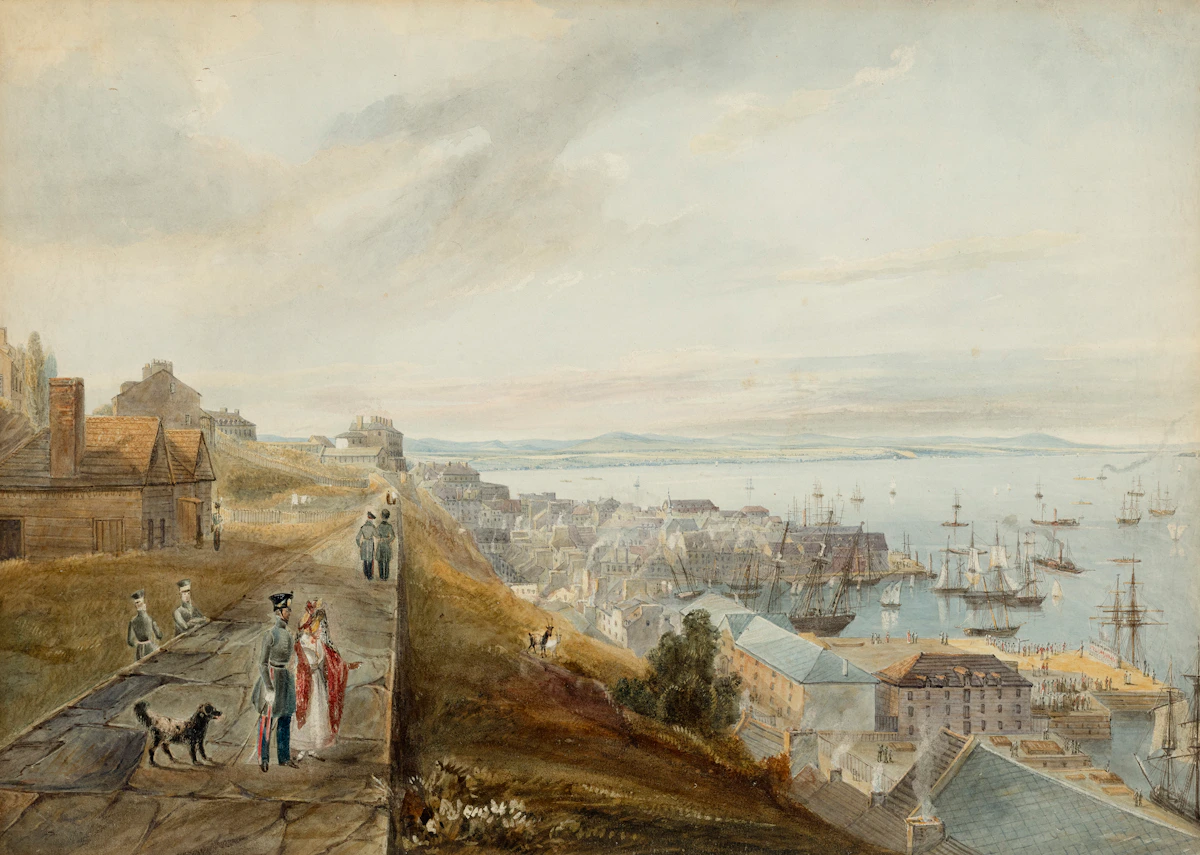
titled in the lower margin; signed, titled, inscribed "The Lower Town and King's Wharf from the Upper Town" on the reverse
15.75 × 22 in (40.0 × 55.9 cm)
(including Buyer's Premium)
G. Blair Laing Galleries, Toronto
John Rogers, Toronto
By descent to the present Private Collection
James Pattison Cockburn began his military training at age fourteen at the Royal Military Academy in southeast London, where future officers were taught drawing. He studied under the renowned watercolourist and engraver Paul Sandby, a founding member of the Royal Academy of Arts. There, he learned to observe and record topography with precision, capturing even the smallest details of defensive structures and fortifications. As a British officer, Major Cockburn was stationed in Quebec City briefly from 1822 to 1823, and again for a longer period from 1826 to 1832.
He became known for his precise renderings of the city’s sites, which he appears to have aimed to document in their entirety, including both the Upper and Lower Towns. This watercolour shows a view along the stone parapet that runs along the edge of the cliff at Cap Diamant. The wall encloses the lower portion of the governor’s garden, marked by picket fences, and extends to the governor’s private grounds. At the cliff’s edge stands his residence, the Château Saint-Louis, while further inland to the left are the administrative buildings of Château Haldimand. Beyond, a panoramic view opens onto the harbour and the rolling hills along the Beauport coast.
In the foreground, the King’s Wharf serves as the city’s main deep- water dock. Beyond it lies the Cul-de-Sac harbour, filled with an array of sailing vessels. An elegantly dressed officer and a young woman stroll along the parapet, reflecting the refined character of this part of the city.
Ackermann & Co. of London executed a folio of six handcoloured aquatints depicting scenes of Quebec by Cockburn in 1833. An aquatint of The Lower Town and King's Wharf from the Upper Town by Cockburn is included in this rare set.
