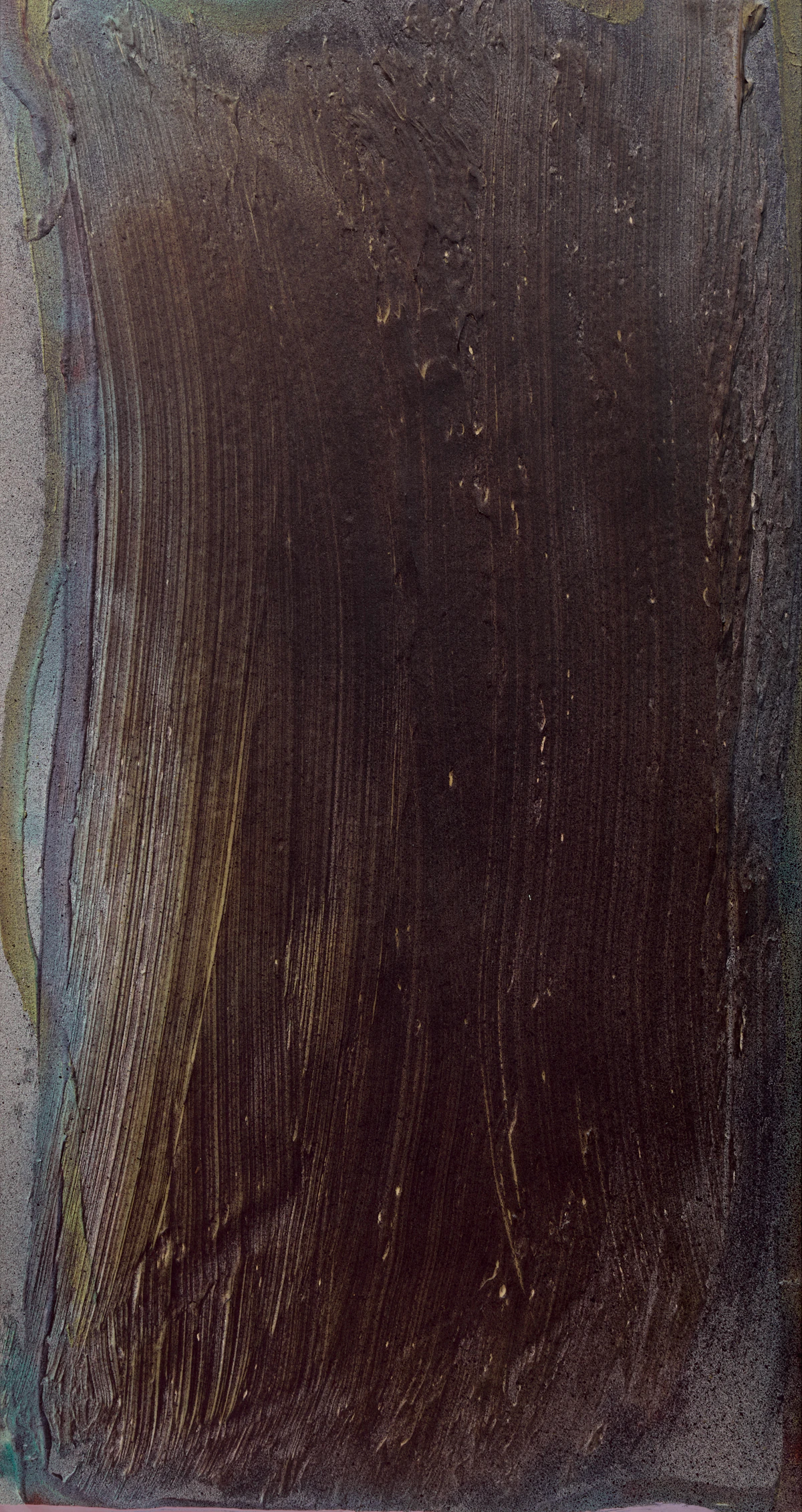
signed, titled, dated 1982 and inscribed “82-15-0” on the reverse
34.25 × 65 in (87.0 × 165.1 cm)
(including Buyer's Premium)
André Emmerich Gallery, New York
Gallery One, Toronto
Private Collection, Toronto
Alex Grimley, “An Expression of Order: Jules Olitski’s Traditional Painting,” in Jules Olitski: 100 Years, 100 Paintings: A Centennial Exhibition, New York, 2023, page 17
A leading figure of 1960s Color Field painting, Jules Olitski's work had been characterized by his ethereal, airbrushed canvases until he radically shifted his practice during the following decade. By the late 1970s and into the 1980s, Olitski abandoned the smooth, atmospheric gradients of his earlier work in favour of an intense exploration of surface texture and extreme materiality.
Twelfth Tribe, executed in 1982, exemplifies this transition. The artist uses an all-over dark purple tone stretching vertically while experimenting with the physical boundaries of the surface. The heavy brushstrokes are interspersed with thin, vaporous layers of blue and green along the left and upper edges, breaking the otherwise muted surface. This edge-drawing, common to Olitski's late 1960s and early- to-mid 1970s works, serves an important aesthetic function, not only registering the artist's hand but also contrasting the texture and colour of the interior of the painting.
At the outermost edges of the canvas, subtle slivers of lighter, contrasting pigment-faint flashes of green and soft blue-peek out from beneath the heavy, dark central expanse. This delicate framing technique is a hallmark of Olitski, ensuring the vast, energetic interior field does not simply bleed out into space but is tightly anchored within the canvas's boundaries. Art historian Alex Grimley suggests, Olitski's works offer viewers "new avenues for active, embodied perception. The effect of his painting is to concentrate attention, to heighten awareness of sensory stimulation, and to sharpen visual acuity."
