unframed
30 x 40.25 in (76.2 x 102.2 cm)
(including Buyer's Premium)
Private Collection, Toronto
Katerina Atanassova, “You are Here: Kim Dorland and the Return to Painting” in Katerina Atanassova, Robert Enright and Jeffrey Spalding, Kim Dorland, Vancouver/Berkeley/Kleinburg, 2014, pages 44, 52
Contemporary painter Kim Dorland excels at creating imagery that is simultaneously abrasive and attractive. A native of Wainwright, Alberta, the artist relies heavily on his tumultuous experiences growing up, translating into works that challenge preconceived notions of the Canadian wilderness. Known for his paintings of landscapes, often including figures, Dorland seeks to demystify the idea of terra nullius—the void, pristine, virgin land often idealized by historical Canadian painting and art history. Rather, the artist often incorporates contemporary figures and objects in a rugged environment, emphasizing one’s place in the landscape. Graffiti, cars, toys and modern infrastructure populate his landscapes, making a contemporary comment on the traditionally barren Canadian landscape throughout art history. Dorland works in a variety of media, including neon pigments, spray paint and even inkjet technologies.
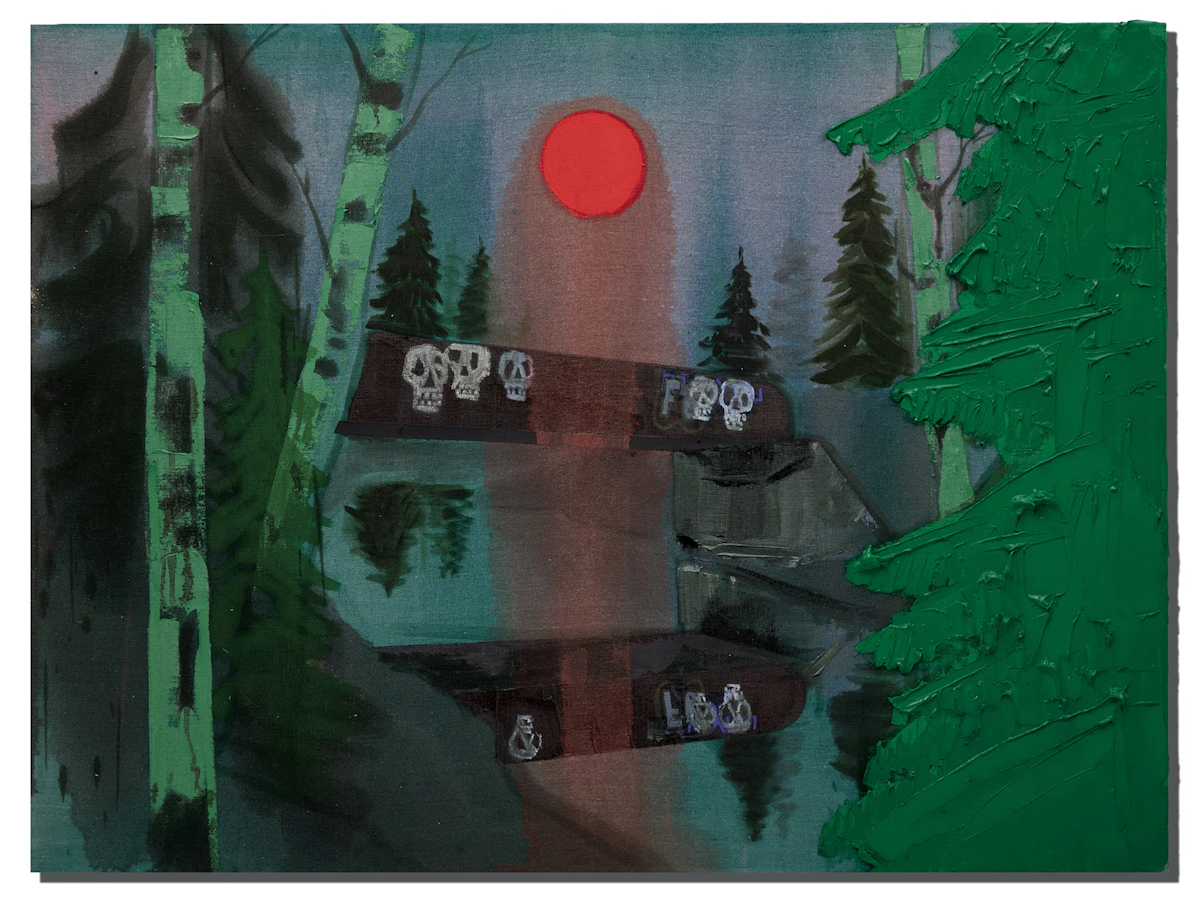
Bridge depicts a classic Dorland forest scene, with a mix of slender birch trunks and dense fir trees rendered with a striking interplay of textures: passages of thick, impastoed paint of the large tree in the right foreground contrast with thin washes of colour. The luminous jewel-toned green forest is punctuated by a fluorescent orange full moon with a translucent veil descending to the bottom of the canvas. The skull graffiti on the bridge references the destructive human presence and the tension between beauty and unease in the northern landscape.
Curator Katerina Atanassova observes that “Dorland’s world–although referencing locales in his native Wainwright, Alberta–is no longer focused on a specific place but rather represents a kind of ‘anywhere’.” In many of Dorland’s works, including Bridge, the artist has challenged the conventional notion of the romantic Canadian landscape. Jeffrey Spalding remarks on how Dorland’s scenes of Canadian life and terrain are important because they are truthful. He writes “It may still be plausible to manufacture an encounter with pristine wilderness, but it is not our predominant, day-to-day lived reality. [...] Kim Dorland’s figuration and landscapes sit as a continuity of Canadian art history, not as an anomaly.”
