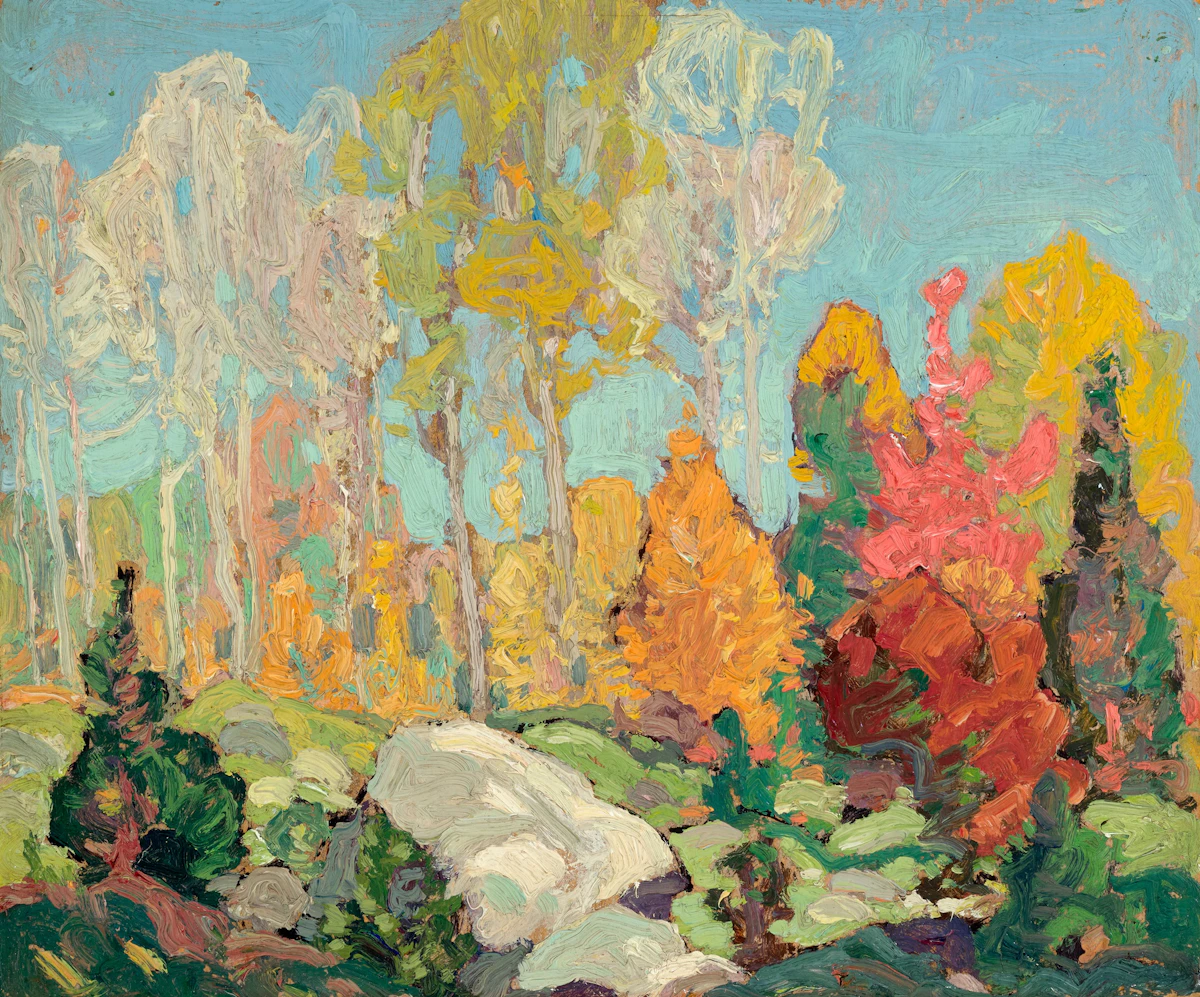
inscribed "This is a genuine sketch painted by Franklin Carmichael. A.J. Casson, April 13, 1978" on the reverse
9.75 × 12 in (24.8 × 30.5 cm)
(including Buyer's Premium)
Wedding Gift from the Artist
By descent to the present Private Collection
Jon S. Dellandrea, The Great Canadian Art Fraud Case: The Group of Seven & Tom Thomson Forgeries, Fredericton, 2022
A.Y. Jackson, A Painter's Country: The Autobiography of A.Y. Jackson, Toronto/Vancouver, 1976, page 138
Between 1919 and 1923, the focus of Franklin Carmichael’s painting practice was the geography between Orillia and his home in Lansing. Unlike his Group of Seven cohorts, he did not join the famous Algoma Box Car trips of 1918-1920, or the early trips to Lake Superior beginning in 1921. These subjects were closer to home, where Carmichael’s family had settled in the City of Orillia, and where he and his wife Ada lived beginning in 1919, in today’s District of North York, Toronto. Between 1920 and 1924, Carmichael’s focus was on developing his skills in painting the fall season in its many varieties, especially at the height of colour as shown in this sketch with its radiant pinks, oranges and yellows contrasted against the perennial greenery and a sun-filled blue sky. It was sketches like this one that led Carmichael’s friend, A.Y. Jackson, to describe him as “a lyrical painter of great ability” in his autobiography first published in 1958.
Carmichael began showing his plein air oil sketches in the Little Pictures exhibitions of the Ontario Society of Artists and the early exhibitions of the Group of Seven. Often though, he left them untitled and undated, simply showing them as numbered sketches, as was the case in 1921 for both the Group of Seven and O.S.A. exhibitions. When left without a signature or date on either the front or back of the work, such early works present a certain degree of obscurity to the onlooker. But the inscription on the back of this painting, written by his friend, A.J. Casson, tells an important story, assuring succeeding generations that this work indeed had its origins in Carmichael’s Lansing studio.
It was in the early 1960s that A.J. Casson began working with the Ontario Provincial Police to untangle a complex fraud case pertaining to falsely signed works attributed to the Group of Seven. After the case was resolved in court in 1963, Casson was often called upon to ‘authenticate’ the works of his peers, thus his inscription on the verso of this painting as documented above. Casson and Carmichael had been very close friends since in 1919, after Carmichael hired him to be his apprentice at Rous and Mann Ltd. and they remained lifelong friends. With the deaths of J.E.H. MacDonald in 1932 and Carmichael in 1945, these and other painters’ legacies were left vulnerable to unprincipled conduct, and Casson felt it essential to protect the works of his esteemed colleagues. In the event of an unsigned sketch like this one, Casson’s inscription adds much to the history of this painting, while also alluding to a ‘mystery solved’ chapter of Canadian art history thoroughly detailed in Jon Dellandrea’s 2022 insightful book.
We extend our thanks to Catharine Mastin, PhD, art historian, curator, and Adjunct Member of the Faculty of Graduate Studies in Art History at York University, for contributing the preceding essay. Catharine curated the exhibition Franklin Carmichael: Portrait of a Spiritualist, organized by the National Gallery of Canada, Ottawa, which toured Canada between 1999 and 2001.
