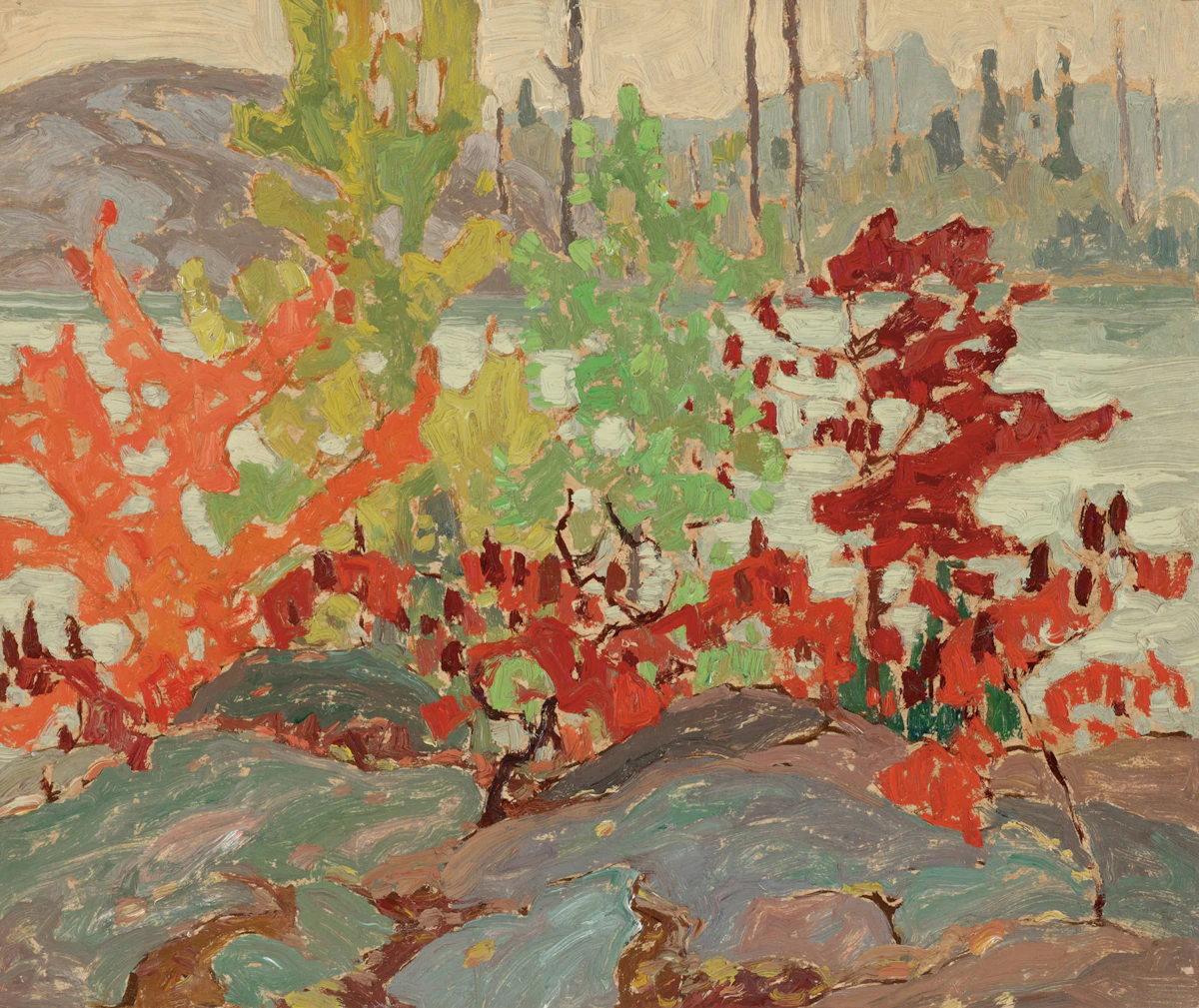
signed, titled and inscribed "$35" and "Lansing" on the reverse
10 x 12 in (25.4 x 30.5 cm)
(including Buyer's Premium)
Wedding Gift from the Artist
By descent to a Private Collection, Toronto
By descent to the present Private Collection
Possibly Exhibition of Small Pictures and Sculpture, Ontario Society of Artists, Toronto, 1 December 1922-1 January 1923 as "On the Severn"
Margaret Gray, Margaret Rand, Lois Steen, "A.J. Casson (Canadian Artists 1)", Agincourt, Ontario, 1976 Paul Duval and A.J. Casson, "A.J. Casson: My Favorite Watercolours", 1919-1957, Toronto, 1982 Megan Bice, "Light & Shadow: The Work of Franklin Carmichael", Kleinburg, 1999 Janet Arnett, “Review of James T. Angus, 'Severn River: An Illustrated History,'” [online publication], Canadian Book Review Annual Online, 1995, accessed 10 October 2025
In October 1922, Franklin Carmichael made the first of three known trips to the Severn River, a waterway that joins the north end of Lake Couchiching and Georgian Bay, bridging Simcoe County and the south end of the Muskoka District. The Severn River is part of the larger Trent-Severn Waterway, Canada’s national canal system, completed in 1922. The waterway comprised of natural and man-made elements was designated a Canadian National Historic Site because of its strategic importance as a transportation route. As Janet Arnett has observed, the Severn was “once the spinal cord for a rapacious lumber industry.” By the time that Carmichael made his way to the region in 1922, new growth forests would have been returning to the stripped nineteenth-century landscape. Carmichael’s The Severn features a foreground spread of such short regrowth in a tangle of orange, red, green and ochre leaves and berries, from maple, oak and sumac trees. In the background, though, the hills remain largely bare, a reminder of the deforestation that had occurred. Between foreground and background, the Severn River bisects the composition.
Carmichael’s early works of the Severn River are by no means numerous, despite his additional trips there in 1923, and again in 1929, which led to his impressive studio watercolour, Old Sawmills, Severn Bridge, 1930 (McMichael Canadian Art Collection, 1974.14). The 1922 Exhibition of Small Pictures and Sculpture by Members of the Ontario Society of Artists documents that Carmichael exhibited one sketch from his travels called On the Severn. Carmichael inscribed $35 on the back of this sketch, an indicator that he possibly had it for sale in this exhibition. Based on the subject of this sketch and his other Severn works, Carmichael’s interest in the area was prompted by the history of lumbering, the deforestation left behind, and the abandoned sawmills. The 1922 sketches he produced would have marked the beginnings of Carmichael’s interest in depicting such human settlements and industrial subjects, which he pursued in the years ahead.
Carmichael’s trip to the Severn River in 1922 was the farthest from Toronto he had yet travelled. Still, it could be accommodated in a short weekend excursion, but not by himself. By 1922, Carmichael had invested heavily in his apprentice, A.J. Casson, who he had hired in 1919, at the design firm of Rous and Mann. From the outset, Carmichael supported the development of Casson’s landscape painting practice outside of work. It was in the Carmichael family car, nicknamed “Old Bell,” that Carmichael and Casson ventured forth to the Severn River in October 1922. Casson vividly recalled the travails of their trip and the high expectations Carmichael held for those whose work he endorsed. He explained: “We’d stay overnight in an old hotel on Friday, get up at 7 Saturday morning and go to Severn Bridge and paint all day, and all day Sunday, and we’d get home to Toronto around 9 P.M. Mrs. Carmichael would give us our dinner and then Frank would have a hundred things for me to see, and about twelve midnight I’d pry myself away and catch the radial car on Yonge Street to the city limits (now Summerhill) then the Yonge car, then the Bloor car. I’d get home about 3 A.M. and have to be at work the next morning by 8 A.M. But if I didn’t do that, Frank wouldn’t have anything to do with me.” Despite the trials Casson endured, these years were the gestation of an enduring friendship between them. Casson, who remained indebted to his mentor’s support, recalled in 1982, “Frank took a personal interest in me and was more influential than any other single person in shaping my career as an artist.”
We extend our thanks to Catharine Mastin, PhD, art historian, curator, and Adjunct Member of the Faculty of Graduate Studies in Art History at York University for contributing the preceding essay. Catharine curated the exhibition Franklin Carmichael: Portrait of a Spiritualist, organized by the National Gallery of Canada, Ottawa, which toured Canada between 1999 and 2001.
