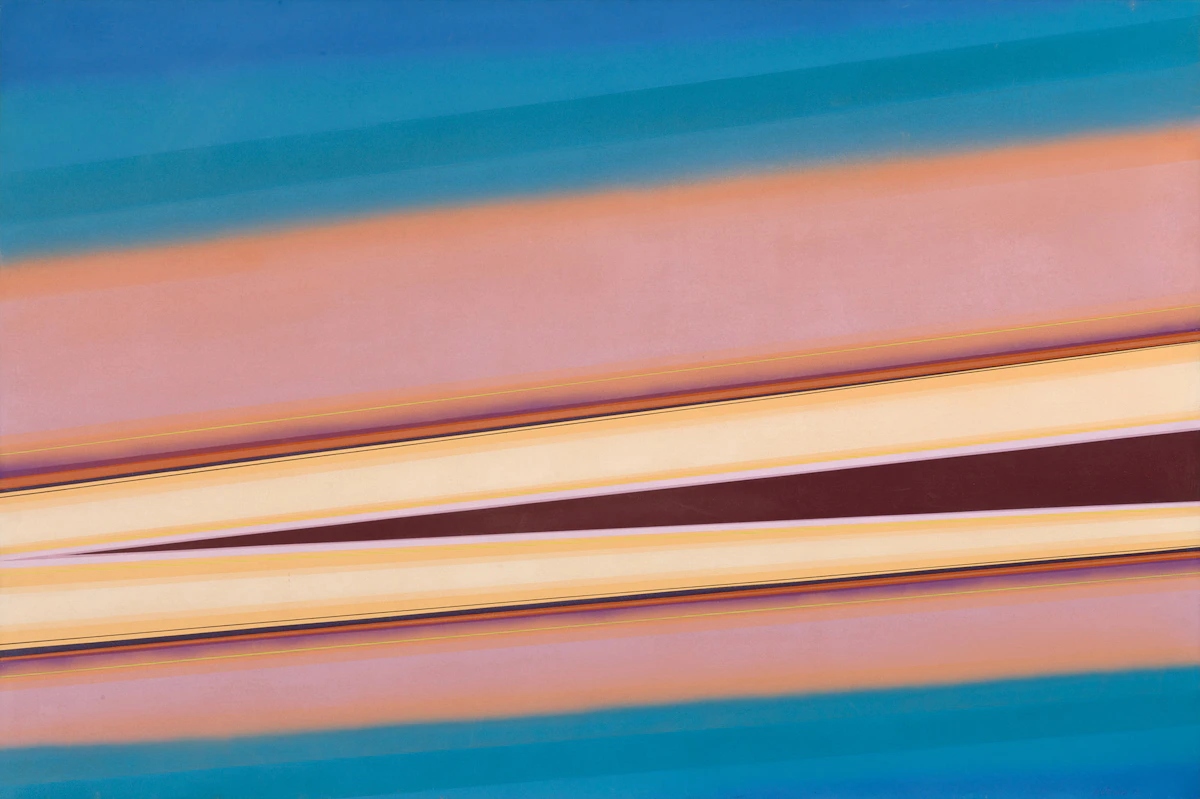
signed, titled and dated 1974 on the reverse
48 x 72 in (121.9 x 182.9 cm)
(including Buyer's Premium)
The Arwin Galleries, Detroit
Private Collection, Montreal
As one of the few women at the forefront of Canadian abstract art, Rita Letendre occupies a revolutionary place in the country’s art history. Over the course of her career, she created some of the most innovative works of abstraction, her style always fluctuating between gestural and hard-edge approaches. Initially influenced by Paul-Émile Borduas and the Automatistes in the 1950s, but after receiving a major mural commission for the University of California, Letendre shifted toward hard-edge abstraction in the following decade, exploring crisp lines and flattened planes of colour.
Letendre’s large canvases of the 1970s explore her fascination with speed and vibration. The sharp wedges or arrows that cut across the image plane are characteristic of her work from the decade. In Field, a thin black ‘arrow’ shoots downward toward the left edge of the canvas, surrounded by blue, purple and orange bands of varying width and with soft borders. This large painting was completed in 1974, three years after Letendre first adopted the airbrush technique to apply acrylic paint. It marked a turning point in her style from her gestural 1960s work into smoother, more luminous gradients and sharply defined bands of colour. The airbrush allowed her to create seamless transitions and an almost light-filled atmosphere in her work, which became a hallmark of her 1970s paintings. In 1979, Letendre held a solo show at Arwin Galleries in Detroit, further cementing her international presence. A similar work by Rita Letendre executed in 1973 entitled, "Tziyah", is in the collection of the Drummondville Open Air Museum.
