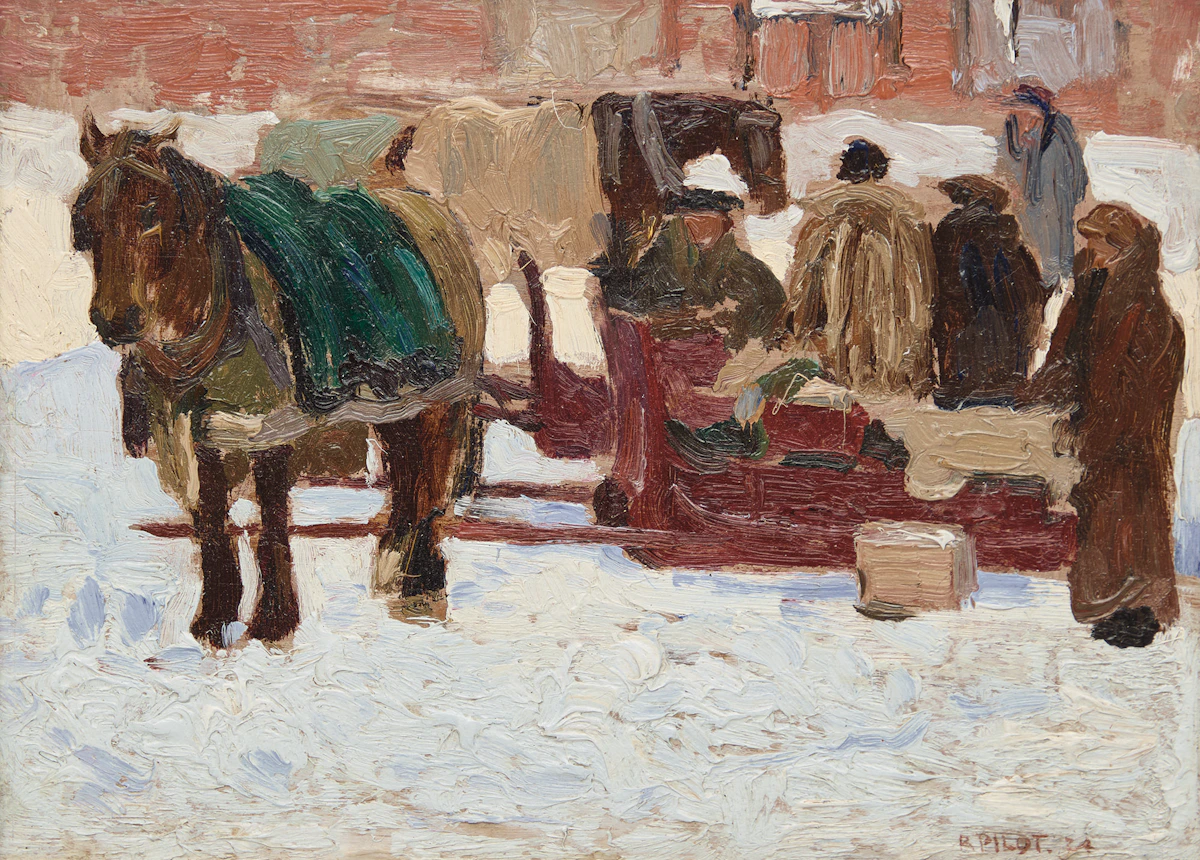
signed and dated 1924 lower right; Dominion Gallery stamp on the reverse
6.5 x 9 in (16.5 x 22.9 cm)
(including Buyer's Premium)
Watson Art Galleries, Montreal
Dominion Gallery, Montreal
A. K. Prakash & Associates Inc., Toronto
Private Collection, Toronto
Heffel, auction, Toronto, 26 November 2015, lot 148
Private Collection
A.K. Prakash, Impressionism in Canada: A Journey of Rediscovery, Stuttgart, 2015, pages 621, 632, reproduced page 624
Robert Pilot’s Cabbies of 1924 offers viewers a compelling glimpse into the urban fabric of early twentieth-century Montreal. Painted shortly after his return from studying at the Académie Julian in Paris, this artwork demonstrates how Pilot absorbed the painterly vocabulary of Impressionism—its loose brushwork, atmospheric effects, and interest in everyday subject-matter—into a distinctly Canadian context.
The composition is compact and atmospheric. The horses, draped with blankets, stand patiently as their drivers and passengers converse, situating the scene in a world on the cusp of modern transition, where cabbies remained an essential mode of urban transport. Reminiscent of the work of James Wilson Morrice, Pilot’s thick, gestural brushstrokes animate the surface of the canvas, conveying both the chill of the snow and the warmth of human presence.
Pilot’s urban scenes are notable for their ability to capture the poetry of everyday life in a rapidly changing society, balancing structure and atmosphere in equal measure. “He generally excluded the new world from his record–there is, for example, a noticeable absence of automobiles in his compositions,” notes A. K. Prakash. “Rather, his paintings convey a precise image of a world that was soon to disappear.” In Cabbies, this poetry emerges through the juxtaposition of cold and warmth, labour and leisure, modernity and tradition.
