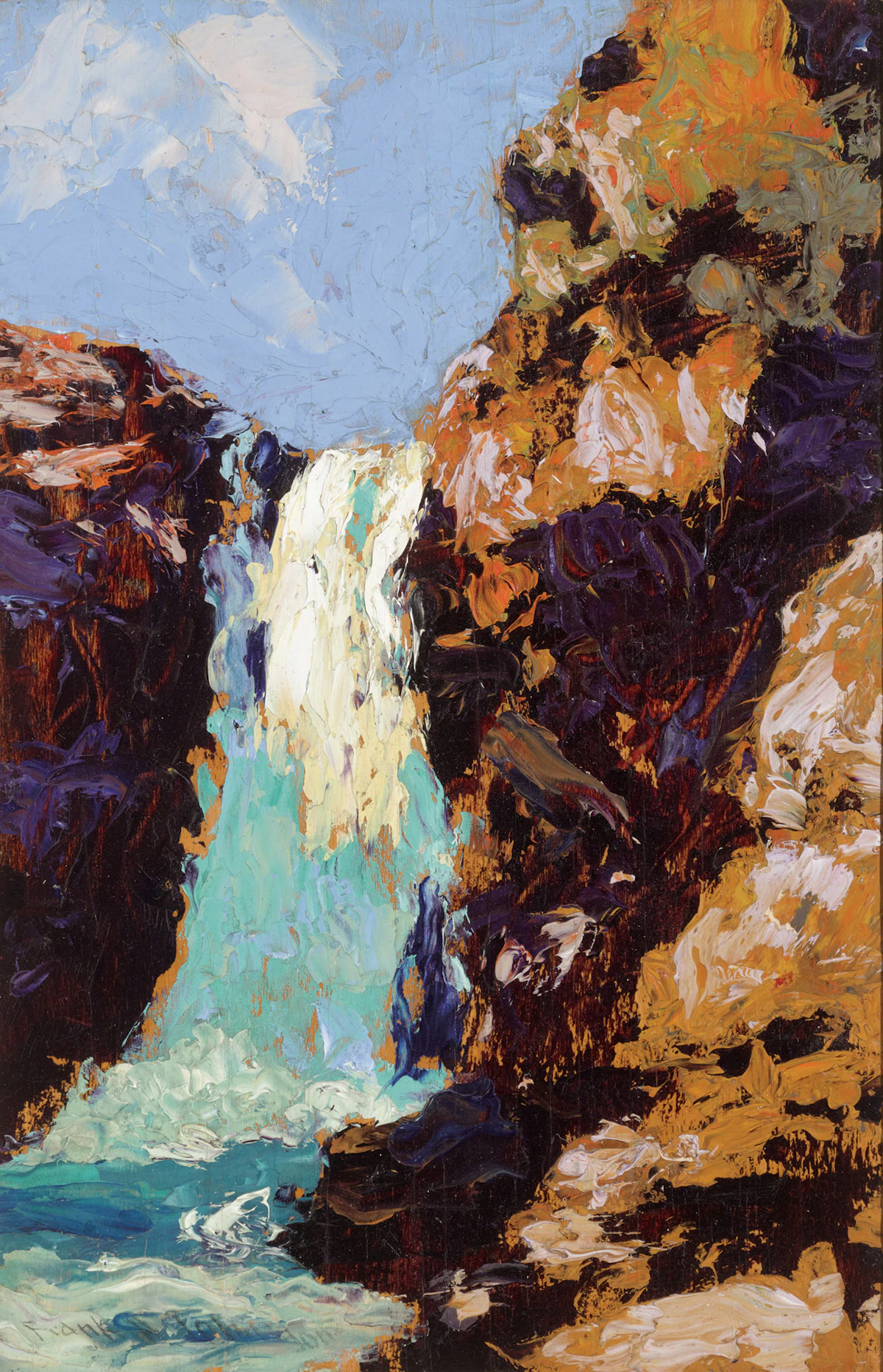
signed lower left; titled and dated 1920 on a gallery label on the reverse
13.75 x 8.75 in (34.9 x 22.2 cm)
(including Buyer's Premium)
Dominion Gallery, Montreal
A. K. Prakash & Associates Inc., Toronto
The Art Emporium, Vancouver
Masters Gallery, Calgary
Private Collection, Toronto
F.H. Johnston, Toronto to Eric Brown, Ottawa, File 5.42 Johnston, Library and Archives, National Gallery of Canada, Ottawa
“Etchings Predominate at Art Exhibition”, Daily Star, Toronto (3 May 1919)
Algoma is intimately associated with the early history of the Group of Seven, inspiring their bold new explorations in the years following World War I. Twenty-five Algoma subjects were included in the first Group of Seven exhibition in May 1920. In August 1918, Frank Hans Johnston received a commission to draw and paint the activities of the flight training schools in southern Ontario for the Canadian War Memorials program; however, a trip to Algoma with Lawren Harris and J.E.H. MacDonald in October interrupted his war work and set him off in a new direction. “Our trip north was a great success–we struck new country in every respect and had a wonderful time sketching for all that was in us,” he wrote to Eric Brown, director of the National Gallery.
Johnston had fifty-seven works in the Algoma exhibition at the Art Museum of Toronto in late April 1919, fifty-one sketches of varying dimensions, and six larger canvases previously shown with the Ontario Society of Artists in March. The writer in the Toronto Daily Star admired Johnston’s contributions, stating, “Mr. Johnston sees nature much as a huge decoration‒the blue and purple mountains with a glimpse of orange sky; the sparkle of autumn foliage against the molten grey of a placid lake‒he eliminates detail and finds wide unbroken expanses.”
In September 1919, Johnston returned to Algoma with Harris, MacDonald and A.Y. Jackson, prior to the first Group exhibition in May 1920. Waterfall, Algoma contains Johnston’s signature loose and expressive brushwork of his early style, with simplified forms that give the composition a quasi-abstract appearance.
Having encountered financial difficulties constructing a house in Toronto, in the fall of 1920, Johnston moved his family to Winnipeg, where he taught at the city’s art school and directed the public gallery. In January 1922, he held an exhibition at the Winnipeg Art Gallery that included three hundred and twenty-six works of which over one hundred bore Algoma titles. In spite of the great number of Algoma subjects he painted, they remain relatively rare today.
