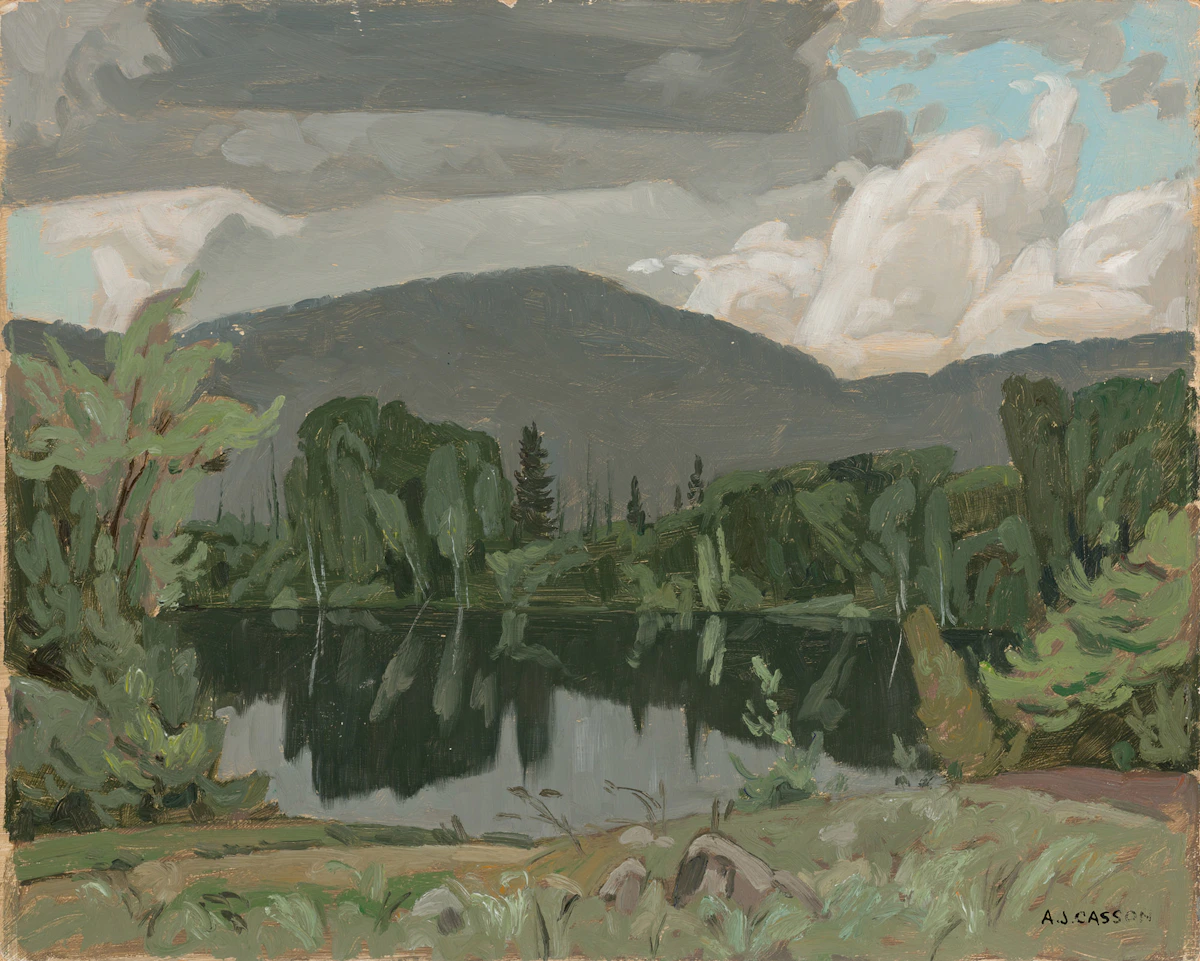
signed lower right; titled and dated "circa 1959" on the reverse
12 x 15 in (30.5 x 38.1 cm)
(including Buyer's Premium)
Private Collection, Toronto
Paul Duval, Alfred Joseph Casson: President, Royal Canadian Academy, Toronto, 1951, page 62
An example of A.J. Casson’s mature style, Madawaska River at Jewelville showcases the artist’s sharp design sensibility and deep appreciation for the Ontario landscape. Having begun his career as a commercial artist, Casson brought a strong sense of structure and rhythm to his painting, transforming scenes of quiet rural life into bold, graphic compositions. Madawaska River at Jewelville exemplifies the painter’s marked shift to a more abstract rendering of the Ontario landscape, which occurred in the mid-1940s. Paul Duval mentions that this change coincided with the end of the war, which may have subconsciously brought Casson an emotional release and a longing for simplicity. The artist began to portray nature in reductive, abstract designs, foregoing literal atmospheric portrayal. Duval writes of this shift: “Suddenly, all of the elements in his paintings become highly simplified into formal patterns. Shapes are condensed into knife-edged rectangles and triangles. Colours are plotted into very deliberate counterpointal arrangements, and natural texture is subdued almost to the point of elimination. Design has become paramount.” The author’s description of Casson’s new style is demonstrated in this painting, where the forest and its reflection in the Madawaska River appear flattened and angular. Above, heavy clouds gather in broad sweeps of grey and pale blue, their sculptural presence enhancing the painting’s compositional balance.
The region around Jewelville, near Barry’s Bay, was a favourite sketching ground for Casson and other Group of Seven members. In contrast to the sweeping grandeur of the north, this landscape captures a gentler, more intimate vision of Ontario.
