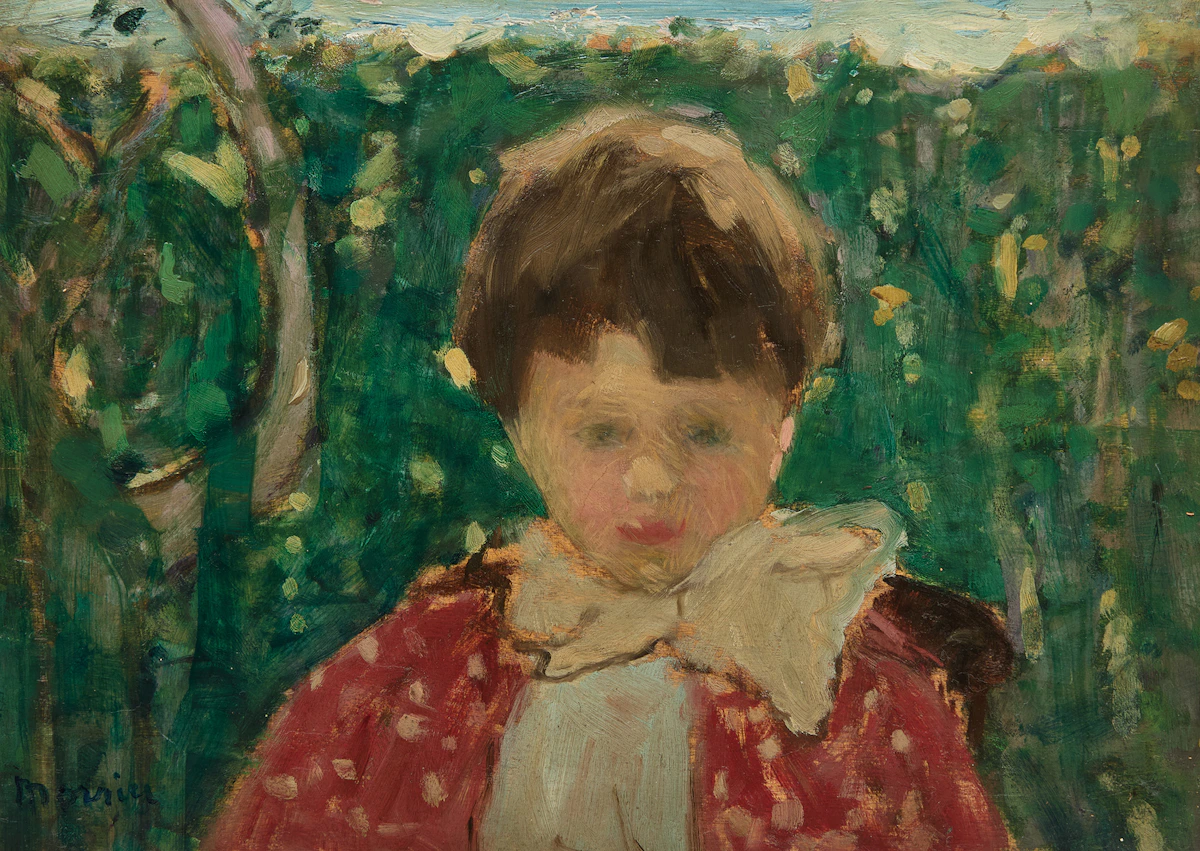
signed lower left; titled and inscribed "Paris" on a label on the reverse; titled and inscribed "Morrice no. 7" and "1818" on the reverse of the frame
9.5 x 13 in (24.1 x 33.0 cm)
(including Buyer's Premium)
W. Scott & Sons, Montreal
Private Collection, United Kingdom
Eighth Annual Exhibition, Canadian Art Club, Toronto, 1915, no. 86 as Head of Boy
Robert J., Lamb, The Canadian Art Club, 1907-1915, Edmonton, 1988, listed page 91 (works in Canadian Art Club 1915 Exhibition)
Head of Boy is one of the few portraits James Wilson Morrice completed during his lifetime. Model studies and portraits count for about six percent of his artistic output. Morrice’s interest in the human figure evolved gradually, and then only after his move to Europe. No portraits of family or friends exist from his early years in Toronto, and only one from his time studying at the Académie Julian, where the students worked from live models.
Unlike landscapes, which James Wilson Morrice favoured painting during his years travelling, figure studies and portraits were produced in bursts of creativity, rather than consistently. Morrice painted his mistress Léa Cadoret, his friend Robert Henri, and William Brymner, all in small format oil sketches, which are more spontaneous than large, carefully planned canvases. Numerous sketches of female models fill his sketchbooks from 1895 to 1898.
Lesser-known are the many drawings and paintings of Italian children from a trip to Italy that we currently date to the spring of 1894, especially a little girl on a vaporetto in Venice, as well as a slightly older one in Capri. Morrice's two sketchbooks from that trip contain many quick drawings of Capri children, usually girls, wearing the local costume. There are four small paintings of an older girl, who Morrice always painted with her eyes down or closed. Morrice spent part of the summer in 1896 in the fishing town of Cancale, north east of Saint- Malo, producing more than twenty-five small paintings and sketches, including the rare portrait of a young boy from the fishing town (lot 49).
According to Lucie Dorais, a recognized J.W. Morrice expert, the present portrait of a young boy was not discovered until very recently. Though not mentioned in the James Wilson Morrice exhibition databases, it proves to be one of the artist's best early portaits and dates to circa 1894. Depicted on a horizontal panel (rare for a portrait), he is dressed fashionably, posing in front of vegetation that is difficult to place. We may interpret the oval form at left as a kind of shrub typical of Capri, and the blue band at the top could be read as either sky or sea. It bears similarities to other portraits of Capri children, including Girl Knitting (Private Collection), depicting a girl wearing an indigo bolero and puffy gigot sleeves. Like the other children depicted in the sketchbook, their eyes are barely indicated, but the boy in this work and the little tourist girl have theirs open, not yet shy of that strange man focusing on them.
We extend our thanks to Lucie Dorais, Canadian art historian and author of J.W. Morrice (1985), for assisting with the research on this artwork.
