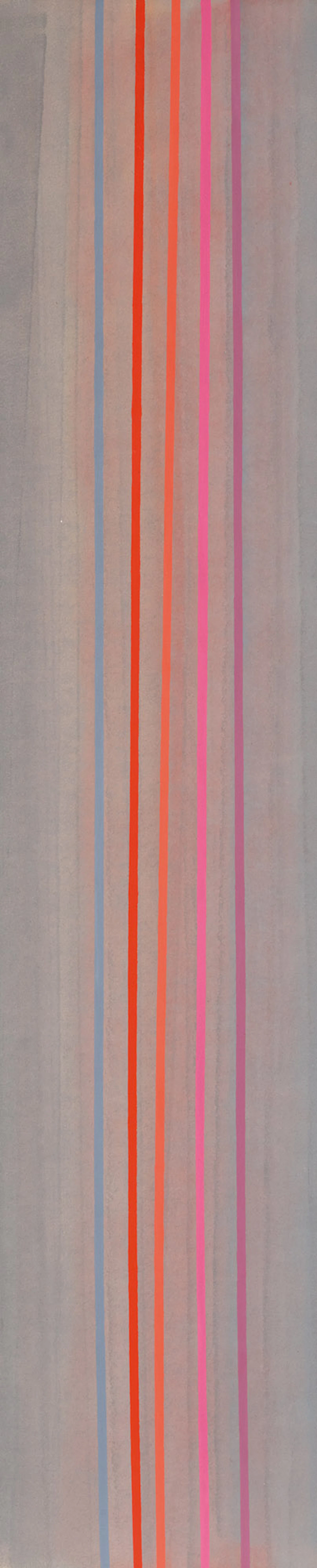
signed, titled and dated 1977 on the reverse
13 x 64 in (33.0 x 162.6 cm)
(including Buyer's Premium)
Private Collection, Toronto
Roald Nasgaard, "Abstract Painting in Canada", Toronto/Vancouver, 2007, page 290
Saskatoon artist William Perehudoff maintained a long and formative connection to the Emma Lake Artists’ Workshops. During the sessions of 1962 and 1963, he was introduced to the principles of Post-Painterly Abstraction through the influence of art critic Clement Greenberg and American painter Kenneth Noland. These encounters marked a turning point in his practice, inspiring him to explore the expressive potential of pure colour and to develop a distinctly personal visual language–one that would soon resonate powerfully within the field of Canadian abstraction. In Abstract Painting in Canada, Roald Nasgaard refers to Perehudoff's paintings as “plays of light and dark, of transparency and opacity [as] subtle and sensuous.” The artist has said he prefers paintings “with a kind of pulse,” referring to an active interplay among the elements of the picture. Many of the artist’s wide vertical canvases of the mid-to-late 1970s were constructed of coloured ground transversed by vibrant parallel bars of colour, such as AC-77-25. Here, a calm, grey ground is energized with stripes of orange, red and pink. By emphasizing the ground and simplifying the figurative elements to simple vertical bars, Perehudoff created a cohesive unity in his paintings. The interplay of contrasting colours enhances the rhythm of the stripes, suggesting musical chords. The long, parallel stripes in primary colours reflect Perehudoff’s commitment to visual form, focusing on reducing painting to its very essence.
