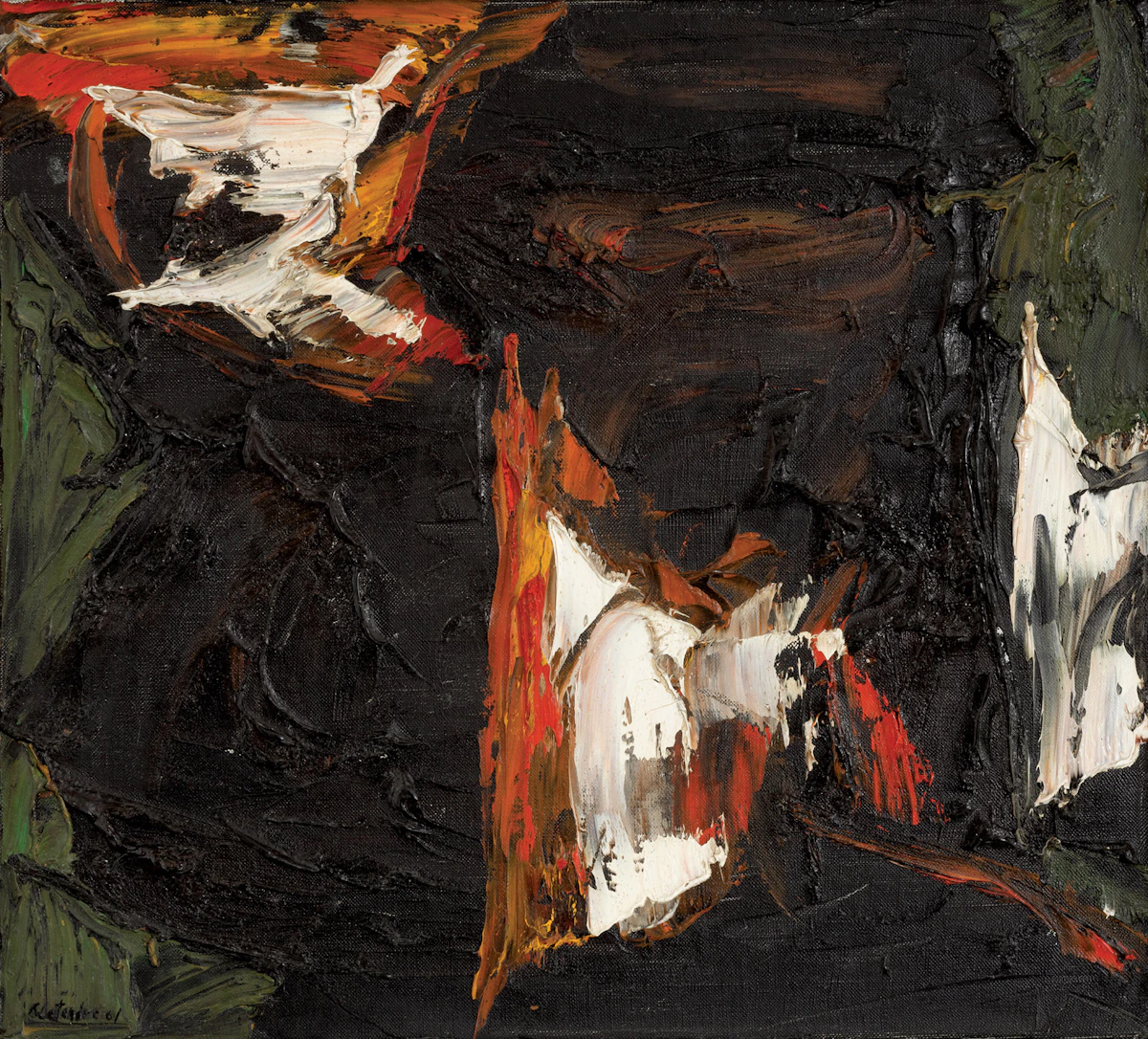
signed and dated 1961 lower left; signed, titled and dated on the reverse
18 x 20 in (45.7 x 50.8 cm)
(including Buyer's Premium)
Private Collection, Toronto
ICYMI: Remembering Rita Letendre [online publication], The Art Gallery of Ontario, 24 November 2021
The early 1960s were a crucial period for Rita Letendre, both artistically and commercially. Letendre had earned first prize in the Concours de la Jeune Peinture in 1959 and the Prix Rodolphe-de-Repentigny in 1960. The following year, the Montreal Museum of Fine Arts held a well-received solo exhibition for the young painter. Critical acclaim fuelled increased demand for her work, which allowed Letendre to paint full-time and commit herself to the development of her craft. Her paintings of the period demonstrate a rapidly growing confidence, marked by the expert use of rich impastos and the bold use of colour. Using a palette knife or spatula, Letendre would build up a painterly topography in oil on the surfaces of her canvases.
Circuit nocturne features the jagged forms and sweeping areas of black which recur throughout Letendre’s paintings from the early 1960s. The dark expanse, which occupies much of the composition, contains subtle shifts in hue. Like a visual staccato, explosive red and white bursts appear as flashes of light in darkness. Letendre explained: “Light and colour, and sometimes the absence of colour, have always been the key elements in my painting. With its different values, colour reflects the shades of life. But light, from the first shock of birth to the last breath of life–light is life.” The wedge-shaped forms of Circuit nocturne are likely an important precursor to the artist’s later compositions. Letendre’s geometric paintings from the late 1960s on would feature triangular visual structures with sweeping, energetic diagonals.
