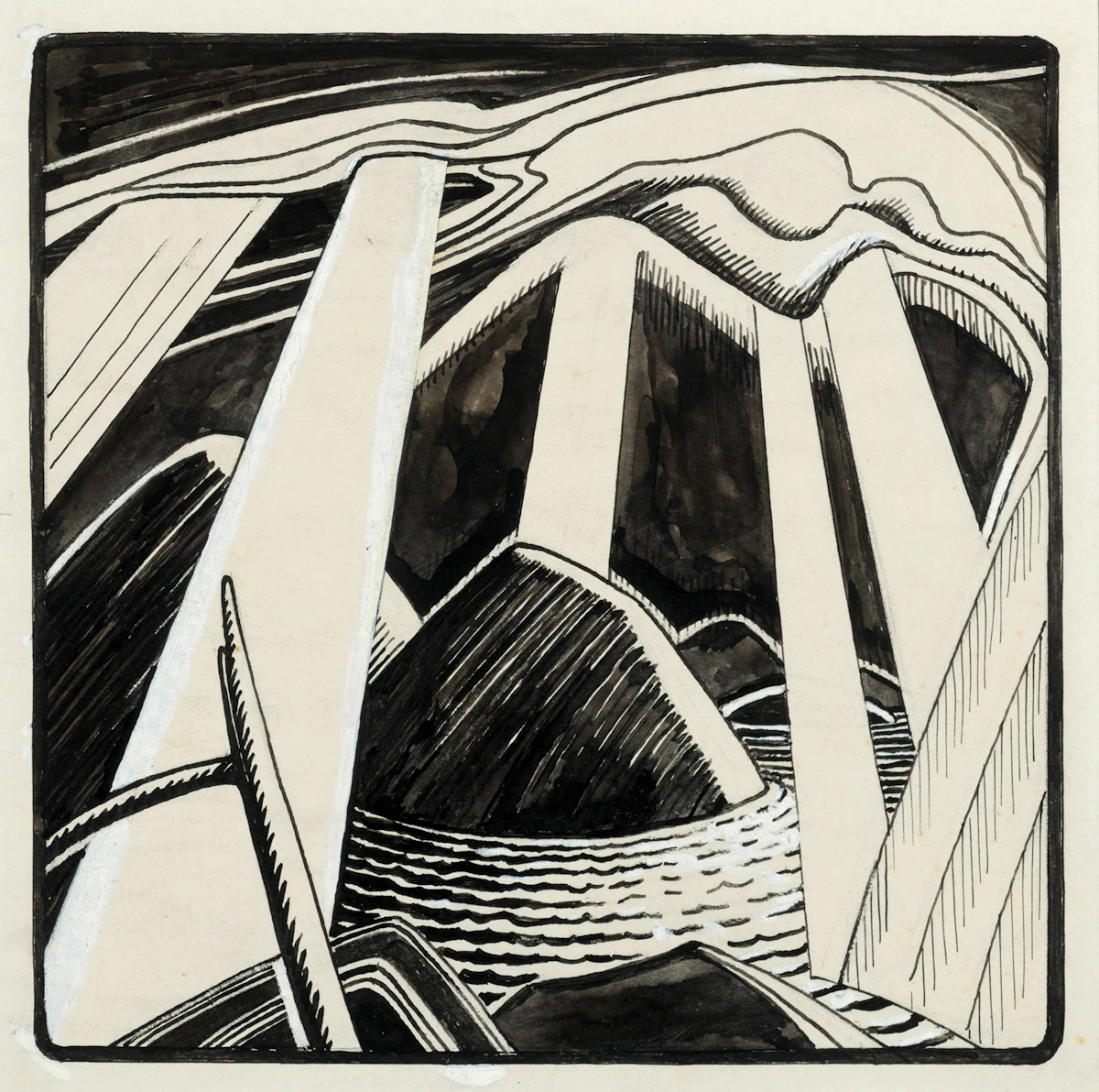
inscribed "763" on the reverse of the card backing; titled on a gallery label on the reverse
6 x 6.75 in (15.2 x 17.1 cm) (plate)
(including Buyer's Premium)
The Artist
By descent to Howard Kilbourne Harris
Estate of Howard K. Harris, 1976, no. 38 as Ellesmere Island ?
Masters Gallery, Calgary, circa 1980
Private Collection
Exhibitions Curatorial Box 23, File 1: Harris Retrospective 1948 and Photographs of Canadian Art, Box 6, File 30, AGO Archives, E.P. Taylor Library & Archives, Art Gallery of Ontario, Toronto
The Canadian Forum, VIII 91 (April 1928), reproduced page 609
Paul Duval, Group of Seven Drawings, Toronto, 1965, reproduced plate 31
Emily Carr, Hundreds & Thousands, Toronto/Vancouver, 1966, page 15
Joan Murray and Robert Fulford, The Beginning of Vision: The Drawings of Lawren Harris, Toronto, 1982, pages 26, 90-91
Joyner Fine Art Canadian Art Auction, Toronto, 22-23 November 1988, see lot 235 for a related ink drawing
Paul Duval, Lawren Harris: Where the Universe Sings, Toronto, 2011, reproduced page 177 as On the North Shore, circa 1923
The first issue of The Canadian Forum, an outgrowth of the University of Toronto periodical The Rebel, was published in October 1920. The periodical’s goals were clearly articulated. “The Canadian Forum had its origin in a desire to secure a freer and more informed discussion of public questions and, ... to trace and value those developments of art and letters which are distinctly Canadian.” Close associates of the Group of Seven, Barker Fairley and Peter Sandiford, were among the periodical’s first directors, providing regular coverage of the Canadian art scene, and articles and drawings by individual Group members were frequently published in its pages throughout the 1920s. A pre-war graphite drawing of Old Toronto by Lawren Harris was reproduced in the issue of May 1921 and the following month a lovely brush and ink drawing of houses in the Ward. This and future drawings by Harris in The Canadian Forum provided a starker and more effective contrast of black and white and were undoubtedly the instigation for the photo lithographs reproduced in Canadian Drawings by Members of the Group of Seven and launched at the Group’s exhibition in January 1925.
The drawing being offered here bears an evident relation to the canvas Lake Superior now in the Thomson Collection at the Art Gallery of Ontario. A graphite drawing related to the canvas appears to have been the initial concept but both that drawing and On the North Shore have important differences in composition. In both the final canvas and this ink drawing the stylized shafts of light shine down starkly through the curvilinear clouds onto the rocky islands and water. The foreground is characteristically defined by a rocky shore, almost a platform from which the viewer can take in the vast panorama. The conical island defines the centre of the composition in both the ink drawing and painting but in "On the North Shore", a broken tree trunk projects lower left and the foreground is framed by additional light shafts on either side. Gouache was a common medium used to cover changes in a composition and was used here to clarify the lines in the light shaft in the left foreground and to break up the details in the repeated lines in the water and clouds upper right. These were not visible when reproduced in the periodical.
In December 1927, Emily Carr visited Harris in his studio and closely observed the painting he was working on, “a big canvas–rock forms in deep purples with three large rocks in the middle distance. The sky was wonderful–swirly ripples with exciting rhythms running through them. The right corner was in brilliant light and from under the cloud shafts of strong sun pierced down on the rocks in straight wide beams that made a glowing pool of pure light on the water that lay flat and still. Behind, was a deep, rich blue distance. To the right the shafts of light turned it paler green-blue. On the other side a blinding blue played richly with the purple rocks. Under the left side of the rippling, swirling grey cloud forms the water lay flat in blue-grey wonderfulness. The foreground was unfinished but would be dark rocks. There was a wonderful feeling of space.” This was clearly the Thomson Collection Lake Superior canvas, but unfinished.
In the Group of Seven exhibition in February 1928, Harris showed two paintings curiously titled, Design for a Chapel and A Fantasy. The former is the painting currently titled Figure with Rays of Light, also in the Thomson Collection and previously sold by Sotheby’s in association with Ritchie’s in Toronto in May 2006. A sarcastic review (“Junk Clutters Art Gallery Walls While Real Paintings Are Hidden in Cellar,” Toronto Telegram, 18 February 1928) compared Design for a Chapel to “a peeled banana of gigantic size standing on end before a display of northern lights,” confirming the identification. But of the painting titled A Fantasy the reviewers gave no clue save to characterize it and others that Harris exhibited as “pure abstraction” (Fred Jacob, “In the Art Galleries,” Mail & Empire, 18 February 1928).
In 1947, the Art Gallery of Toronto prepared a major retrospective of Lawren Harris’ career. Harris was then living in Vancouver and many of his paintings were in storage in Toronto. The correspondence between Sidney Key, the gallery’s curator, and Harris provides several insights into the artist’s working process and evaluation of his own paintings. The Thomson canvas Lake Superior was in Toronto and on 27 August 1948, Key suggested it was included, referring to it as Lake Superior Fantasy. “The title was suggested by Dr. Jackson.” Jackson’s memory might suggest that the canvas was the painting shown in 1928 but on 2 September Harris responded, “No. 61 Lake Superior Fantasy (unfinished)... I would exclude... Lake Superior Fantasy was never exhibited because to my mind it was not successful. I made a drawing of it but never repainted the thing with improvements in the drawing.” The drawing Harris refers to here is On the North Shore reproduced in The Canadian Forum in April 1928.
In her book on Lawren Harris’ drawings Joan Murray quotes Harris’s fellow artist and friend Yvonne McKague Housser. “His drawings are a key which open the door to what he was thinking and painting… The drawings were important as an introduction, to clarify his mind before he started a painting.” In this case, the graphite drawing was a preliminary introduction and On the North Shore an intermediate step in the process, post-dating the painting Carr saw in December 1927 but preceding the final canvas as known today.
We extend our thanks to Charles Hill, Canadian art historian, former Curator of Canadian Art at the National Gallery of Canada and author of The Group of Seven: Art for a Nation, for contributing the preceding essay.
