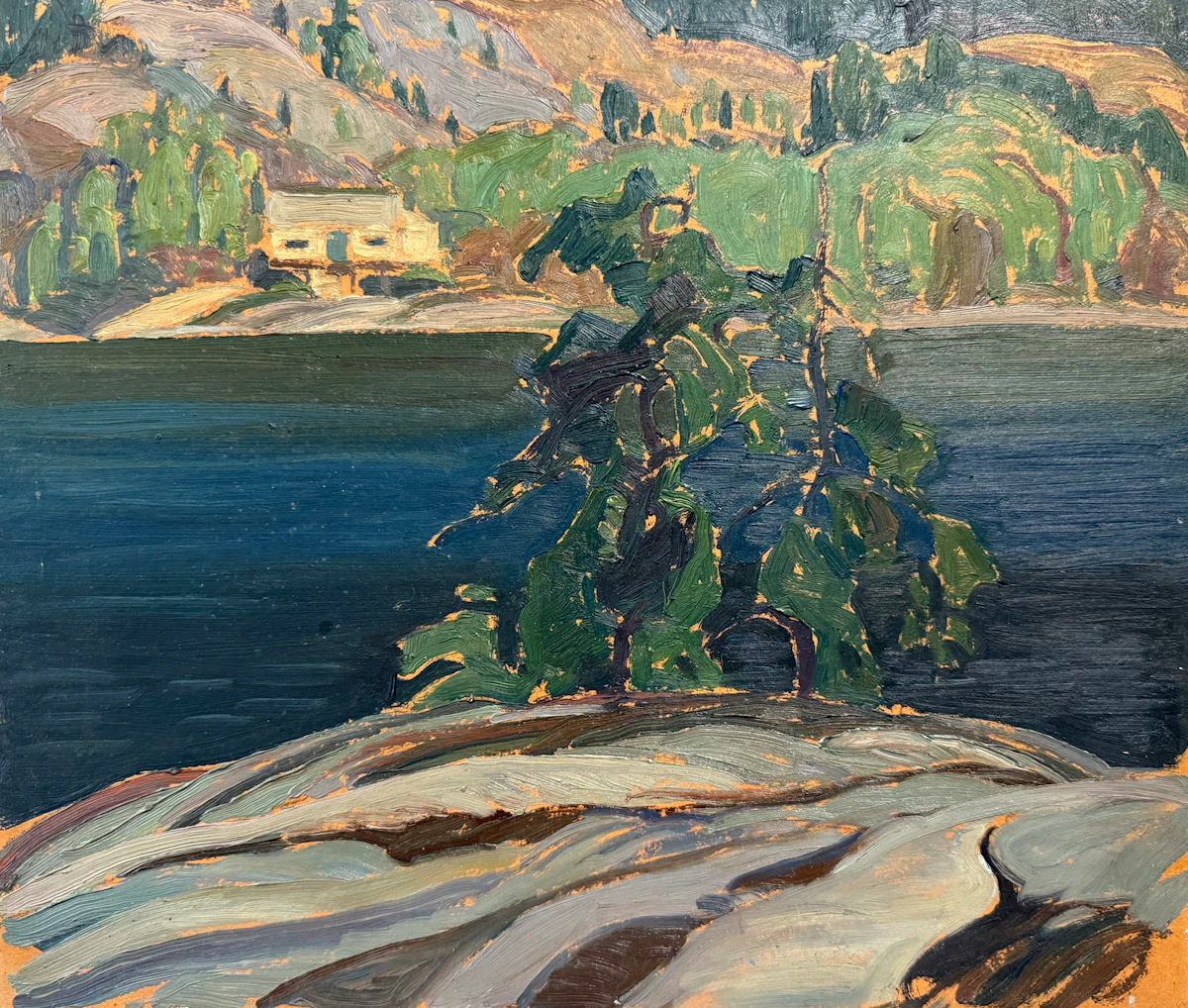
inscribed "OS 131" with "Estate of Franklin Carmichael" stamp on the reverse
10 × 12 in (25.4 × 30.5 cm)
(including Buyer's Premium)
Estate of the Artist
Private Collection
Mary Mastin, "The La Cloche Decision," in Megan Bice, Light & Shadow: The Work of Franklin Carmichael, Kleinburg, 1990, pages 106-111
Derek J. Coleman, Jim Waddington, D'Arcy O'Neill, La Cloche Country: Its History, Art and People, circa 2008
In 1935, Franklin Carmichael and his family built a summer home in La Cloche, Ontario, nestled into a bay on the north side of Cranberry Lake, just east of Whitefish Falls. Carmichael had been quite taken with La Cloche when he was introduced to it for the first time in 1927; afterwards, it became a recurring subject in his art practice. Carmichael’s vision for the cottage was for it to be in harmony with its surroundings, and thus it was built from locally sourced logs assembled by artisanal workers using Carmichael’s design. A photograph taken soon after completion gives a sense of how well it sat within the surrounding landscape; it was located high up on the rock formations before the rise of the lake level after the Frood Lake Dam was completed in 1960. The commitment to a cottage meant that he had more time to work there, sometimes making up to three trips there annually for family holidays and sketching.
In this scene, Carmichael includes a tiny view of the new cottage on the far shore, looking north across Cranberry Lake. With its green entry door and windows left and right, and a tiny kitchen off to the right, the building was finished by the time of this sketch, thus confirming that it would have been painted in or after July 1935.
That he chose yellow to depict the exterior suggests the logs were only recently peeled of their bark, a still radiant warmth exuding from their natural poplar colour before inevitable weathering set in. His view across Cranberry Lake includes the building being placed back from shore on a large white quartz formation, which he balanced with a much larger one in the foreground. The clear blue lake in the middle ground offers contrast against the white and lichen-covered quartz, and the gnarly pine in the foreground strategically bridges the distance across the water to the cottage on the far shore.
Carmichael is known to have produced some house portraits of subjects elsewhere in Ontario, including those in Cobalt, Bissett, Severn River, Newton Robinson, and Bradford. However, rarely did he offer up his own places of refuge as subjects for his art. Even in the painting Old Orchard, 1940 (private collection) of the property in Lansing where the Carmichaels lived after 1919, the buildings viewed are those of his neighbour, not those of the Carmichaels. That the family cottage found a presence in this charming sketch is an indicator of the roots he put down in La Cloche. In the painting Scrub Oaks and Maples, 1935 (McMichael Canadian Art Collection, 1977.44), Carmichael painted the view from the cottage looking back towards that scraggy pine, but not often did he look back on his own encampment. Carmichael made a handful of drawings of the new cottage, such as the tiny maquette included on a sketch and print proof sheet in the McMichael Canadian Art Collection, but this is the only known oil sketch he did to include this subject. On a modest scale, it documents a moment of great joy for him and his family as they embarked on annual holidays, and his preferred sketching haunt provided a constant source of inspiration.
We extend our thanks to Catharine Mastin, PhD, art historian, curator, and Adjunct Member of the Faculty of Graduate Studies in Art History at York University for contributing the preceding essay. Catharine curated the exhibition Franklin Carmichael: Portrait of a Spiritualist, organized by the National Gallery of Canada, Ottawa, which toured Canada between 1999 and 2001.
