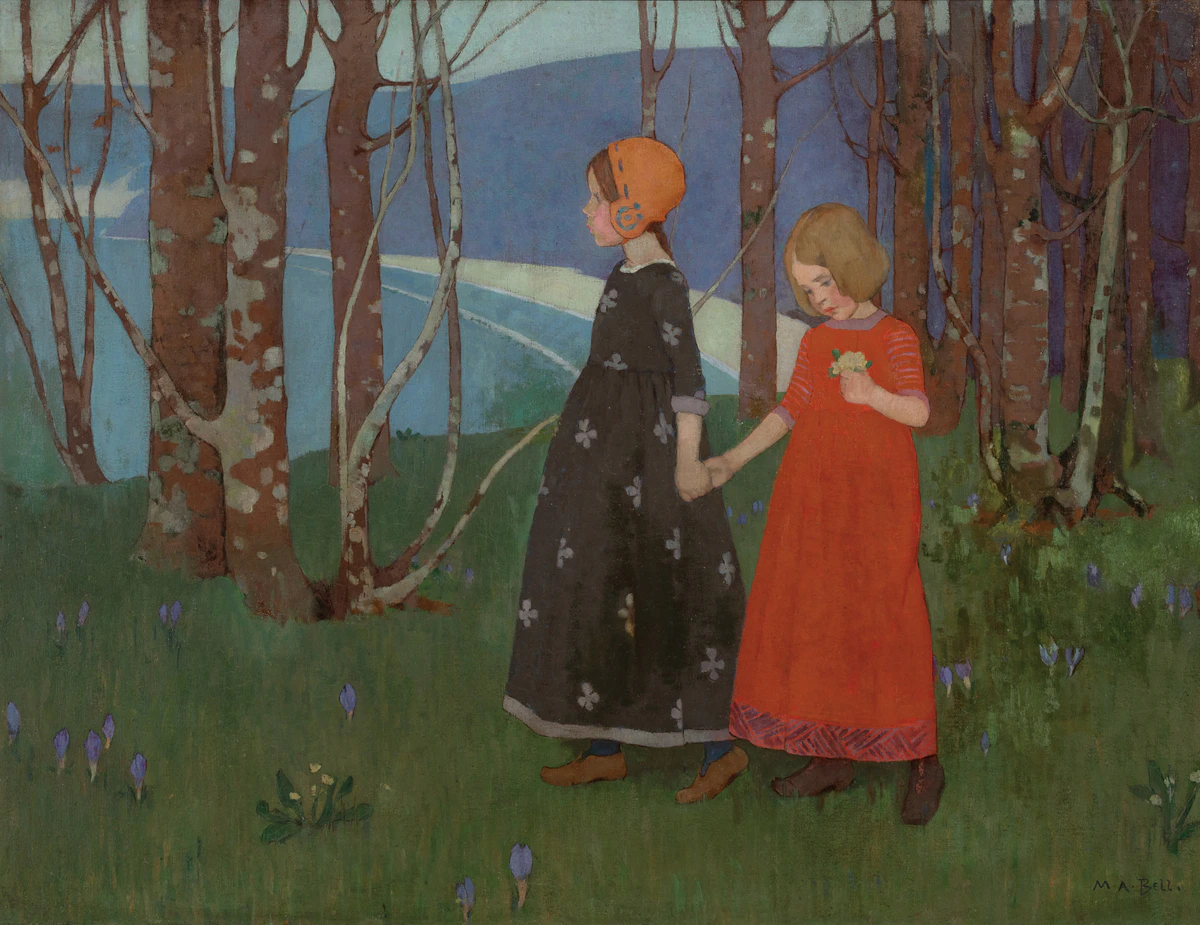
signed lower right
34 x 44 in (86.4 x 111.8 cm)
(including Buyer's Premium)
J. Harold Foley, Ottawa, early 1970s
By descent to the present Private Collection, Ontario
21st Annual Exhibition, Royal Canadian Academy of Arts, National Gallery of Canada, Ottawa, from 15 February 1900, no. 11 as When Spring Rides Through the Woods Annual Spring Exhibition of Oil Paintings, Watercolours, Sculpture, etc., Art Association of Montreal, from 16 March 1900, no. 9 as When Spring Rides Through the Woods
'Among the Pictures', Montreal Star (17 March 1900), page 21
Jane Quigley, 'Volendam as a Sketching Ground for Painters', Studio 38 (July 1906), page 123-124
A.K. Prakash, Mary Bell Eastlake (1864-1951), Masters Gallery, Calgary, 25-26 May 2006, page 7
Mary Alexandra Bell Eastlake was known for rarely signing and hardly ever dating her canvases. This canvas, exhibited in 1900 is signed using the artist's maiden name, despite marrying the landscape painter, Charles Eastlake, in 1897. Bell Eastlake continued to use her maiden name in 1900, before switching between her married and maiden names in 1901 and then finally settling on using her married name in 1902.
When Spring Rides Through the Woods was mentioned in an article on the Spring Exhibition of the Art Association of Montreal as among the pictures of note as a, "work which attracts favourable comment. This is a picture of two children in a forest. The colouring is chaste and the composition excellent." Here we see two young girls walking through a forest dotted with spring flowers. When Spring Rides Through the Woods bears all the hallmarks of Bell Eastlake’s work. Known for her highly decorative, rhythmic compositions with a tendency towards pattern, the young girls walk through a field with highly decorative blue flowers lining their path. A shoreline with a cresting wave can be glimpsed through the screen of trees, which has been laid down in flat tones with pure and strong colours as is typical of Bell Eastlake’s other works, including the record-breaking In the Orchard sold by Cowley Abbott in June, 2023. Bell Eastlake was inspired by her contemporaries Mary Cassatt, Helen McNicoll and Laura Muntz Lyall. Katerina Atanassova notes that Bell Eastlake may have viewed Cassatt’s prints in Paris, which inspired the flatness and use of outlined forms visible in her work.
Although not exclusively a figure painter, the artist was known for her depictions of women and children in domestic outdoor settings, which was deemed an acceptable subject for female painters of the time. The viewer is left to speculate at the connection between the two young figures. Are they friends or sisters? Bell Eastlake’s work remains fresh by avoiding making her subjects overly sentimental. The figures are reserved and styled simply, which belies a sympathy for her subjects which avoids becoming maudlin. The artist refused to paint formal portraits, instead preferring to capture her subjects in natural settings.
The costumery of the young girls points to a European subject. The artist travelled widely. After studying in Montreal under Robert Harris, she left for Paris to work at the Académie Colarossi and exhibited at the Salon. Later Bell Eastlake associated with a group of Cornish artists in St. Ives. The artist exhibited extensively including solo exhibitions in London, Montreal, New Zealand and elsewhere. After her marriage, Bell Eastlake and her husband found inspiration in Volendam in Amsterdam. An article from 1906 noted the Eastlakes' interest in the area as they, “wandered about and found subjects at all sorts of out-of-the-way places in England and abroad, seem to have found their inspiration of late at Volendam. Mrs. Eastlake (M.A. Bell) is best known in England by her pastels, and her studies of Dutch child life have already met with much success in England and America.
She finds an ever-increasing pleasure in working in Volendam, where the naïve and simple children appeal strongly to her temperament. She is a strenuous worker, keen to attain what she has in view, and her work expresses her own sincere and original personality. Perhaps this freshness of idea is due to her Canadian parentage... Her work is delightful in colour and feeling, and has the essential quality of restfulness.”
As A. K. Prakash writes, "[Eastlake's] children are children of poetry, rather than history. Although painted with stylistic loyalty to her French academic training, they are composed on artistic imagination rather than on the stimulus of external happenings." Indeed, the title, When Spring Rides Through the Woods, appears to be in reference to a poem titled "Child's Song In Spring" by Edith Nesbitt, which was published in 1895. The poem is an ode to the changing season and uses personification to describe different trees as characters in a springtime scene, with each having a unique personality. The narrator appears to be a child who revels in the joy of spring. Through this lens, the poem invites reflection on growing up, imbuing this rare painting by the female artist with ample meaning. "Child's Song In Spring", 1895 The silver birch is a dainty lady, She wears a satin gown; The elm tree makes the old churchyard shady, She will not live in town. The English oak is a sturdy fellow, He gets his green coat late; The willow is smart in a suit of yellow, While brown the beech trees wait. Such a gay green gown God gives the larches– As green as He is good! The hazels hold up their arms for arches, When Spring rides through the wood. The chestnut’s proud and the lilac’s pretty, The poplar’s gentle and tall, But the plane tree’s kind to the poor dull city– I love him best of all!
