signed (initialed) lower left: R
8.25 × 12.75 in (21.0 × 32.4 cm)
(including Buyer's Premium)
The Artist
Ambroise Vollard, Paris
Galerie Bénézit (?), Paris
Joseph Mirisola, New York
Shorr Goodwin Fine Art and Rare Jewels of the World, Scottsdale
Private Collection, Canada, 1987
Guy-Patrice and Michel Dauberville, Renoir: Catalogue raisonné des tableaux, pastels, dessins et aquarelles, Volume 3, 1895-1902, Paris, 2010, listed and reproduced page 87, no. 1831, dated 1900-1902
Colin B. Bailey, Christopher Riopelle, John House, Simon Kelly, and John Zarobell (ed.), Renoir Landscapes: 1865-1883, London, 2007, pages 51, 53
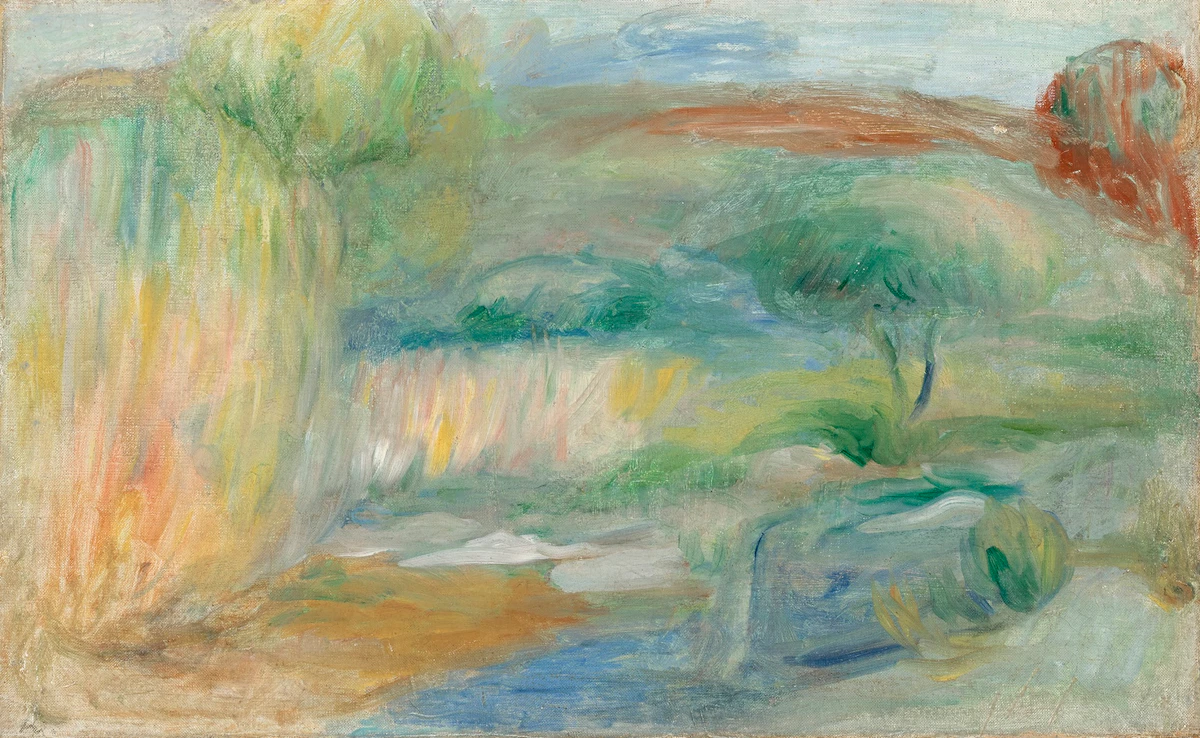
At the beginning of the twentieth century, Pierre-Auguste Renoir entered a profound phase of his career that reshaped his approach to light, form, and colour. By the late 1890s, the artist began suffering from arthritis, a debilitating condition that compelled him to seek the temperate climate of the South of France. He settled in the Mediterranean region, first visiting Grasse and Le Cannet, then acquiring a residence at Les Collettes in Cagnes-sur-Mer in 1907. There, he was captivated by the mythic, sun-drenched landscape of the Midi. This move sparked a stylistic transformation. He abandoned the sharp, linear precision of his “Ingres period” from the 1880s and embraced a looser, more fluid application of paint. Paysage du Midi, executed around 1900, exemplifies this period, capturing the warmth and idyllic serenity of the Mediterranean scenery.
For Renoir, the landscape of southern France was not just a topographical subject but a timeless vision. Unlike his earlier Impressionist scenes that recorded the bustling modern life of Paris and its suburbs, his late landscapes lack contemporary markers. Instead, they offer an idealized vision of nature, heavily influenced by the Barbizon masters, considered the godfathers of the modern movement. The Mediterranean light, with its clarity and golden warmth, led Renoir to elevate his palette, adopting rich, saturated hues that seem to glow from within the canvas. In this lush environment, he sought to paint the sensation of heat and the gentle rustle of olive and almond trees, transforming the physical world into a visual symphony of pure joy.
In Paysage du Midi, the viewer is immediately immersed in a radiant, sensory world. The composition is open and fluid, with rapid, sweeping brushstrokes that prioritize atmospheric feeling over rigid architectural structure. On the left side of the canvas, a mass of what appears to be foliage anchors the scene. Renoir applies long, vertical strokes of pale yellow, soft peach, and vibrant chartreuse. These suggest cascading leaves of a weeping tree or a sun-bleached thicket moving in the breeze. The forms are unmoored from harsh outlines. They dissolve at their edges and merge seamlessly into the hazy, azure sky above. The foreground features a dynamic interplay of textures and tones.
A meandering pathway or stream, rendered in swift, horizontal dashes of cerulean blue and sandy ochre, leads the eye deeper into the middle distance.
The palette of this painting is masterfully arranged with harmonious tones. Soft pastels dominate the composition and contrast with the lively energy of Renoir’s brushwork. The artist forms the landscape not by outlining, but by layering coloured strokes. Luminous patches of rust-orange and terracotta emerge in the distance and in the foliage on the far right. These warm hues provide a counterpoint to the cool greens dispersed across the surface. The paint is applied in varied thicknesses. Some areas feature thin, translucent washes that allow the weave of the canvas to breathe, while others are built up with dense impasto that catches the light. This varied application produces a dynamic surface that conveys the shimmering atmospheric heat of the Midi as a tactile, physical presence.
This dissolution of strict form in favour of atmospheric resonance aligns Renoir’s late work with the ultimate trajectory of Impressionism, pushing the movement to the very edge of abstraction. As the art historian Colin B. Bailey observed regarding Renoir’s landscapes, “details of site and setting were of less interest to Renoir than the creation of an Arcadian vision, timeless, natural and unchanging.” Despite the physical pain he endured during the execution of these late works, there is absolutely no trace of suffering in the brushwork. Instead, the work is radiant, testifying to Renoir’s optimism. Monet’s influence on the evolution of Renoir’s pictorial language after 1873 is undeniable: “In their quest to capture the effects of daylight in nature—what Mallarmé would later term ‘the natural light of day penetrating and influencing all things’—both artists developed a shared synoptic handling and liberated colour that fully rejected traditional chiaroscuro.”
In his later years, Paul Durand-Ruel continued to play an influential role in Renoir’s career, even as dealers such as Ambroise Vollard, Gaston and Joseph Bernheim of Bernheim-Jeune entered the market. According to Vollard’s records, his professional relationship with Renoir began in October 1894, when Renoir purchased two Manet watercolours exhibited at Vollard’s gallery at 37, rue Laffitte, near the Hotel Drouot in Paris. Soon after this initial transaction, Vollard began selling Renoir’s works for prices below 1,000 francs. Over the years, Vollard attracted the attention of prominent critics—including Julius Meier-Graefe, who wrote the first Renoir monograph in 1911—and artists such as Roger Marx, Camille Pissarro, and Maxime Maufra. As Renoir's professional relationships evolved, so too did the nature of his artistic achievements, culminating in works that went beyond traditional landscape painting.
Paysage du Midi goes beyond a simple landscape study, serving as a sanctuary for both artist and viewer. Through fluid brushwork and vivid colour, Renoir captures fleeting sunlight, preserving its beauty on canvas. The painting shows the mature vision of an artist in full command of his medium, guided by intuition and emotional resonance. This work stands as a clear emblem of Renoir’s legacy and his belief in the transformative power of art, reflecting his dedication to portraying the beauty of the natural world.
The work will be included in the forthcoming Digital Catalogue Raisonné, currently being prepared under the sponsorship of the Wildenstein Plattner Institute, Inc.
