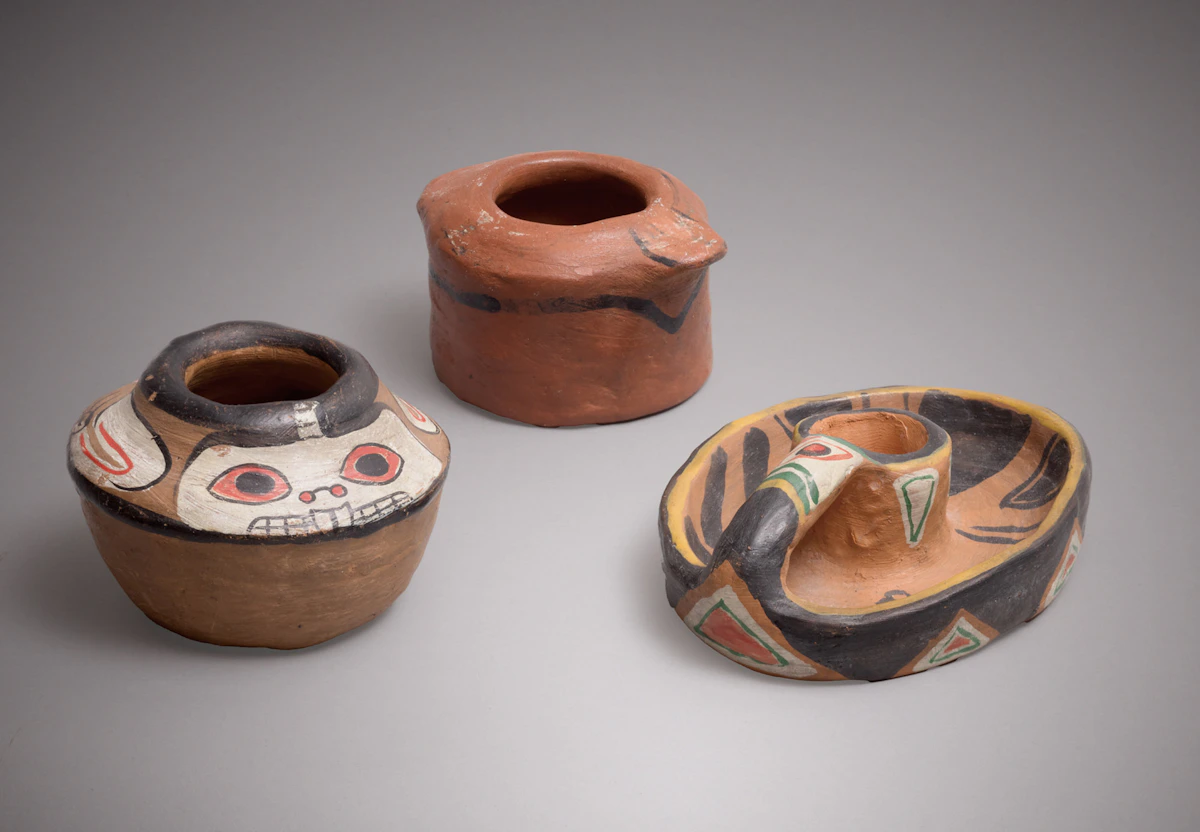
Beaver: "Klee Wyck" incised on the underside, 2.25 ins x 3 ins x 3 ins; 5.7 cms x 7.6 cms x 7.6 cms Candle Holder: "Klee Wyck" incised on the underside, 1.75 ins x 4.5 ins x 3.25 ins; 4.4 cms x 11.4 cms x 8.2 cms Pot: "Klee Wyck" incised on the underside, 2 x 3.25 x 2.5 ins; 5 cms x 8.2 cms x 6.3 cms
1.75 x 4.5 x 3.25 in (4.4 x 11.4 x 8.3 cm) (largest (overall))
(including Buyer's Premium)
Masters Gallery, Calgary
Private Collection
Emily Carr, The Emily Carr Collection: Four Complete and Unabridged Canadian Classics, Toronto, 2002, pages 444‒445
“Klee Wyck,” meaning “Laughing One,” was the name given to Emily Carr by members of the Nuu-chah-nulth Nation. Carr later used this name as the title of her autobiography and as the signature on much of her pottery from this period. Drawing inspiration from the Indigenous iconography of the West Coast, she began producing hooked rugs and later pottery from her Victoria home, catering to the tourist market. At the time, Carr’s family faced financial strain as rising taxes prompted her father to sell off much of his property in lots. Each daughter retained one lot, and Carr built a four-suite apartment on hers to generate rental income. However, with the onset of the First World War, the rental market declined sharply, prompting her to seek other ways to support herself. She raised hens and rabbits, sold small fruits, and produced pottery to supplement her earnings.
Carr described her introduction to pottery making stating, “with the help of a chimney sweep I built a brick kiln in my back yard, firing my own pots. The kiln was a crude thing, no drafts, no dampers, no thermometer - one door for all purposes...Firing my kiln was an ordeal. I stoked overnight, lighting my fire well before day-break so that nosy neighbours would not rush an alarm to the fire department when the black smoke of the first heavy fire belched from the chimney. The fire had to be built up gradually. The flames ran direct among the pots, sudden heat cracked the clay. First I put in a mere handful of light sticks, the clay blackened with smoke. As the heat became stronger the flames licked the black off. Slowly, slowly the clay reddened passing from red hot to white of an awful transparency, clear as liquid. The objects stood up holding their shapes with terrifying, illuminated ferocity. A firing took from twelve to fourteen hours; every moment of it was agony, suspense, sweat. The small kiln room grew stifling, my bones shook, anticipating a visit from the police, fire chief, or insurance man. The roof caught fire. The floor caught fire. I kept the hose attached to the garden tap and the roof of the kiln-shed soaked. The kiln had to cool for twenty-four hours before I could handle the new-fired clay.”
