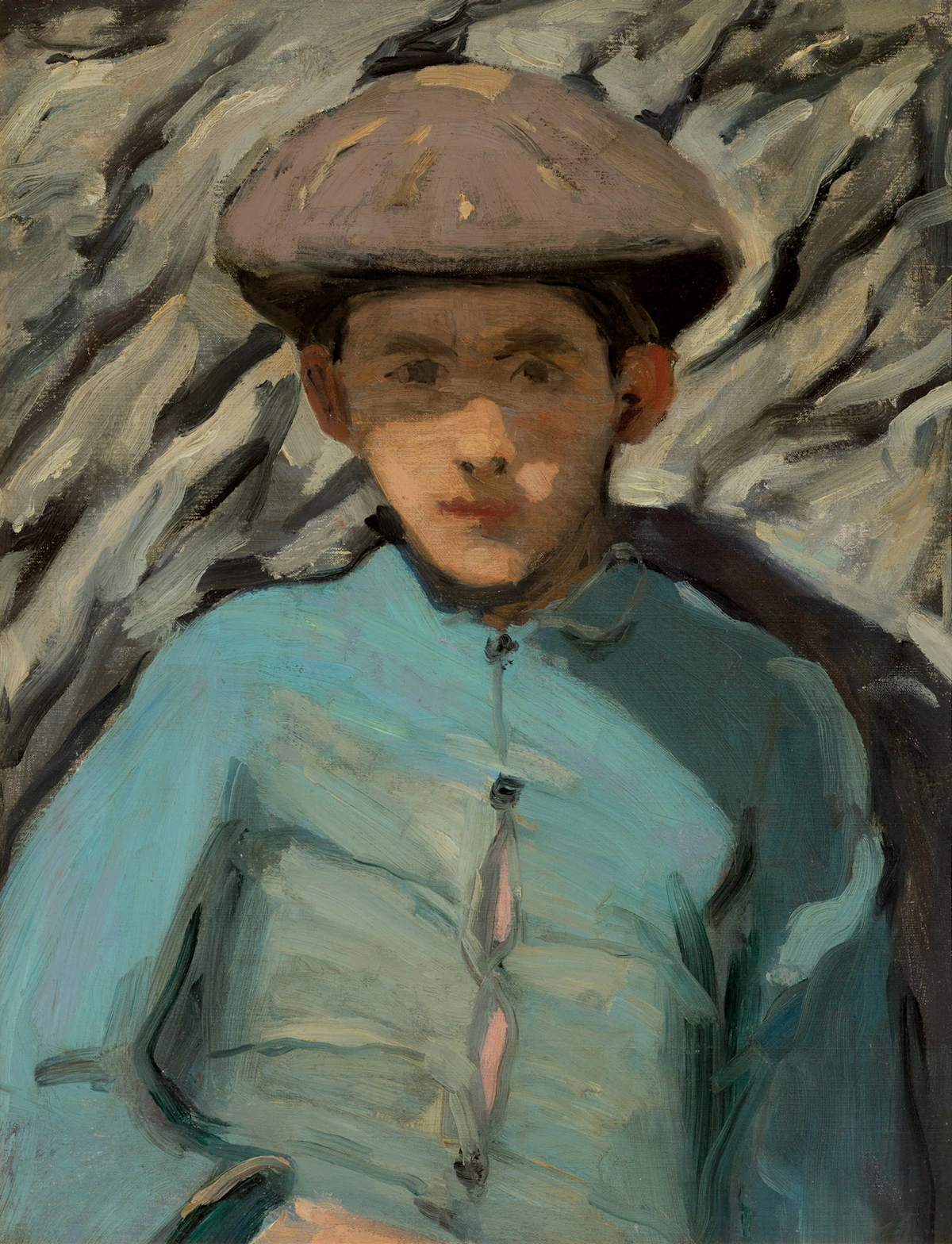
titled and dated 1896 on a gallery label on the reverse; inscribed “J.W. Morrice” on the reverse of the canvas, inscribed “Recorded-Buchanan James Wilson Morrice p. 180-Portrait of Boy Painting/Nomad” and “M-228” on the stretcher
18 x 14 in (45.7 x 35.6 cm)
(including Buyer's Premium)
W. Scott & Sons, Montreal (Morrice Estate, Inv. M-228), 1925
Sydney Carter (Montreal dealer), 1936
Private Collection, Montreal, before 1940
By descent to a Private Collection, Montreal, until 2008 Masters Gallery, Calgary, 2025 Private Collection
Possibly Memorial Exhibition of Paintings by the Late James W. Morrice, R.C.A., Art Association of Montreal, 16 January-15 February 1925, no. 31 as Head of Boy
Donald W. Buchanan, James Wilson Morrice: A Biography, Toronto, 1936, listed page 180 as Portrait of Boy, Half-length portrait, full face, blue in costume, black and grey stripes in background. 18" by 15". Not signed.
Kathleen Daly Pepper, "James Wilson Morrice", Toronto, 1966, listed page 97 as Portrait of Boy
James Wilson Morrice, who had been living in Paris since 1890, decided to spend the summer of 1896 in the bathing resort of Saint-Malo. Morrice found inspiration in the nearby fishing village of Cancale, returning to Paris in August with a well-filled sketchbook (Sketchbook #2, Montreal Museum of Fine Arts) and more than twenty-five paintings–only one of Saint-Malo. Compared to what the artist drew and painted before and after, the cancalais summer stands apart because he concentrated on the human figure first and its environment second; in Cancale, that meant local women and children working in the oyster beds (the men were fishing).
Until then, Morrice had painted small and competent landscapes, which he did not exhibit in Paris. However, in the spring of 1896, he sent a dark Nocturne (Private Collection) to the Salon de la Société Nationale, probably encouraged by his new friend from Philadelphia, Robert Henri. Obviously, the American had quickly introduced the Canadian to the most famous works of James McNeill Whistler; Henri’s entry at the Salon (a first for him too), Suzanne, now lost, was perhaps also Whistlerian. Both entries prefigure what each artist will become well-known for: portraits for Henri, landscapes for Morrice; except in Cancale, where his landscapes are few, and more descriptive than atmospheric–young girls walking on the quay, oyster beds, fishing boats, women washing oysters. The remaining Cancale output consists of “portraits”–two of fellow painters, but mostly of local children, including a girl in a pink blouse and a white cap, and the portrait of this boy.
His blue shirt and ample beret are typically cancalais. In The Oyster Beds, Cancale (Private Collection), he walks barefoot in the mud, returning from the beds with a pail and a basket. Here he sits with his back against a stone wall, resting on the (invisible) beach below the quay or the jetty. His face, painted very carefully, is partly obscured by the late afternoon shadow, simplifying the rendering of the eyes, and ranking this portrait study among Morrice’s best. The same care was given to the boy’s clothes: his shirt, already too small for him and soiled, reveals a pink undergarment. So even if his “attributes” (pail and basket) are not visible, we understand that this young boy already works to support his family. Unfortunately, Morrice will not continue in this promising, almost ethnological artistic vein, and his interest in the human figure will remain almost dormant until after 1910.
We extend our thanks to Lucie Dorais, Canadian art historian and author of J.W. Morrice (1985), for contributing the preceding essay.
