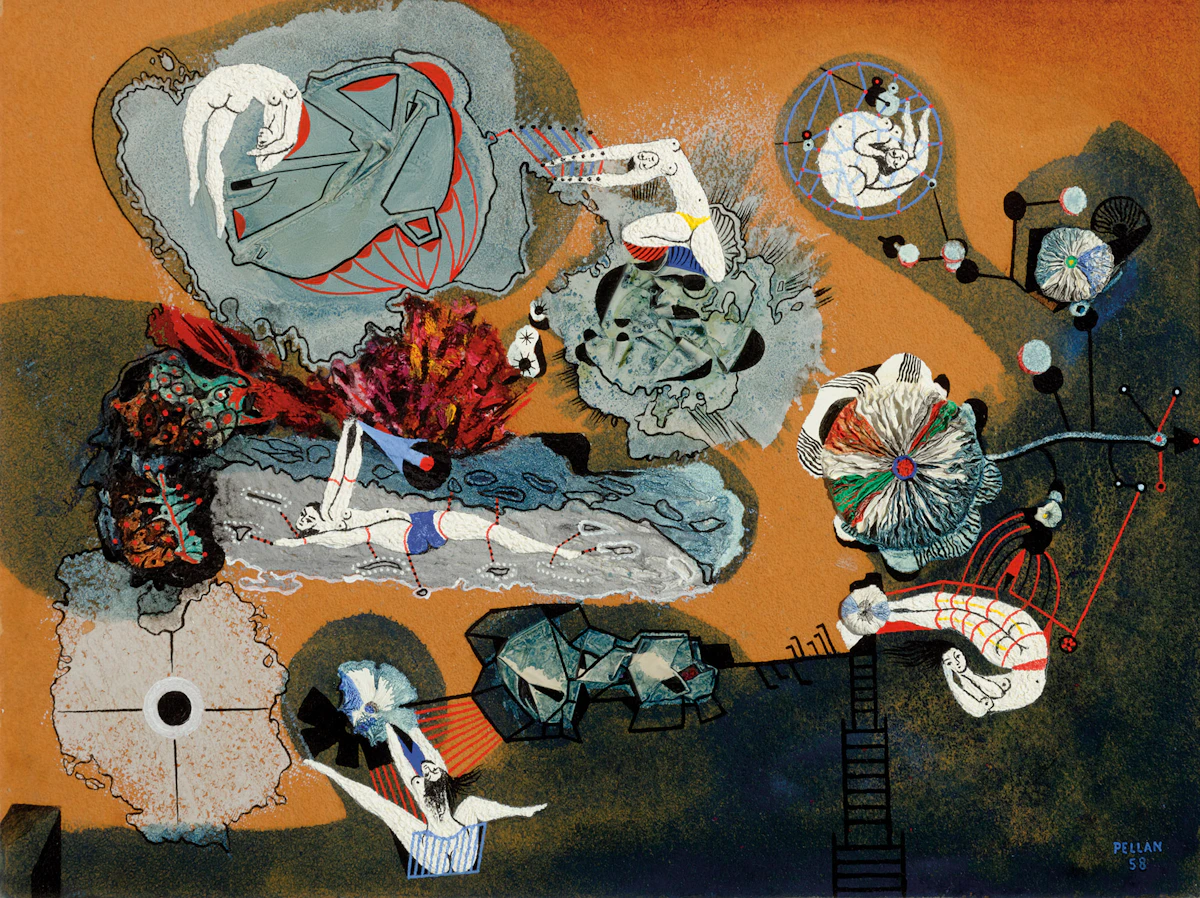
titled, inscribed "les femmes et la lune" and "#346" and artist stamp on the reverse
14.75 x 19.75 in (37.5 x 50.2 cm)
(including Buyer's Premium)
Mr. and Mrs. M. Boisvert, Montreal
Waddington & Gorce, Toronto
Masters Gallery, Calgary
Private Collection
Hommage à Pellan, Galerie Denyse Delrue, Montreal, 25 April–7 May 1960, Les femmes et la lune (Au soleil noir was part of a suite of fourteen paintings)
Pellan, Musée du Quebec; travelling to Musée des beaux-arts de Montreal; the National Gallery of Canada, Ottawa, 7 September 1972-8 January 1973, no. 114 (loaned by Mr. and Mrs. M. Boisvert, Montreal)
'Alfred Pellan. Painter, poet, dreamer', Star Weekly (6 August 1960), page 17
David Giles and Jean Soucy, Pellan, Quebec City, 1972, no. 114, discussed pages 22, 23, listed page 110
'Introduction' in Pellan, Quebec/Montreal/Ottawa, 1972, page 44
German Lefebvre, Pellan, Toronto, 1973, reproduced page 62
German Lefebvre, Pellan. Sa vie, son art, son temps, Quebec, 1986, page 180, reproduced page 130
In 1958, Alfred Pellan received a grant from the Canada Council that allowed him to explore the physicality of colour and surface, mixing pigment with various materials to create reliefs. Through these experiments, he developed the language that would define his Jardins series. Au soleil noir anticipates that shift. The surface is not merely raised through pigment but built with attached elements: small moulded forms, ridged folds, and embedded materials project into space. Pellan moves beyond painterly relief toward an integrated object. Although thematically distinct from the Jardins, the painting sets the foundation for Pellan’s later exploration of structure, rhythm, and the tactile energy of matter.
Germain Lefebvre spoke of the “shimmering blooms of Au soleil noir,” noting how Pellan’s electric movements scatter across joyfully decorated aerial fields. The painting is built around a series of floating zones, each defined by texture rather than line. Against a warm ochre ground, clusters of material rise from the surface. Circular shapes unfold like flowers or mineral growths, their creased folds catching light from the gold and silver tones around them. The eye moves between compact, crater-like forms and finer drawn connections that link them together.
The naked female bodies of the painting “recline and stretch out, fly away, turn about in space before diving back, light and pneumatic, in joyous fluids and plunging into heady, scintillating matter”. Within this floating environment, the women act less as subjects than as currents of movement linking the different zones of the composition. They animate the work’s tension between gravity and suspension, between the solid crust of pigment and the open space around it. Women don’t merely occupy the image. They build it, holding together its material and emotional core. For Pellan, this sensual cosmology was inseparable from emotion itself: “Love is like life... one cannot escape being dazzled by it. Love is desire, harmony, hope in life.”
Au soleil noir was exhibited in Pellan’s retrospective of 1972 and is listed in the accompanying catalogue, as well as in Germain Lefebvre’s 1986 monograph, which includes a colour reproduction of the work—though with a slightly altered palette. The note “les femmes et la lune” on the back of the painting refers to the series to which it originally belonged. Shown in the exhibition Hommage à Pellan at Galerie Denyse Delrue in Montreal (April 25–May 7, 1960), it included fourteen paintings exploring the relation between the feminine and the cosmic. The built surface and floating figures of Au soleil noir translate the theme of “women and the moon” into form itself, joining the tactile language of the Jardins with the sensual imagery typical of Pellan’s work.
We extend our thanks to Maria Rosa Lehmann (PhD, Sorbonne University), an art historian and computer science scholar whose research bridges cultural history and technology, for contributing the preceding essay. She has held research fellowships at Brown University, Cornell University, the Université du Québec à Montréal, and the German Center for Art History in Paris. She is the author of the Art Canada Institute monograph on Alfred Pellan (2023) and co-author of a forthcoming book on artist Mimi Parent. She contributed to exhibitions, including Une brève histoire de l’avenir at the Louvre Museum (2015). Alongside her art-historical work, she designs data- driven tools for art-historical research, developing analytical platforms and algorithmic models that map the transnational circulation of the avant-garde.
