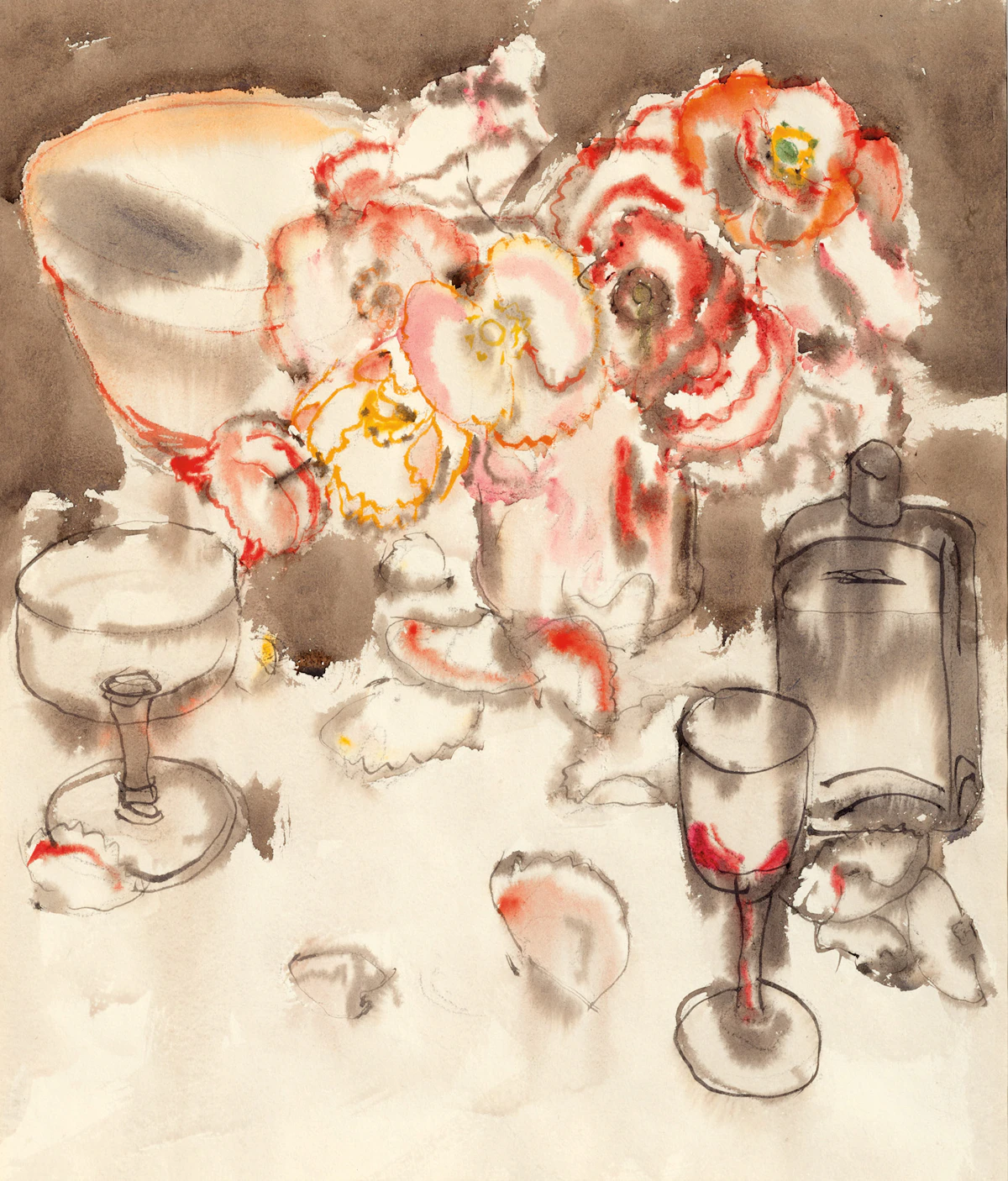
titled and dated 1941 on the gallery label on the reverse; inscribed "Poppies and glass" and "W-253" (by Douglas Duncan) on the reverse; catalogue raisonné no. 403.67
16.75 x 14.25 in (42.5 x 36.2 cm) (sight)
(including Buyer's Premium)
Douglas Duncan/Picture Loan Gallery Vancouver Art Gallery Picture Rental Mr. and Mrs. Reginald A. Wilson, Vancouver, 1948 Ohler Fine Arts, 1990 Masters Gallery, Calgary, 1990 Private Collection
"David Milne: Recent Watercolours and Some Etchings", Hart House, University of Toronto, 22 October-12 November 1943 "David Milne Paintings", Masters Gallery, Calgary, 4-7 December 1996 "Sight and Site: Location and the Work of David B. Milne", Nickle Arts Museum, University of Calgary, 8 August-2 November 1997
David Milne Jr. and David P. Silcox, "David B. Milne: Catalogue Raisonné of the Paintings, Volume 2: 1929-1953", Toronto, 1998, listed and reproduced page 768, no. 403.67 David P. Silcox, "Painting Place: The Life and Work of David B. Milne", Toronto, 1996, page 319
Poppies, zinnias and nasturtiums, along with an assortment of household objects, recur in a series of Milne’s still life works of the early 1940s. From this period on, Milne increasingly worked from his imagination rather than from direct observation. Though Milne’s earlier paintings of spring flowers were likely created in the spring, from the late 1930s on, this is no longer necessarily the case. Many of these works exhibit a reduced palette of pinks, reds and oranges glowing against a dark background. Art historian David Silcox noted the importance of Milne’s distinct palette: “Milne’s pictures suddenly developed a gentler brilliance, but they still had explosive power… The flower pictures painted in the summer of 1941, such as the numerous paintings of poppies… all have a scarlet richness that saturated the paper in a way that was new in Milne’s work, and that he would exploit over the next few years.” Milne also experimented with wet wash techniques, applying water to the paper immediately before or after putting down colour. The resulting diffused, watery brushstrokes create a glowing, soft-focus effect which contrasts with crisp line work. This distinct technique differentiated Milne from most Canadian watercolourists of the era, instead demonstrating surprising parallels with Asian brush painting. Milne would continue to explore and expand on these methods for the rest of his life.
