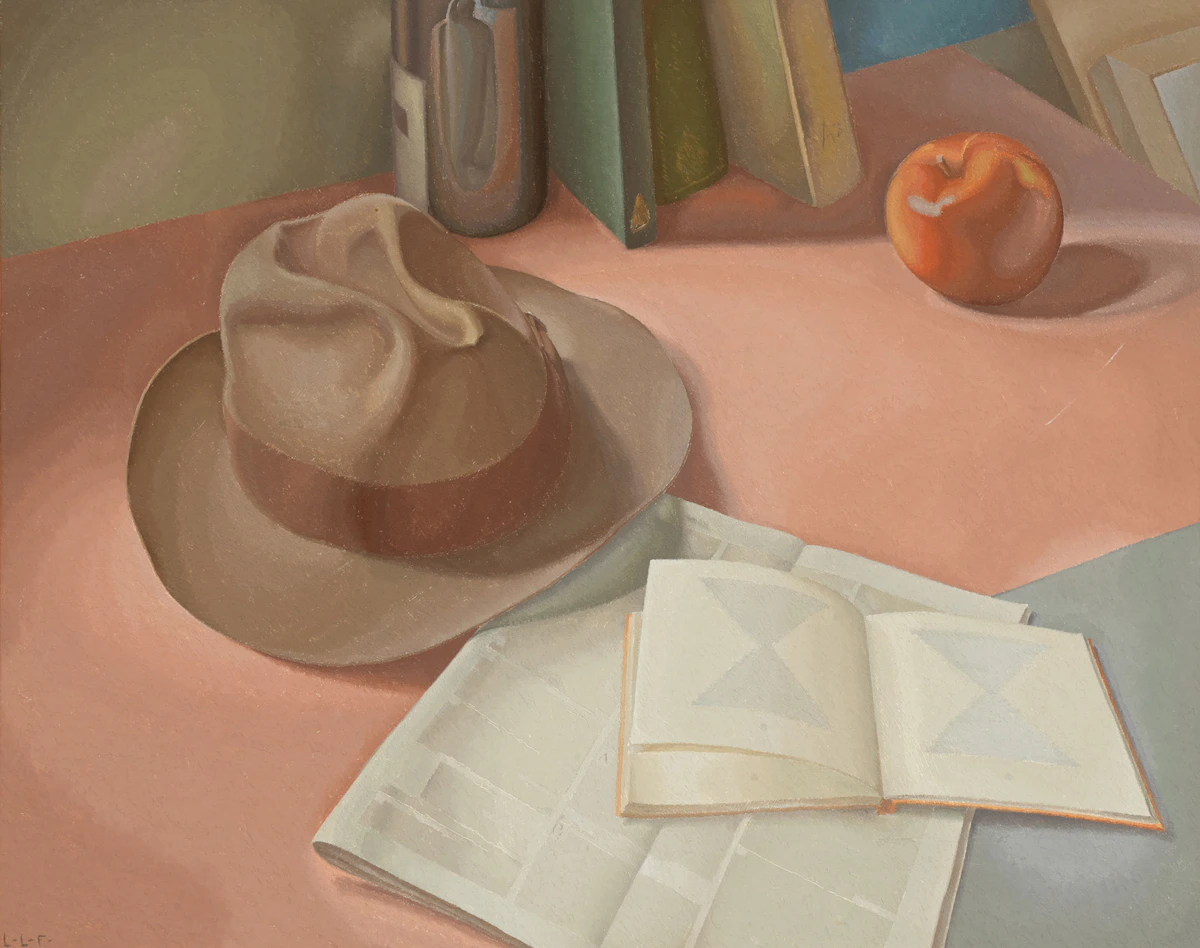
signed with initials lower left; titled and dated 1955 on multiple labels on the reverse
24 x 30 in (61.0 x 76.2 cm)
(including Buyer's Premium)
Mrs. L.L. FitzGerald, Winnipeg
Patricia L.F. Morrison, Toronto
Mr. and Mrs. Donald C. Steele, St. Catharines
Masters Gallery, Calgary
Private Collection
Lionel LeMoine FitzGerald, 1890-1956: A Memorial Exhibition (Supplement for the Winnipeg Showing), Winnipeg Art Gallery, 23 February-23 March 1958, no. 104
Painting in Canada, Canadian Government Pavilion, Expo '67, Montreal, 28 April-27 October 1967, no. 8
Canadian Classics, The Morris Gallery, Toronto, 21 October-4 November 1972, no. 37
LeMoine FitzGerald, The Morris Gallery, Toronto, 10-24 February 1973, no. 20
Lionel LeMoine FitzGerald, 1890-1956: The Development of an Artist, Winnipeg Art Gallery; travelling to National Gallery of Canada, Ottawa; Norman MacKenzie Art Gallery, Regina; Musée d’art contemporain de Montréal; Art Gallery of Ontario, Toronto; Glenbow Museum, Calgary, 28 July 1978-1 December 1979, no. 100
Canadian Roots, Rodman Hall Arts Centre, St. Catharines, 8 January-1 February 1982
In Seclusion with Nature: The Later Work of L. LeMoine FitzGerald, 1942 to 1956, Winnipeg Art Gallery; travelling to London Regional Art Gallery; Dalhousie Art Gallery, Halifax; McMichael Canadian Art Collection, Kleinburg; Musée du Québec, Quebec City, 2 October 1988-28 January 1990, no. 75
John Russell Harper, Painting in Canada: A History, Montreal, 1967, no. 8, unpaginated, reproduced
Canadian Classics, Toronto, 1972, unpaginated, no. 37, reproduced as The Artist's Desk
Theodore Allen Heinrich, 'In the Galleries/Toronto', artscanada 29, no. 174/75 (December 1972-January 1973), reproduced page 73
LeMoine FitzGerald, Toronto, 1973, no. 20, unpaginated, reproduced as The Hat Karen Linda Sens, '"A Discussion of the Stylistic Development in the Dated Oil Paintings of Lionel LeMoine FitzGerald (1890-1956)" (Master's thesis, University of British Columbia, Vancouver, 1978), pages 94-96
Patricia E. Bovey, Lionel LeMoine FitzGerald, 1890-1956: The Development of an Artist, Winnipeg, 1978, no. 100, reproduced page 71
Marci Lipman and Louise Lipman, Images: Contemporary Canadian Realism, Toronto, 1980, reproduced page 9
Michael Parke-Taylor, In Seclusion with Nature: The Later Work of L. LeMoine FitzGerald, 1942 to 1956, Winnipeg, 1988, pages 35-36, reproduced page XV
Michael Parke-Taylor, Lionel LeMoine FitzGerald: Life and Work, Art Canada Institute, 2019, reproduced page 36
During the latter years of his career, Lionel LeMoine FitzGerald’s art toggled between abstraction and figuration. While the majority of his paintings and drawings after 1950 were based on various degrees of abstraction from nature, he remained devoted to figurative works based on close observation of the empirical world.
In late 1954 and 1955, FitzGerald created several figurative still life drawings and watercolours depicting apples, bottles, and jugs reminiscent of his work from the thirties and forties. These were followed by a series of at least three semi-abstract drawings featuring a hat with other still life objects conceived using a technique of short pen-and-ink strokes that he had developed after 1950. Central to each composition was FitzGerald’s soft, grey felt hat-a personal attribute since he never failed to wear one whenever sketching in the intense sunshine of the open prairie.
FitzGerald’s preparatory drawing Still Life with Hat, dated 18 August 1955 (Art Gallery of Ontario), was squared for transfer to a large piece of masonite. This was the genesis of the large painting Still Life with Hat, begun on 23 August and completed on 25 October 1955. This ambitious picture has the look of paintings made during the artist’s classic period of the early thirties and is considered his last major painting. In keeping with FitzGerald’s dictum that the eye of the viewer should revolve within the boundaries of the frame, the balanced spatial arrangement of the still life objects contributes to an effect of perfect unity.
While the hat is a symbolic self-portrait, the open book references Dr. E.J. “Ted” Thomas, FitzGerald’s physician and friend. In his diary dated 5 December 1955, FitzGerald noted that the picture had been purchased by Dr. Thomas. Although Dr. Thomas never took possession of the painting, he revealed in an interview (in conversation with Michael Parke-Taylor, 21 February 1987) that the book, opened to a page with an hourglass design, not only serves as a "memento mori", suggesting that time is running out, but also references the name “Thomas.” FitzGerald depicted the poem Vision and Prayer (1944), written by the Welsh poet and prose writer Dylan Thomas. The stanzas of the poem were composed to conform to a geometrical pattern in the shape of an hourglass in emulation of the pattern poems of the early seventeenth-century English poets of the metaphysical school. Thus, a close reading of this subtle painting demonstrates the shared erudition of both artist and patron.
We extend our thanks to Michael Parke‒Taylor, Canadian art historian, curator and author of Lionel LeMoine FitzGerald: Life & Work (Art Canada Institute) for contributing the preceding essay.
