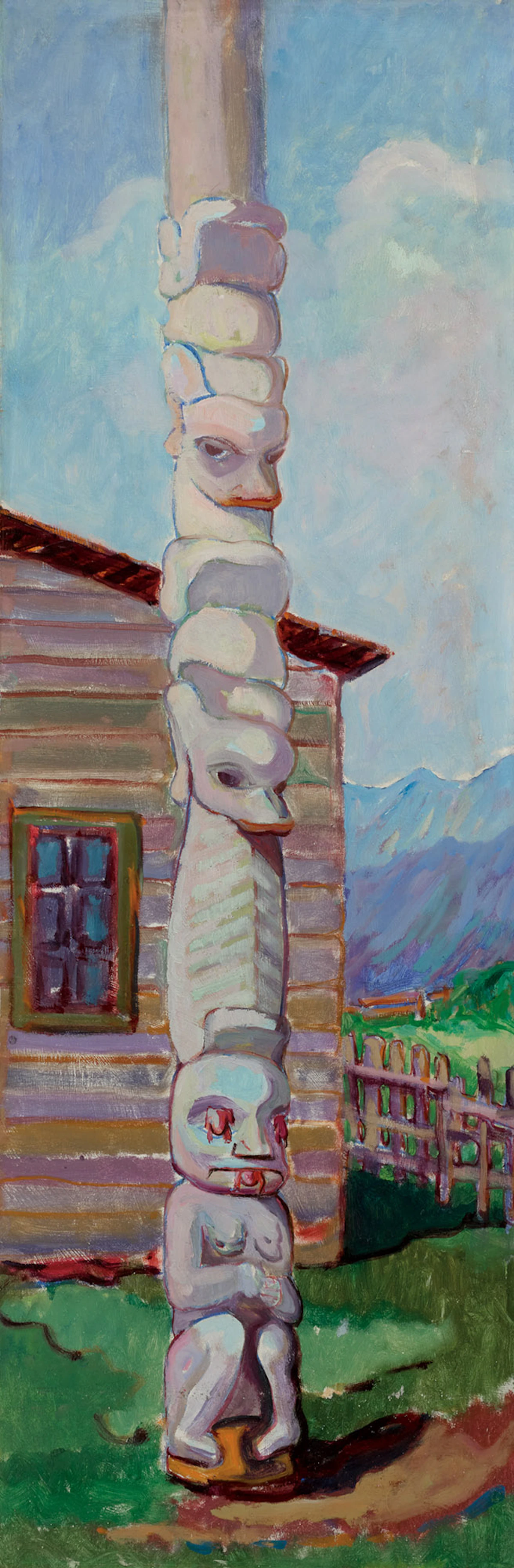
titled and dated 1912 on a gallery label and inscribed "Kispayaks" and "115" on the reverse
37.75 x 12.75 in (95.9 x 32.4 cm)
(including Buyer's Premium)
Dominion Gallery, Montreal
Private Collection, Victoria
Masters Gallery, Calgary
Private Collection
Emily Carr, "Lecture on Totems", Vancouver, 1913
Marius Barbeau, "Totem Poles of the Gitskan, Upper Skeena River, British Columbia", Ottawa, 1929, page 77, see page 235, plate XIII, figure 3, "Pole of Harhu, at Kispayaks" and page 237, plate XIV, figure 1, “Pole of Harhu, at Kispayaks”
Susan Crean, "Opposite Contraries: The Unknown Journals of Emily Carr and Other Writings", Vancouver, 2004, see for full account of Emily Carr’s “Lecture on Totems”
Harold J.T. Demetzer, Earl Muldoon and Elmer Derrick, "The Tradition Continues: Monumental Sculpture in the Gitanyow and Gitxsan Territories 1986-96", 2005
Gerta Moray, "Unsettling Encounters: First Nations Imagery in the Art of Emily Carr", Vancouver, 2006, for a full account of Emily Carr’s sketching see pages 40-42, 96-109
Emily Carr visited the Gitxsan village of Anspayaxw (then spelled Kispiox) on her ambitious sketching trip of 1912 to paint British Columbia’s northern First Nations villages and totem poles. She found more than twenty poles standing here, of which Pole of Harhu was a notable example. We know that she decided to sketch two general views (one from each end) of the village with its stands of poles, later transposed into large oil paintings in her studio, such as Kispiox Village (Royal British Columbia Museum and Archives). She also made four careful close-up studies of single or closely adjacent poles with remarkable imagery, of which the Pole of Harhu is one.
From childhood Carr had felt drawn to the Indigenous population in Victoria and she had already painted scenes of the Salish communities there and around Vancouver, then venturing as far north as the Kwakwaka’wakw villages of ’Yalis (Alert Bay) and T’sakwa’lutan (Cape Mudge). But in 1910-1911 her approach had been completely transformed by a period of studio training in France. Her teachers there had introduced her to Post-Impressionist colour theory and composition, and confirmed her intuition that the carvings of northwest coast Indigenous peoples had great aesthetic merit on their own terms.
The 1912 Pole of Harhu clearly shows the impact of Carr’s colouristic French training. She boldly flattens the space into intense but modulated expanses of colour, with a counterpoint of distinct, curving outlines and patterned areas. The pole itself is outlined with blue and purple lines, its surface modelled in light pinkish lilac shades with pale blue highlights and violet shadows. The darker wood of the plank house behind it is rendered in deeper tones of the same colours, with dark blue shadowing, and the edges of the planks are marked in red. She creates a bright sunlit scene, articulated with firm, decorative outline.
At the time when Carr visited, the Skeena valley was a site of tension and hostility between the Gitxsan and Wet’suwet’en people, to whom the government had allotted inadequate reserves that took no account of their traditional territories, and the flood of incoming settlers, who were pre-empting indigenous lands for agriculture and invading their traditional fishing and hunting grounds. Carr was eager to understand the function and meaning of the poles and to explain their significance to the settler community, whom she sought to educate about the Indigenous traditions and culture that she admired. Carr wrote and delivered a Lecture on Totems for a show of nearly two hundred paintings of First Nations villages and poles that she organized in Vancouver in 1913. There she related the story referred to on the Pole of Harhu, revealing that she had gained sufficient respect from the local Gitxsan people to be given an account:
“One of these old mythological legends told me in Kispiox ran thus... This pole represents a woman's figure on the base, with a frog coming out of each eye and another out of the mouth. This is the story. A beautiful young woman went down to the water to clean her fish. She looked about her for a large flat stone to sit upon while she worked Now a monster in form of a frog had long loved her but she would have nothing to do with him, she used to climb out on a tree leaning over the water and taunt him when he would vainly try to clasp her reflection : so when he saw her come to clean her fish, he flattened himself out among the stones, and she taking him to be a large flat stone, sat upon his back & began to clean her fish; stealthily he slid into the water bearing her with him and down he dived to the bottom: where the fish were his slaves & the frogs his servants. The ducks and geese on the top of the water were the sentinels guarding his realm: For long she live(d) under there & wept & mourned to get back to her home & husband but in vain.– At last it was revealed to her by her guardian spirit, that there was a certain weed which all these people were very fond of & which if eaten by them would produce a sound sleep... She procured large quantities of this weed which they all devoured greedily & were soon fast asleep [so] she passed by the Monster & his people & rose to the top of the water... escaped & got back to her husband.”
Carr’s version of the story of ‘Neegyamks the frog woman is fuller than that given by anthropologist Marius Barbeau, who reproduced the pole in his book, Totem Poles of the Gitksan as Pole of Harhu, at Kispayaks and briefly identified its other images–a set of shingles and two frogs facing downward with waterlily leaves wrapped around their midriffs.
Carr was fascinated by this pole and its record of an ancestral legend, and she made an oil on board sketch entitled West Coast Totem [Kispiox] (Royal British Columbia Museum and Archives) of it in the field. The present painting is a larger studio version where Carr improved the composition and enhanced the luminosity of the colours. The pole appears again right at the centre of Carr’s large village view in Kispiox Village. For the Gitxsan people, the poles act as records of their family lineages and title deeds, documenting their rank and territory. For this reason, copies of the ancient poles are still made and continue their active role in villages like Anspayaks today.
The title of this painting, Pole of Harhu, was taken from Marius Barbeau's book, Totem Poles of the Gitskan, Upper Skeena River, British Columbia (1929), by later owners of the painting, as Carr did not inscribe a title or location. Barbeau discusses the origins of Harhu and the family, stating, “Harhu owns a totem pole, which stands at the head of the rear row, to the northeast.”
We extend our thanks to Gerta Moray, Professor Emerita, University of Guelph, author of Unsettling Encounters: First Nations Imagery in the Art of Emily Carr (UBC Press, 2006) and numerous other publications on Canadian art for contributing the preceding essay.
