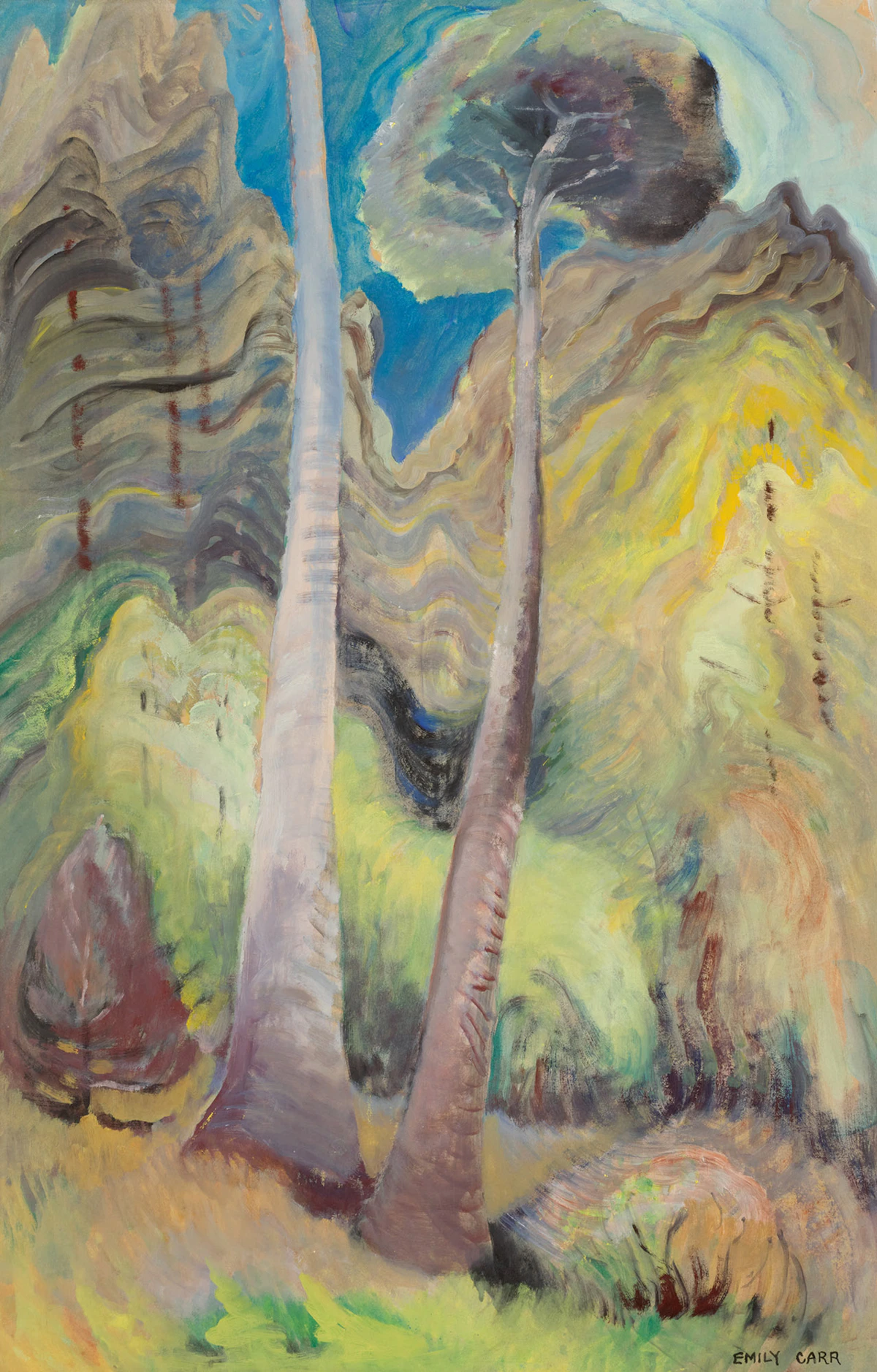
signed lower right; titled and dated 1939 on a label and inscribed "31" on the reverse
34.5 x 22 in (87.6 x 55.9 cm)
(including Buyer's Premium)
Private Collection
Walter Klinkhoff Gallery, Montreal
Masters Gallery, Calgary
Private Collection
Emily Carr: The Mature Years, Vancouver Art Gallery; travelling to Canada House, London and Centre culturel canadien, Paris, 20 June-21 September 1979, no. 40 as Trees in September
Emily Carr: The Mature Years, Vancouver, 1979, unpaginated, no. 40
Tree Boles in September represents the period of Emily Carr’s career for which she was best known. Though her career was long, productive and marked by outstanding quality, it is her silent, dark forests and tall firs that created a visual legend of the West Coast. It was also in this period of her work, towards the end of her life, that she expressed her view of nature and life as energy. Carr had become deeply religious and the movement within the picture came to represent the spiritual energy, cosmic consciousness and growth. This period is the culmination of a life spent living, working and travelling within British Columbia. A comprehensive body of work that integrates a clear, universal framework while drawing on specific regional insights. Tree Boles in September was painted during one of Carr’s many “spiritual” sketching excursions throughout British Columbia.
Carr’s style evolved considerably over the years. Her early watercolours reflected the English centric nineteenth-century manner encouraged by her training. After a year in France, her approach changed to a Post-Impressionist style with moments of fauvism. However, just when it seemed she was about to hit her stride, the artist painted little for the next fifteen years. This dormant period preceded an explosion of output which would last the rest of her life. Her new style developed rapidly and was marked by a distinctive approach and a conviction, which distinguished Carr’s work thereafter.
In the early 1930s, the artist made a significant change in her painting method by adopting the new medium of oil on paper. Carr wanted to combine the spontaneity of watercolour sketching with the intensity of oil pigments, and she found this to be possible by diluting oil paint with generous amounts of turpentine and applying the mixture to Manila paper. She was able to attain the structure of oil paint with this medium as well as the delicacy of watercolour. It also dried immediately, was easy to layer pigments, and retained its colour intensity–all providing additional convenience. It also had the added benefit of being easily portable and inexpensive. Carr was excited by this discovery.
Carr would venture into the woods with a folding drawing board and her materials to sketch around Victoria and find fresh perspectives for her studio work. What initially began as a testing ground for ideas later became integral to her production, as some of her most daring works were captured in this manner. Tree Boles in September radiates with movement and vitality. The forest is dense beyond the central trees, forming a wall of flowing waves that seem to rise upwards towards the sliver of clear sky and away from the more solid “boles” or trunks of the tree from which the painting derives its name. Rich colour blends together to form a canopy, which is punctuated with glimpses of tree trunks. The eye is drawn up along the trunks of the two trees to the diaphanous sky above.
