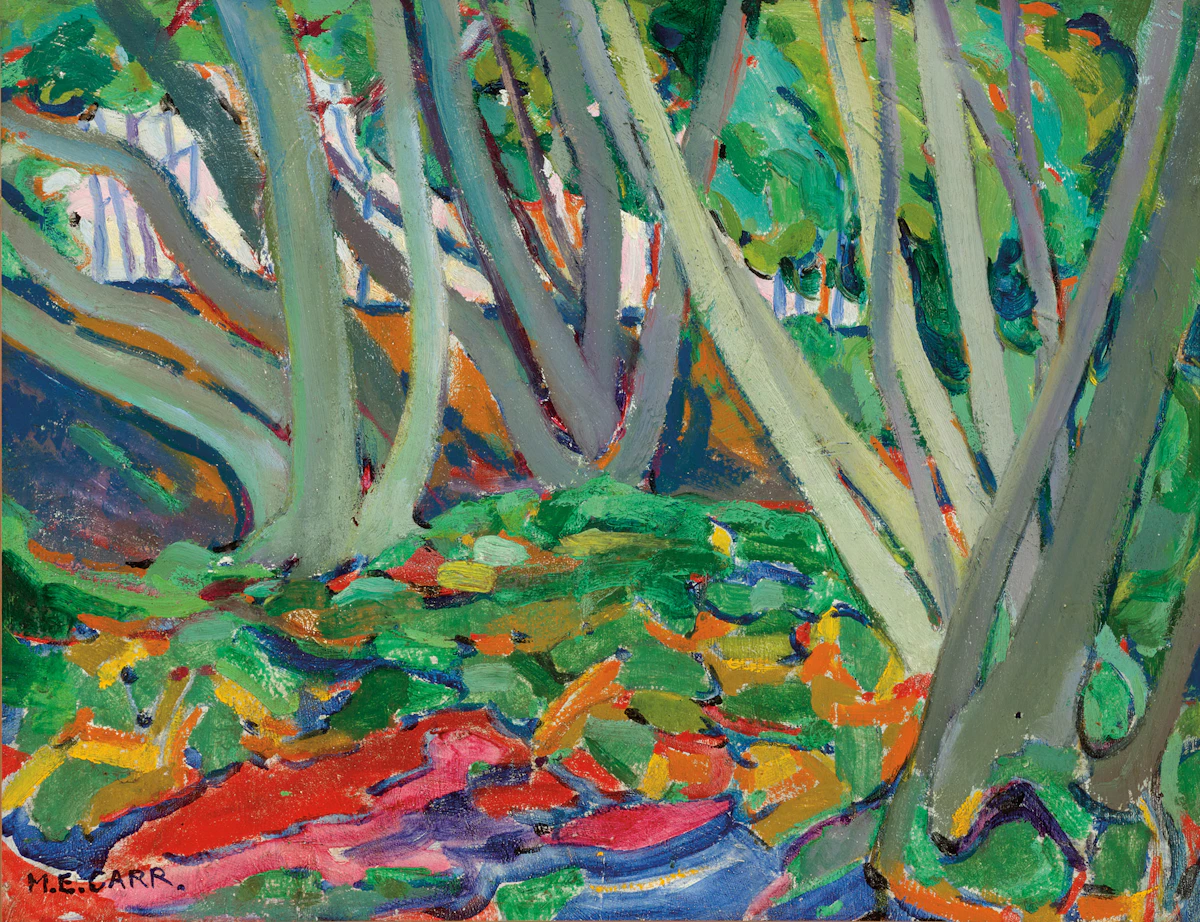
signed lower left; titled and dated 1911 on the gallery label on the reverse
14 x 18 in (35.6 x 45.7 cm)
(including Buyer's Premium)
Lawren Harris, Toronto
G. Blair Laing, Toronto
Ken Thomson, Toronto
Masters Gallery, Calgary
Private Collection
Emily Carr in France, Vancouver Art Gallery, 22 June-22 September 1991, no. 16
Ian M. Thom, Emily Carr in France, Vancouver, 1991, pages 14, 24, 27-30, no. 16, reproduced page 24 as French Landscape, 1911
Determined to broaden her knowledge of current artistic trends and further her training in drawing and painting, Emily Carr left Victoria for France in 1910 to experience the art of the European avant-garde firsthand. She was accompanied by her sister Alice, who spoke French and served as her interpreter. Ian Thom writes that Carr was startled by the artwork she encountered upon their arrival in the French capital, as “it is likely that Carr was previously only vaguely, if at all, aware of the Fauves and was completely ignorant of Cubism.” Carr had been given a letter of introduction from a woman in Victoria to an English artist residing in Paris, named Harry Gibb. She and Alice met Gibb in Montparnasse and Carr was struck by his modernist work. Though less widely recognized in current scholarship, Gibb was closely connected with the Parisian art world at the time, counting Henri Matisse, Georges Braque and Gertrude Stein as close friends. He exhibited in Paris, New York, and London between 1907 and 1913.
Gibb’s class was held in Crécy-en-Brie, a small village on the Grand Morin river, the rolling countryside surrounded by “tiny quaint villages or little huddles of buildings.” Carr delighted in the landscape and set to work before Gibb arrived. She was pleased to learn that Gibb liked her use of paint and colour sense. The realization that one could paint using colour that did not ‘match’ inspired Carr to produce an extraordinary amount of work in the next two months. Her work became increasingly linear, with a greater confidence in the use of colour, the handling of space and the application of paint. Ian Thom highlights this painting in the exhibition catalogue for Emily Carr in France, remarking that "Forest Landscape suggest[s] that Carr’s approach to landscape was strongly influenced by Gibb. Similar in scale and technique to Gibb’s work, [it] speaks a language radically different to Carr’s painting of only a year before.”
In this vibrant composition, Carr depicts a grove of trees rendered in sinuous, curving forms. Strong diagonal trunks sweep upward; beneath them, the forest floor shimmers with expressive patches of red, blue, orange, and emerald green. The undergrowth and foliage dissolve into bold planes of colour, applied with short, loaded brushstrokes that recall the Fauves and Parisian modernists. Here, Carr has replaced the muted naturalism of her earlier work with a chromatic intensity and a clear structural design. Her interest in capturing the “living movement” of nature is evident.
After three or four months of painting together, Gibb was sufficiently impressed by Carr that he suggested she submit work to the Salon d’automne. When the salon opened in September two of Carr’s paintings were exhibited. As the two artists parted ways, Gibb complimented Carr when he suggested “If you go on you should be one of the women painters of the world.” Forest Landscape is a superb example of Carr’s pivotal French period, when exposure to the radical experimentation of early twentieth-century Paris emboldened her to develop a distinctly modern language—one that would ultimately transform the visual expression of the Canadian landscape.
