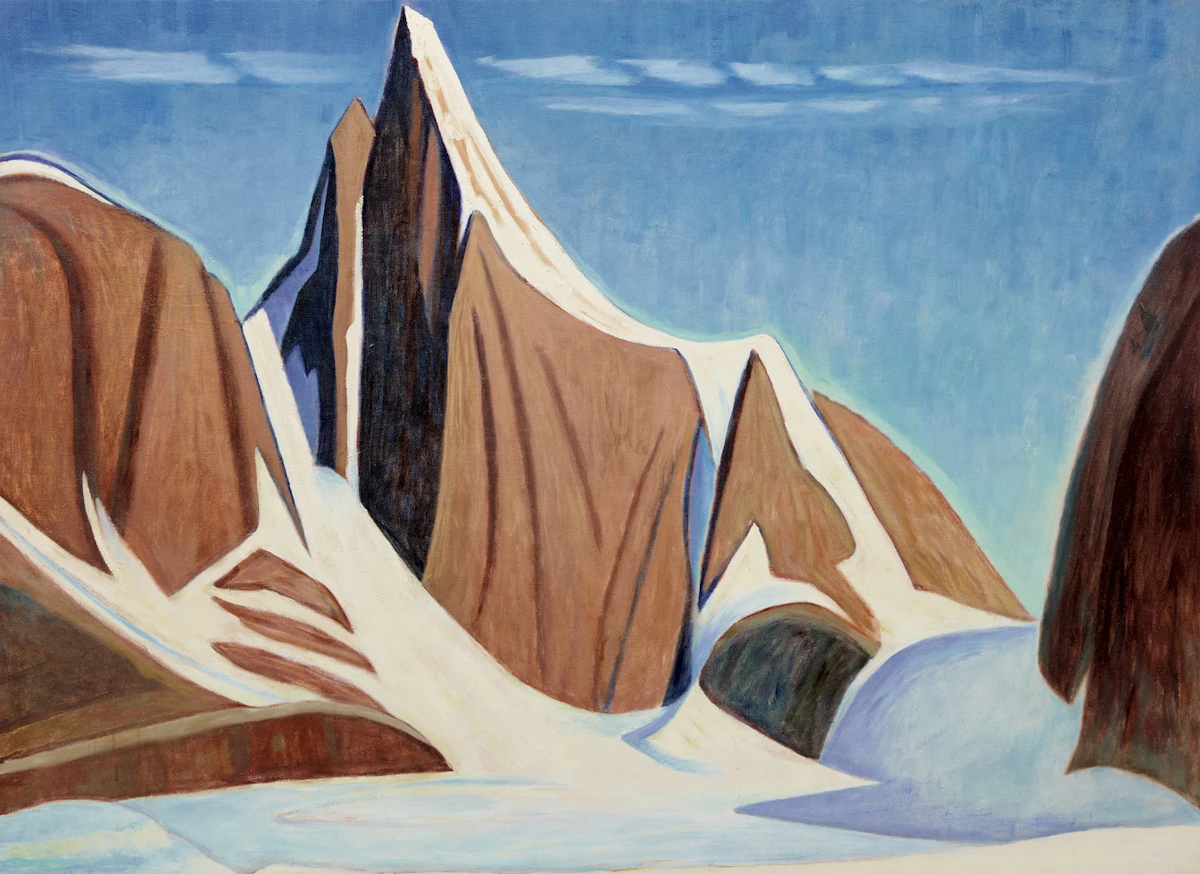
titled on the gallery label on the reverse and inscribed Lawren Harris LSH Holdings Ltd. (108) on the stretcher; an abstract composition on the reverse
40.5 x 55.25 in (102.9 x 140.3 cm)
(including Buyer's Premium)
Howard Harris Collection, Vancouver
The Art Emporium, Seattle as Rocky Mountains
Galerie Walter Klinkhoff, Montreal
Private Collection, Toronto
A.K. Prakash and Associates Inc., Toronto
Private Collection, 2016
Lawren Harris to Raymond Jonson, August 3rd 1941, as cited in James King, Inward Journey: The Life of Lawren Harris, Markham, 2012, page 284
By the time Lawren Harris returned to Canada after living in New Mexico, he had come to “understand his landscapes... and the abstract paintings, and with them his ongoing theoretical speculation about aesthetic and spiritual matters, as one continuous project.” As part of this ongoing project, he began using the subjects of the mountains he had painted prior to 1929 to express new ideas. Through their shapes, he sought to depict a visual synthesis of the earth’s physical structure– in this case the glacial planes and rock faces, and the earth’s–(in fact the universe’s)–spiritual voice. With intensified interest, Harris revisited specific mountain scenes in his Vancouver studio. He painted an almost quivering, vibratingly alive version of Maligne Lake in the 1950s. It is based on extant paintings and sketches, memories of three visits there, a series of photographs he took, and layer upon layer of deep consideration and reflective thought. Lake Oesa, the location shown in Rocky Mountains is another such place. A sculptural and serene return to a familiar location, it is enough like the place itself to be located on a map–we see the soaring peak of Mount Ringrose at Lake O’Hara, in Yoho National Park–but idealized, reshaped, and re- refined through Harris’s increasingly sophisticated visual vocabulary.
There are at least four versions of the scene we see in Rocky Mountains. Beginning with Lake Oesa-Rocky Mountains, circa 1926-1928, Mountain Sketch XXXII (undated and possibly depicting Victoria Lake), Lake Oesa, and Rocky Mountains, we can follow Harris through the refinement process, charting the evolution of each work, as if we are making a reduction sauce, where all the required ingredients are first combined, but then, as we steam and stir, anything without the desired flavour is removed. Of the four versions, Rocky Mountains alone has a tallness to it, an expanding feeling of upward motion, a distance and aloofness that speak to something more, something distinctly mystical, like the quivering seen in Maligne Lake (National Gallery of Canada), it is understood but yet unknowable. It seems an experience of the place, rather than a rendition of the place.
In Higher States, Lawren Harris and his American Contemporaries, Roald Nasgaard identifies four factors that paved Harris’s road to abstraction. Harris’s “intense spirituality,” in particular his in-depth study of theosophy and transcendentalism. Next, Harris’s longstanding (and, by the 1950s still unchanged) desire to foster, create, and champion a distinctly national, and uniquely Canadian art. Harris campaigned for this home-grown approach prior to, and then quite fiercely during the heyday of, the Group of Seven. He never abandoned it. Third, that the goal of fostering home-grown Canadian art was inseparable from Harris’s conspicuous rejection of any borrowed European artistic mores. The art must be unique. The fourth factor was Harris’s overwhelming enthusiasm for the modern. Moving forward was an absolute necessity. But that did not mean one should never look back. Harris found source material for his abstract painting everywhere, and a direct, rich, and deeply meaningful source was his own mountain work. By the time Rocky Mountains was painted, his plein air period was more than twenty years behind him, yet the soaring forms, with their endlessly morphing palette, and already austere serenity, were an at-hand launchpad to the next. Harris would choose certain works from his studio holdings, sometimes painting directly over the original painting, keeping certain compositional elements to guide the new. Works such as Rocky Mountains, and the related works noted above, provide a fantastic opportunity to chart the painter’s progress without having to peel back the paint. Each work creates a bridge to the next, and in sufficient number as we have here, this bridge is fully supported and strong, enough so that we can walk back and forth with ease, knowing where we are, from whence we have come, and where we now might go. Echoes of topography, hinted at in Rocky Mountains, are fully expressed in the earlier works, while the esoteric geometry of later Harris masterworks, Untitled, L.S.H. 152, 1950, for example, can be seen in their infancy. In well-known abstracts such as Mountain Experience, painted in 1936, and Abstraction No. 3, from about the same time, we note forms that can be traced directly back to the geography, topography, shapes, and hints of shapes that are based on the terra firma of the physical world of the earlier works. The triangle becomes a sweeping, swirling series of triangular lines, hollowed out and floating. The glacier seen in Rocky Mountains, as well as the shadow on the glacier, even the soaring peak of Ringrose herself are reworked into pure energy. Only the stutter of clouds, breaking on either side of the summit of Ringrose, and the very near ground of the ice sheet remind us of Harris’s attachment to pictorial depth, despite his exploration of the flat picture plane of the modern. Thus, Rocky Mountains is a picture of a foundational mountain experience.
The location Harris has depicted, and the small hanging valleys directly above and below, are to this day highly sought after plein air painting locations. All of the members of the Group of Seven who worked at O’Hara visited this location, and Harris would take Bess there in 1941, spending six weeks at Lake O’Hara Lodge with fellow Vancouver painter Jock Macdonald and his wife Barbara. Harris’s steadfast conviction to always moving forward is apparent in a letter written that summer: “We did very little work but a great deal of climbing and even more clambering around, imbibing the elevation of the spirit of the mountains afford in the hope that it will convert itself into plastic ideas for painting... There is an austere starkness about them than braces me to no end. But there is an almost complete divorce between the naturalistic–representation–and non-objective painting. The one wont’ go into t’other, yet on seeing marvelous mountains and having exciting experiences among and on them I am convinced that there are equivalents in non-objective painting which are more expressive, moving and elevating than any possible representation of them in paint.”
We extend our thanks to Lisa Christensen, Canadian art academic and the author of three award-winning books on Canadian art, for contributing the preceding essay. We extend our thanks to Alec Blair, Director/Lead Researcher of the Lawren S. Harris Inventory Project, for assisting with the research on this artwork.
