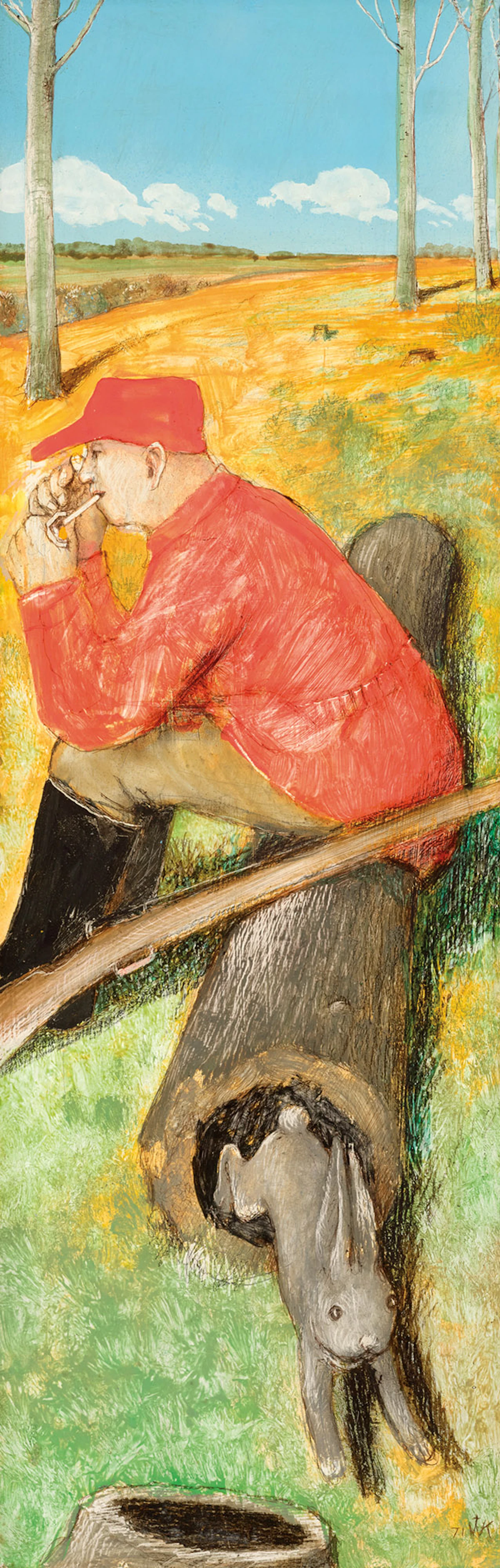
signed with initials and dated 1971 lower right; titled "Untitled (Missed Opportunity)" on a gallery label on the reverse
23.5 x 7.75 in (59.7 x 19.7 cm)
(including Buyer's Premium)
Wynick/Tuck Gallery, Toronto
Private Collection, Toronto
William Kurelek is widely celebrated for his vivid depictions of prairie life and his ability to fuse memory, religion, and social critique into deceptively simple visual narratives. Painted in 1971, Missed Opportunity exemplifies Kurelek’s distinctive blend of narrative clarity and rural subject matter, while simultaneously engaging in an ironic commentary on human folly.
The vertical composition is striking for its intimacy and theatrical framing. At the top, we see a hunter crouched on a log in a field of bright yellows and greens under a vast prairie sky. His posture is contemplative but distracted: he is absorbed in lighting a cigarette, the small flame pulling the viewer’s gaze toward his face. Beneath him, in a hollow tree trunk, emerges a rabbit—the very prey he has set out to hunt. The rabbit is both comical and poignant, dangling halfway out of its hiding place, oblivious to the hunter’s inattention. Kurelek wryly underscores the irony of the scene: the hunter, engrossed in a trivial pleasure, fails to notice the chance he has been waiting for.
This seemingly humorous vignette masks a deeper meditation on distraction, morality, and human frailty. Kurelek, a devout Roman Catholic whose conversion shaped much of his mature work, often infused his paintings with moral lessons. Here, the hunter’s lapse may stand as an allegory for spiritual inattentiveness: how easily one misses grace, meaning, or truth when absorbed in secular habits. What might look like a simple hunting anecdote is, in Kurelek’s vision, an emblem of misplaced focus.
Kurelek frequently employed humour, irony, and visual storytelling as tools to make his moral reflections more accessible. Missed Opportunity belongs to a larger body of work where the artist stages scenes exposing humans to vanity, folly, or cruelty. The humour here is gentle rather than grotesque: the hunter is not condemned, but made a figure of human error, caught in a moment of fallible distraction.
Placed within the broader context of Kurelek’s oeuvre, Missed Opportunity reveals the tension between nostalgia and admonition that defines much of his art. He was both an affectionate chronicler of rural labour and a stern moralist, attentive to the spiritual dangers of human frailty. This painting encapsulates his vision: humble subject matter, deceptively simple execution, yet charged with narrative irony and moral resonance.
