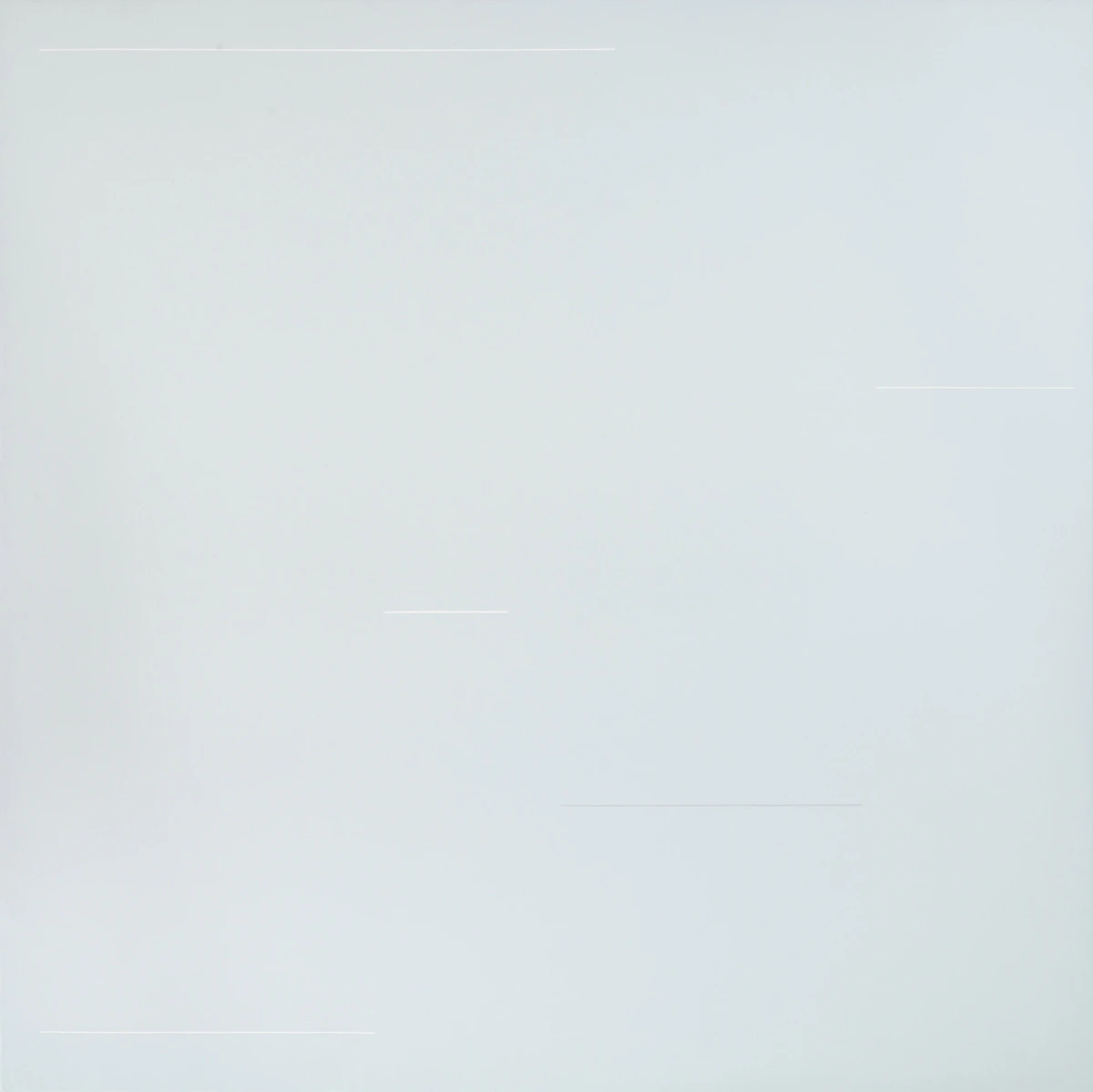
signed, titled and dated 1968 on the reverse; unframed
80 x 80 in (203.2 x 203.2 cm)
(including Buyer's Premium)
Collection of the Artist
Winchester Galleries, British Columbia, 2014
Private Collection
John R. Porter and Michael Martin, Yves Gaucher: Récurrences, Quebec City, 1999, reproduced page 45, figure 45 as THG-III-nd 68
Yves Gaucher extended and refined the pioneering investigations of abstraction initiated in Quebec in the 1940s by Paul-Émile Borduas, Jean Paul Riopelle, and many others of the Automatiste school. He responded more immediately to the less gestural and Surrealist modalities of Les Plasticiens and to fellow travellers in the “Post-Plasticiens” generation of which he was part, including peers Charles Gagnon, Guido Molinari, and Claude Tousignant. He was also drawn to the less gestural types of American AbEx, particularly the work of Mark Rothko and Barnett Newman.
As a printmaker and painter, Gaucher typically worked in series, focusing his attention for a relatively brief period on specific concerns with colour or music, for example. TH/G-III ON-D/68 is an example of his so-called grey-on-grey paintings of 1967 to 1969. The unusual titles of this and related works refer to the type of paint employed and the date. Neither the individual titles nor the appellation “grey-on-grey” for the group of works do justice to the remarkable subtlety and power of these paintings. For a start, the greys in TH/G-III ON-D/68 are individual and tend to the blue-grey scale.
Gaucher’s Signals/Silences series of 1966 helpfully lends the notion of a signal to these grey paintings. Thinking of the almost imperceptible lines that float on his blue-grey surfaces as indicators is one way to understand these faint yet carefully composed marks. The five lines here differ in weight, hue, and length as they inflect the grey atmosphere in which they appear. Though they are stationary as we look at the canvas, we know that the signals are capable of movement. Nor is the visual the only signal transmitted. Gaucher was famously struck by the spatial movement of sound in the compositions of Anton Webern in Paris in 1962. For the painter and many viewers, the quiet registration of these lines is akin to hearing music, a creation of sounds that move through time. Silent in themselves, the signals can be understood as sonic ciphers. We are left to wonder where these signals come from and to what they point. Do they refer us to our own perceptual apparatus, to the formal capabilities of abstract painting, or perhaps towards the ineffable?
We extend our thanks to Mark A. Cheetham for contributing the preceding essay. Mark is a professor of Art History at the University of Toronto, an independent curator, and art writer. Mark is the author of two books on abstract art: The Rhetoric of Purity: Essentialist Theory and The Advent of Abstract Painting (1991) and Abstract Art Against Autonomy: Infection, Resistance, and Cure Since the ‘60s (2006).
