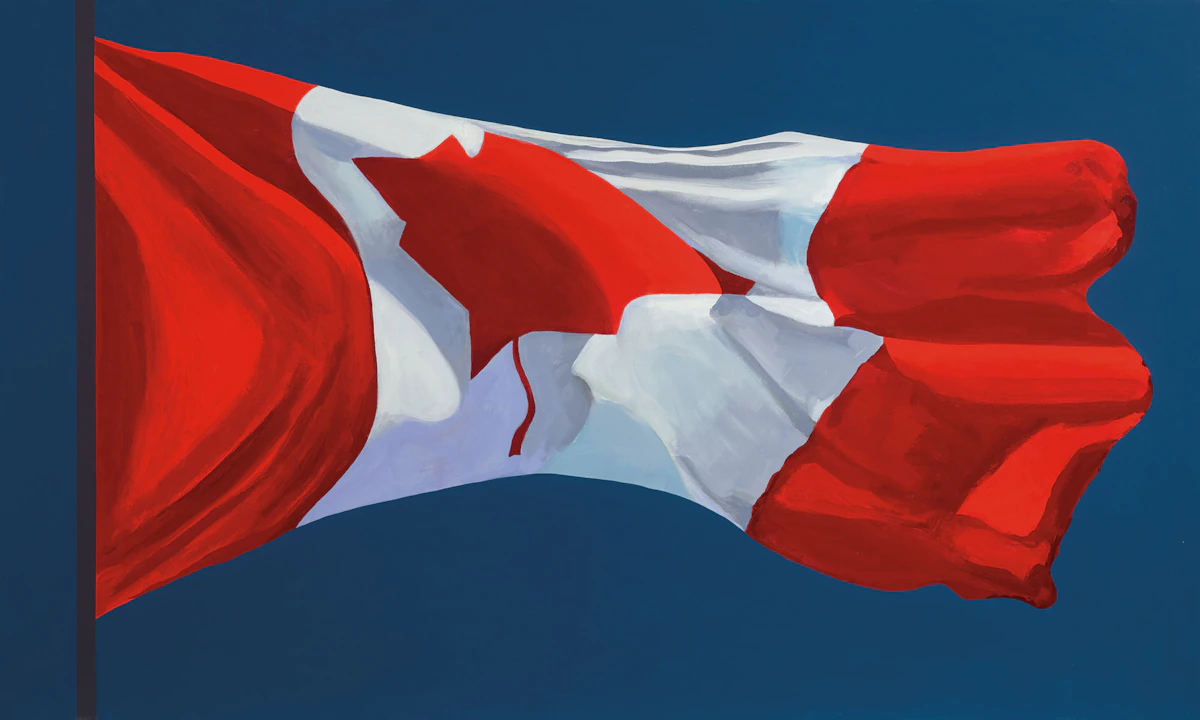
signed and dated 2006 on the reverse
36 x 60 in (91.4 x 152.4 cm)
(including Buyer's Premium)
Private Collection, Toronto
Bogomila Welsh-Ovcharov, Charles Pachter, Toronto, 1992, pages 4, 5, 139
Known for his colourful, iconic work with distinctly Canadian themes, Charles Pachter lends an irreverence to the contemporary Canadian artistic landscape. Amongst the most notable subjects in Pachter's oeuvre are his barn, Toronto streetcar and moose and queen series, but it is arguably the Canadian flag, which is the artist's best known. With impeccable timing, Pachter’s first exhibition featuring Canadian flag motifs, The Painted Flag, opened on November 7, 1981, one day after Prime Minister Pierre Trudeau announced that the Canadian constitution was being repatriated. The well-attended exhibition featured thirty large canvases in the artist’s newly renovated four-storey private commercial gallery on Queen Street in Toronto. The artist remembered his initial inspiration behind the series came to him one summer night when he “built a flag-pole out of two-by-fours nailed together, attached a small rayon flag to the top, and manoeuvred the flimsy mast into a fencepost hole. As the sun was setting, I lay down in a hammock to watch the flag undulate slowly in the breeze, rocking back and forth like a primitive mobile.” While Jasper Johns’ grid-like images of the American flag sit apart from patriotism and serve as a jumping-off point for formal abstraction, Pachter’s Canadian flags are observed and emphasize light and shadow. The images extend beyond a captured moment, and flat acrylic backgrounds, at times in improbable hues, show a proficiency comparable to Johns’.
As a childhood friend and collaborator, the renowned novelist Margaret Atwood explains, “Pachter’s conscious exploration of the visual symbolism that surrounded him began, long before the ascendancy of Andy Warhol, when as a teenager he painted the landscape from a two-dollar bill on his bedroom wall, much to the bewilderment of his mother… Since that time, in a career which has now lasted three decades, Pachter has continued vigorously to explore his several media, to diversify his imagery, and to structure and restructure his visual world. In doing so he has restructured the world around him, and has changed profoundly the way we look at our own familiar iconography, even our own banalities… His is a sophisticated art which draws upon many techniques and evokes many echoes, yet it remains strongly individual, and firmly rooted in a ground which Pachter has both excavated and cultivated himself.”
