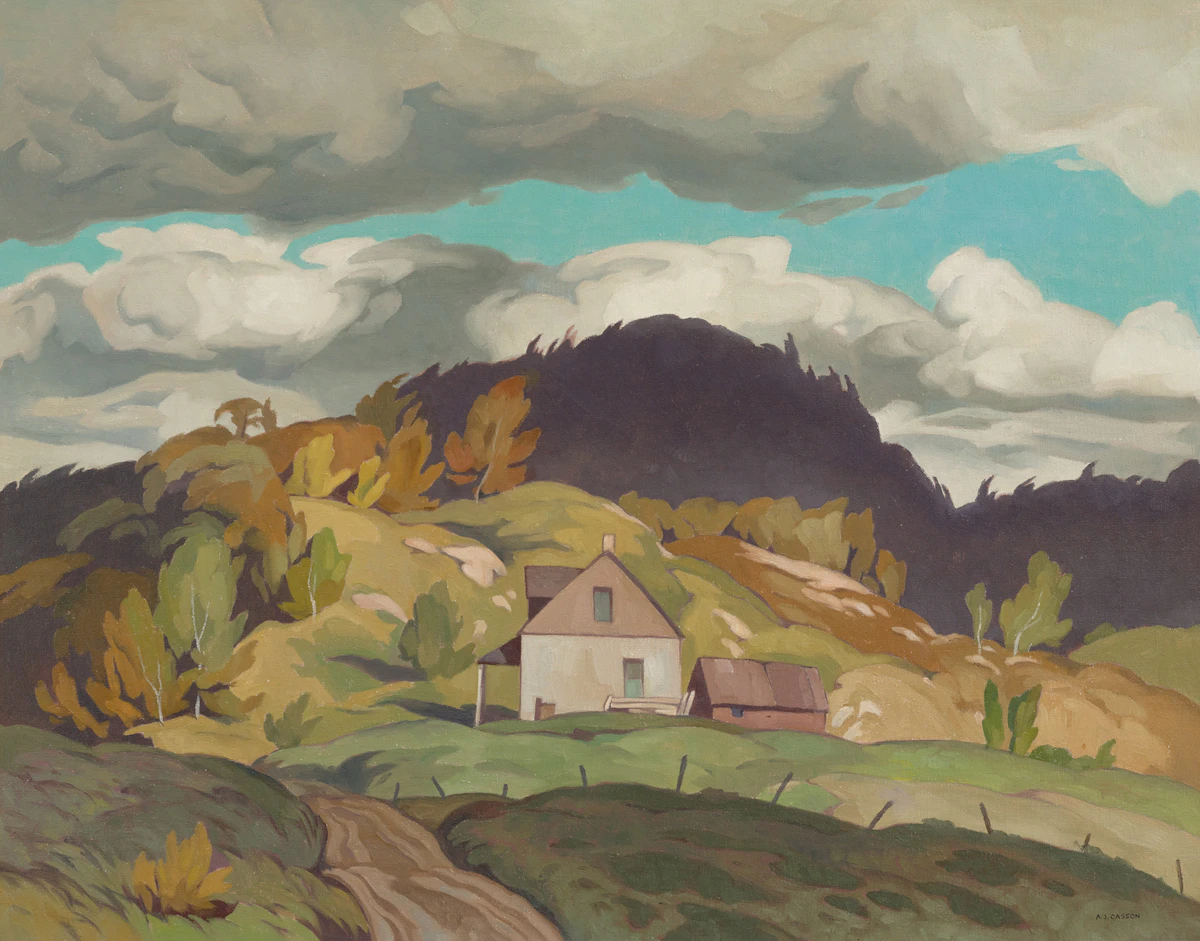
signed lower right; titled and dated 1968 on two gallery labels on the reverse; signed, titled and dated on a label on the stretcher
30 x 38 in (76.2 x 96.5 cm)
(including Buyer's Premium)
Roberts Gallery, Toronto
Manuge Galleries, Halifax
Private Collection, Halifax
Margaret Gray, Margaret Rand and Lois Steen, "A.J. Casson (Canadian Artists 1)", Agincourt, 1976, pages 49-50
Hubert De Santana, “A Painter’s Life: A.J. Casson looks back on 60 years at the easel,” "Canadian Art" (Spring 1985), pages 64-69
In a Saturday Night Magazine interview with A.J. Casson in 1986, six years before his death, Casson reflects back on his time with the Group of Seven. At the time, he was the only remaining member of the Group. Describing his journeys around the province of Ontario, Casson writes that “I loved to paint villages. I must have covered nearly every village in Ontario, and I’m glad, because they’re pretty much gone now. They’ve all changed, fallen down, or been destroyed”. Quebec Farm was painted during one of Casson’s rarer ventures into another province. Casson painted extensively in Quebec from 1966 to 1975, staying with friends in the region of Grenville, situated on the Ontario-Quebec border along the Ottawa River.
Also during this period was the beginning of a fruitful relationship with Roberts Gallery, where Casson held six solo exhibitions between 1959 and 1979. His work was in high demand, and in 1967, he was awarded the Silver Centennial Medal and featured in the Three Hundred Years of Canadian Art exhibition at the National Gallery of Canada.
When Casson began to paint in oils, he was already under the influence of the Group of Seven, having been brought into the group in 1926, by Franklin Carmichael. Artists like A.Y. Jackson, J.E.H. MacDonald and Franklin Carmichael were his teachers and companions in his formative years. Casson worked for many years in design and lithography, retiring as Art Director of Sampson-Matthews in 1958. His dual career fostered a disciplined approach to composition and colour, evident in the precision and balance of his paintings.
In Quebec Farm, the muted palette of greens, blues and browns brings forth the warmth of a summer day. A farmhouse sits nestled in the rolling hills, surrounded and protected by the trees and the mountain behind. A pathway leads to the house, inviting the viewer into the idyllic scene. The white clouds cast shadows on the still farm below.
A.J. Casson’s landscapes of the mid-1940s began to incorporate a more dramatic lighting that is broken into planes across the surface of the composition. Quebec Farm illustrates this shift, visible in the illuminated middleground surrounding the farmhouse and barn, while the road in the foreground and mountain in the distance remain in shadow.
Authors Margaret Gray, Margaret Rand and Lois Steen write that it was Casson’s colour sense that was his greatest strength as a painter. “His colours induce the magic in his paintings. He uses a simple scheme, a restricted palette”. His paintings reveal a sensitivity to light and weather that imbues even the most structured compositions with atmosphere and life. In a 1985 interview, the artist recalls this strategy as being present since his early days with the Group of Seven, when “exhibitions were flaming with colour.” He elaborated by stating: “Well, I’ve always thought that if you want to stand out, don’t follow the herd. I was inclined to go into subtle greys, to get away from the gaudy. I painted a few gaudy ones, but they never appealed to me.”
