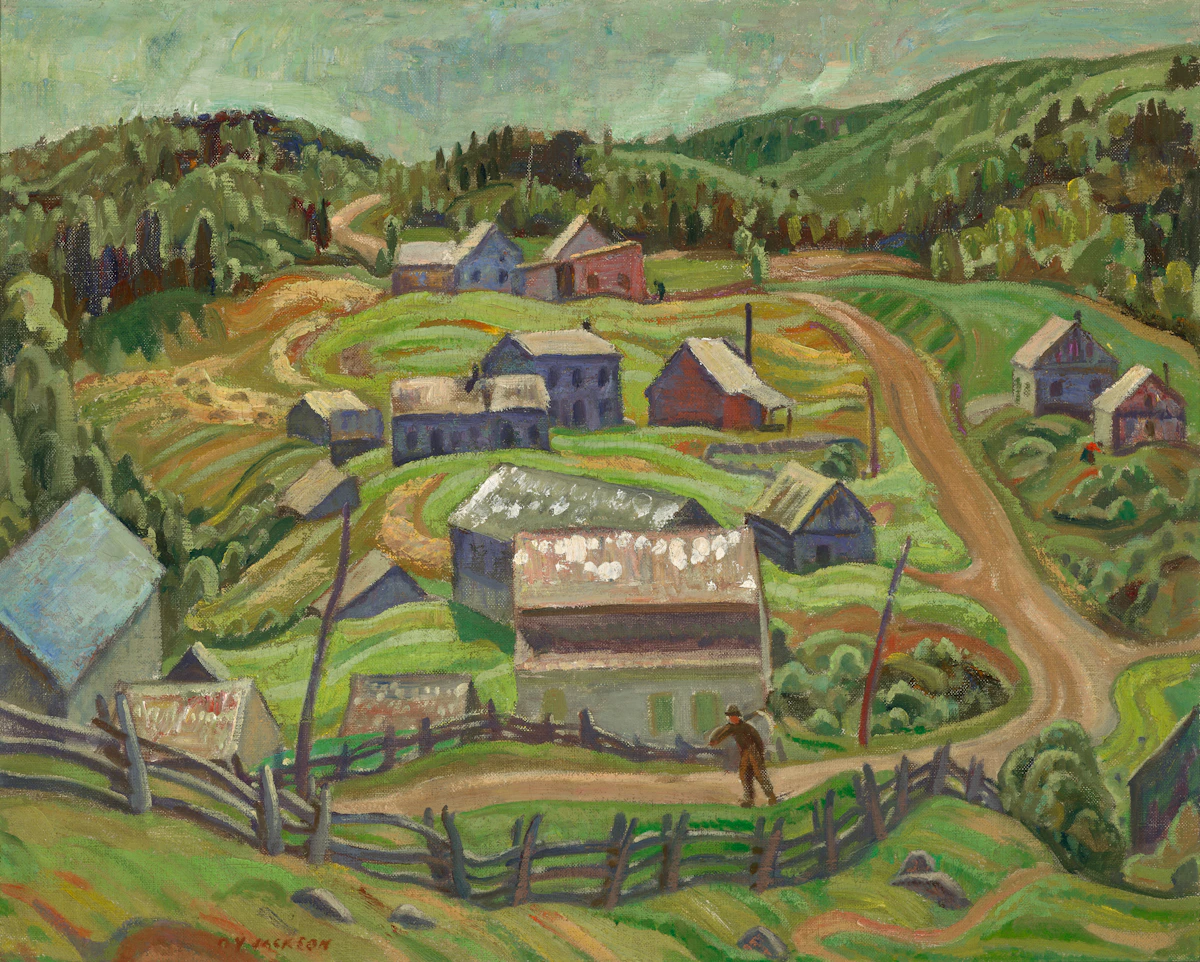
signed lower left; titled on a gallery label on the reverse
21 × 26 in (53.3 × 66.0 cm)
(including Buyer's Premium)
G. Blair Laing Galleries, Toronto
Henry Eugene Sellers, Winnipeg (1886-1970)
By descent to Edward A. Sellers (1916-1985), Winnipeg/Toronto
By descent to the present Private Collection, Kingston/Ottawa
This vibrant landscape by A. Y. Jackson depicts a rural Quebec village nestled within the rolling hills of the Laurentians. The composition is structured through a series of undulating lines, with winding roads, split-rail fences, and clustered rooftops guiding the eye across the terrain. Jackson simplifies forms into bold, rhythmic shapes, while his palette of lively warm greens, ochres, and blues conveys the vitality of the land and the shifting light of the season. The scattered buildings suggest a quiet, lived-in rural community, while the lone figure in the foreground adds a subtle human presence within the expansive landscape. The overall effect is one of movement and harmony, with soft and rounded forms, and a rhythm that is known as Jackson’s trademark.
Born in Montreal, A.Y. Jackson studied art in Chicago and France, but returned to Canada in 1910 when his funds were low. His early paintings were strongly influenced by the Impressionists, followed by the work of Canadian artists Maurice Cullen and J.W. Morrice who led him further in the discoveries of snow and other elements of Canadian subject matter. Upon returning to Canada, Jackson took up residence briefly in Montreal and made many sketching trips to the surrounding countryside before moving to Toronto.
In February and March of 1921 he began painting in the Lower Saint Lawrence region and would return every year, either alone or with other artists. The rural landscapes of Quebec came to be known as A.Y. Jackson’s hallmark subject matter. The artist’s treatment of the Quebec landscape differed significantly from his depictions of northern Ontario. While his compositions of Algoma and Lake Superior emphasized the absence of man, the undulating hills of Quebec were often punctuated with signs of human influence. These rural communities appealed to Jackson, as they preserved a traditional way of life amidst a rapidly modernizing and growing society. This oil painting demonstrates Jackson’s skill and dedication in rendering the charming Quebec landscape. Throughout his long life, the artist depicted an incredibly wide range of landscapes in the province, from Montreal and the Eastern Townships early in his career to the Laurentians and along the St. Lawrence River, to the Gatineau region in his later years.
