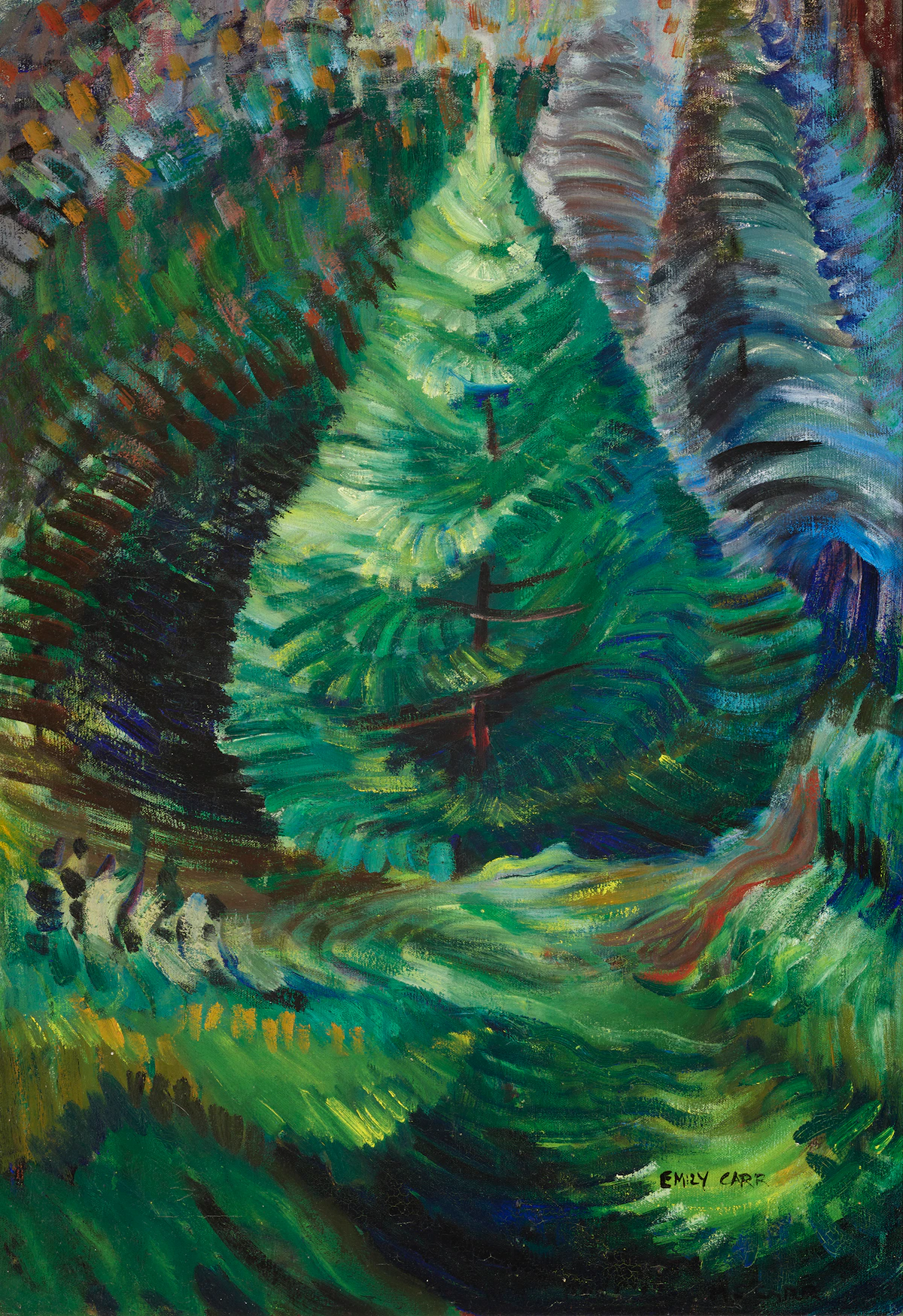
signed lower right; signed, titled and inscribed "M.E. Carr 316 Beckley St., Victoria" and "90 over [72]" on the reverse
28 × 19.25 in (71.1 × 48.9 cm)
(including Buyer's Premium)
Estate of the Artist
Dominion Gallery, Montreal, October 1945 (Estate list no. 90S, Dominion Gallery inventory no. 892E)
The Fine Art Galleries, T. Eaton Co., Toronto, October 1945 (Eaton inventory no. 2797)
Dominion Gallery, Montreal, 1946
Henry Eugene Sellers, Winnipeg (1886-1970)
By descent to Edward A. Sellers (1916-1985), Winnipeg/Toronto
By descent to the present Private Collection, Kingston/Ottawa
Emily Carr, Art Gallery of Toronto, 20 March-2 April 1937
Emily Carr, Picture Loan Society, Toronto, 1937
Emily Carr, The Fine Art Galleries, T. Eaton Co. College Street, Toronto, November 1945
Charles Band Fonds (R10249), Files 1-13 to 1-22, Library and Archives of the National Gallery of Canada, Ottawa
Correspondence with Artists, 1.12 Carr and 7.1-Carr, Library and Archives of the National Gallery of Canada, Ottawa
Dominion Gallery Fonds, Outgoing Correspondence 1942-1948
Lawren Harris and T. Eaton Co., and Sales Book 2, Library and Archives of the National Gallery of Canada, Ottawa
E.P. Taylor Research Library and Archives, Douglas Duncan Fonds (CA OTAG SC095) File 1-2, Art Gallery of Ontario, Toronto
Phyllis Inglis Collection (MS-218, reel A1225, Journal 10 (August 1935-February 1936), Royal BC Museum, Victoria
“Vibrant West Coast Life Caught in Carr Canvases,” Toronto Telegram (25 March 1937)
Graham McInnes, "World of Art," Saturday Night (3 April 1937), page 8
Emily Carr, Hundreds & Thousands: The Journals of Emily Carr, Toronto/Vancouver, 1966, pages 185-188, 192-193, 214, 273-279, 283-289
Edythe Hembroff-Schleicher, Emily Carr: The Untold Story, Saanichton, 1978, pages 131-133, 135-136, 262-263, 309-310
Doris Shadbolt, Emily Carr, Vancouver/Toronto, 1990, pages 167-214
In June 1935 Emily Carr painted at Albert Head on the Metchosin Road, about eighteen miles west of Victoria. Ensconced in her van, the summer’s sketching was very productive as she painted in oil, thinned with gasoline on cheap manila paper, a medium she had adopted in 1932. The technique allowed for the freedom of painting in watercolour with the density of oil paint. In addition, it was economical, an important consideration for the impecunious artist.
At Albert Head Carr returned to subjects she had painted in 1931 and 1932, second-growth trees amidst dense undergrowth. In Forest Interior (Belkin Gallery, University of British Columbia), dated 1932, brushstrokes are blended to create the moulded forms that enfold the young tree. However, in 1935 movement became Carr’s prime concern.
On 12 June she wrote in her journal, “… a picture equals a movement in space…. The idea must run through the whole.” Carr returned to Albert Head for a brief visit in September. Plagued by rain, she nonetheless found shelter in the woods to try and elude the wind. “Sketching in the big woods is wonderful,” she wrote. “You go, find a space wide enough to sit in and clear enough so that the undergrowth is not drowning you…Everything is green. Everything is waiting and still. Slowly things begin to move, to slip into their places. Groups and masses and lines tie themselves together. …Air moves between each leaf. Sunlight plays and dances. Nothing is still now. Life is sweeping through the spaces. Everything is alive.” As Doris Shadbolt has observed, in these new paintings “the brush stroke [became] the agent of the dissolution [of form] and the generator of movement within the new animated form,” as evident in Heart of the Forest (sold by Joyner, 26 November 1985) painted that summer.
If Carr increasingly saw her oil on paper sketches as paintings in themselves, they were also the kernels for reinterpretation in future canvases. “I like to find definitely what my summer’s work was about before trying to ‘canvas’,” she wrote to Edythe Brand, “You are generally, I find, going for some specific thing but if you leave it in the air it stays there until they [the sketches] are pulled together and mounted so that you can meditate on them.”
During the winter Carr worked at her “jungle” sketches. “An organized turmoil of growth, that’s what those thick undergrowth woods are… There is nothing to compare with the push of life.” Heart of the Forest formed the basis for Carr’s canvas Alive (Private Collection). The flowing brush of the oil on paper was translated into short, parallel strokes, similar to her treatment of the trees in A Rushing Sea of Undergrowth (Vancouver Art Gallery 42.3.17) and Reforestation (McMichael Canadian Art Collection 1966.16.17) painted that same year. The surging forest floor in the foreground sets off the central motif of the young tree whose inner branches open up to energize the surrounding growth. The brown tonalities of Heart of the Forest became glowing greens and blues. The rapid brushwork of the central motifs breaks down into dabs of variegated colours upper left contrasting with the conical spirals of the trees upper right.
The sketches from the summer of 1935 were shown at the Women’s Art Association in Toronto in early December where they were praised by Graham McInnes in the pages of Saturday Night on 7 December. “[Emily Carr] paints quickly and with a fierceness and passion that are completely convincing. Her technique is astonishing. Viewed closely, the sheer audacity of her rapid brushstrokes compels admiration, while each picture, regarded as a whole, has in it the concentrated essence of the impact of a deeply sensitive and fervent nature on a scene for which she feels with an intensity that only prolonged study and profound conviction can bring. … [Carr is] an artist who is, in her own way, as possessed with the creative urge as that powerful and tragic figure of the last century whose name was Vincent van Gogh.”
It was from this exhibition that the Toronto collector Charles Band purchased Carr’s British Columbia Landscape (now National Gallery of Canada (16555), Gift from the Douglas M. Duncan Collection, 1970) that he loaned to the Canadian Group of Painters exhibition in January 1936. On 8 December 1936 Carr wrote Band, “Glad you are enjoying the sketch you got from the exhibition. Feel I learned a lot from those paper sketches which I am now trying to take into my canvases. There is such scope for freedom and they are so easily carried about.”
Carr was writing in response to Band’s request that she send some paintings east for his consideration, Band having bought Carr’s Indian Church (now Art Gallery of Ontario) from Lawren Harris the previous month. Carr sent a selection of paintings but on 10 January 1937 she suffered a heart attack.
The British art critic Eric Newton was in Vancouver lecturing for the National Gallery and the Gallery’s Director, Eric Brown, knowing that Carr was financially strapped, asked Newton to visit the artist to select paintings for possible purchase. Among the works Newton selected was Wind, described by Carr’s friend W.A. Newcombe as “Forest movement 1936 – (canvas on an old picture frame) – no name, not signed.” Carr subsequently titled it Wind and signed it in the hospital before it was shipped to Ottawa. The address on the back of the canvas is the house she moved to in the spring of 1936.
Wind was not bought by the National Gallery but was sent with the other unpurchased paintings to Toronto at the request of Charles Band. These and the other paintings Carr had previously sent to Toronto were included in a solo exhibition at the Art Gallery of Toronto from 20 March to 2 April 1937. The exhibition resulted in a flurry of purchases by Band, J.S. McLean, Eleanor Lyle and the Toronto gallery.
Carr was frequently frustrated by her correspondents’ failure to keep her informed about the whereabouts of paintings she had sent east. The unsold paintings shipped to the Women’s Art Association, to Charles Band and to the National Gallery for exhibitions and purchase consideration, were now handed over to the Picture Loan Society, an artist’s cooperative currently managed by Douglas Duncan. An exhibition of Carr’s paintings was held that year and among the works shown was Wind which was kept by the Society for rental or possible sale by instalment. Antagonistic correspondence was kept up until May 1939 when Carr wrote to Duncan, “I do not care about the principle of instalment purchase, in pictures or anything else. I think it causes people to hate a thing by the time it is fully theirs. I was brought up to save up & then buy. Nor do I care about the borrowing plan. It is very hard on pictures.” In the interim Wind was returned to the artist.
Wind remained unsold when Carr died in March 1945. In June 1945 Carr’s co-executors, Lawren Harris and Ira Dilworth, agreed to consign all remaining paintings to the Dominion Gallery in Montreal. No. 90 in the list of consigned paintings was Wind which was sold to Richard Van Valkenburg of The Fine Art Galleries at the College Street store of the T. Eaton Company in Toronto and exhibited there in November. Wind was then returned to the Dominion Gallery and purchased by a private collector. The painting has been a cherished work in the family's collection for decades.
We extend our thanks to Charles Hill, Canadian art historian, former Curator of Canadian Art at the National Gallery of Canada and author of The Group of Seven: Art for a Nation, for contributing the preceding essay.
