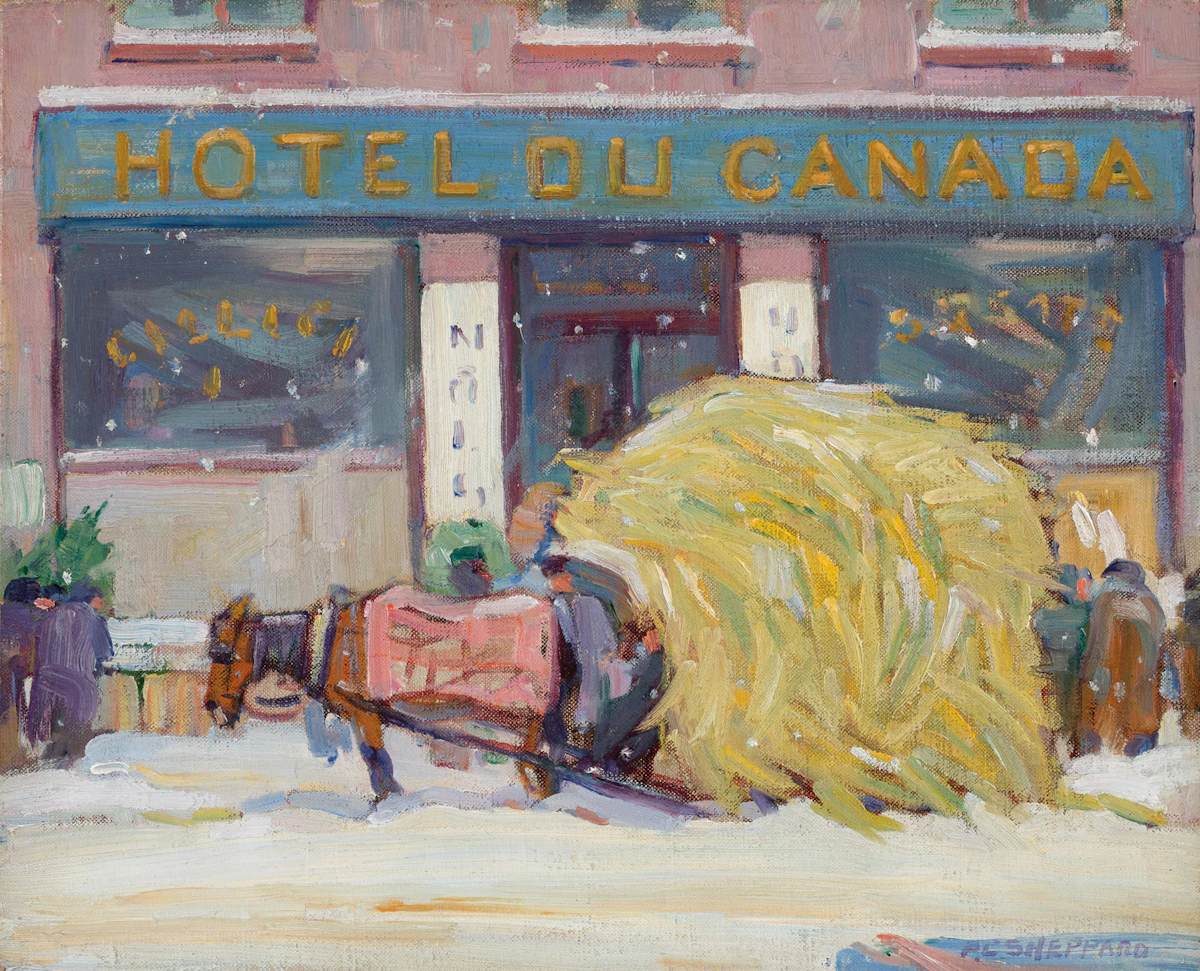
signed lower right; inscribed "Sheppard OSA SP/31" on the reverse of the canvas and estate stamp (no. LG330) on the reverse
13 x 16 in (33.0 x 40.6 cm)
(including Buyer's Premium)
Estate of the Artist
Canadian Fine Arts, Toronto
Private Collection, Ontario
Heffel, auction, Toronto, 26 April 2018, lot 231
Private Collection
Little Pictures, Ontario Society of Artists, Art Gallery of Toronto, November 1931 as Winter (Bonsecours Market)
Tom Smart, Peter Clapham Sheppard: His Life and Work, Toronto, 2018, reproduced page 206
A Toronto native, Peter Clapham Sheppard was a chronicler of the urban environment, elevating everyday scenes to subjects of beauty and significance. He witnessed the rapid construction and urbanization of Canadian and American cities in the early twentieth century, which fuelled much of his artistic production. Drawn to scenes alive with human activity, Sheppard frequently depicted crowds in city streets, markets, fairs, circuses, and harbours. His work aligned closely with that of the American artists known as The Eight and, later, the Ashcan School, who portrayed the bustling streets of New York with expressive colour and an anti-academic spirit. Sheppard embodies this approach in many of his urban compositions, including views of Toronto, New York, and, in this instance, Montreal.
Using strong brushwork and bold colours, Sheppard captures the hustle and bustle of the Montreal market. Mist curls upward from the horse’s mouth as it stands in the cold in front of a heavy load of hay. The condensation on the windows of the Hôtel du Canada gives partial glimpses of the activity within and snow gently falls as the subjects go about their routines.
Constructed in 1847, the Bonsecours Market served as the primary public market for the Montreal area for over a century. This Neoclassical structure became a vibrant hub, attracting a diverse array of vendors and shoppers from both the city and beyond. Its lively atmosphere and rich human presence made it an ideal subject for P.C. Sheppard, who had a particular fascination with scenes depicting crowds in urban environments, including markets, county fairs, circuses, and harbours. At the beginning of the 20th century, the inn known as the Hôtel du Canada occupied most of the building depicted in Hôtel du Canada, Winter, Marché Bonsecours, which was located at 339-349, rue Saint-Paul Est. Originally constructed by the soap and candle manufacturer, Andrew William Hood, an inn came to occupy the upper floors starting in 1862, before taking over much of the building from 1903 to 1938. The hotel remained established there for several decades and was later renamed Auberge du Canada in 1942.
