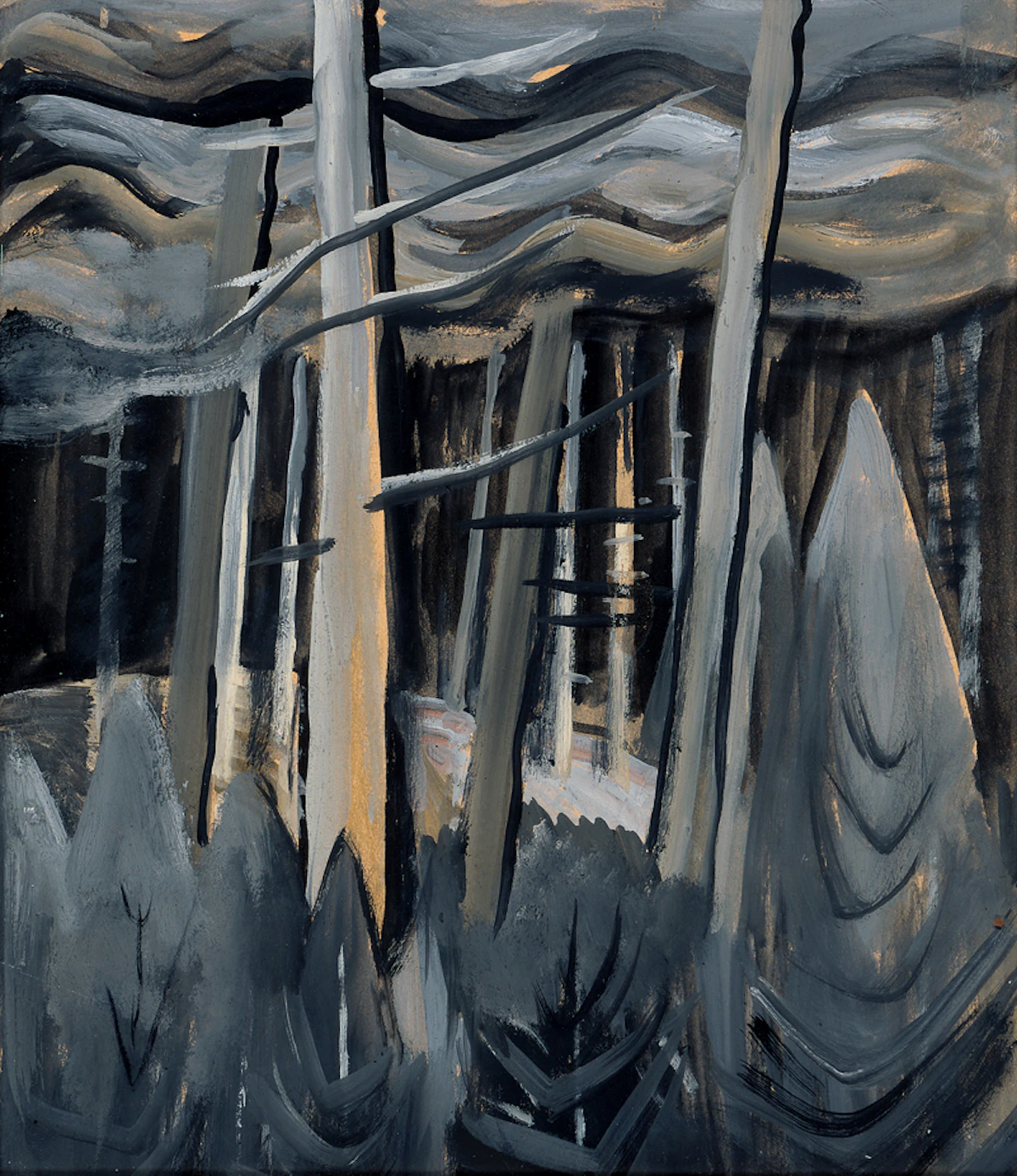
titled on gallery labels on the reverse
13.5 × 11.75 in (34.3 × 29.8 cm)
(including Buyer's Premium)
Roberts Gallery, Toronto
Warwick Gallery, Vancouver
Private Collection, Calgary
Masters Gallery, Calgary
Private Collection, Edmonton
Emily Carr Retrospective, Masters Gallery, Calgary, 13-20 March 2013
This striking monochromatic work by Emily Carr exemplifies the artist’s ability to distill the British Columbia forest into an orchestration of form, rhythm, and tone. Tree trunks rise through the picture plane, set against a dense, shadowed interior that recedes into near abstraction. Loose, sweeping strokes create a sense of movement, like wind through the landscape.
In the early 1930s, Carr made a significant change in her sketching method by adopting the new medium of oil on paper. Carr sought to combine the spontaneity of watercolour sketching with the intensity of oil pigments, and she found this to be possible by diluting oil paint with generous amounts of turpentine and applying the mixture to Manila paper. She was able to attain the structure of oil paint with this medium as well as the delicacy of watercolour. It also dried immediately, was easy to layer pigments, and retained its colour intensity—all providing additional convenience.
Works such as this reflect Carr’s interest in East Asian aesthetics. Carr was interested in Japanese woodblock prints and Chinese ink paintings, which had become popular in the West by the late 19th and early 20th centuries. She admired the precision of line, the emphasis on brushwork, and the use of negative space in these works, all qualities central to her later ink and wash drawings.
Artists often work in a greyscale palette as it enables them to concentrate on tonal relationships, emphasizing form, depth, and clarity. Rendered in a restrained palette of greys, blacks, and whites, the composition is enlivened by areas of exposed Manila paper, which function as a luminous fourth tone. The result is an atmospheric interpretation of the forest—less a specific place than an evocation of its enduring presence and inner life.
