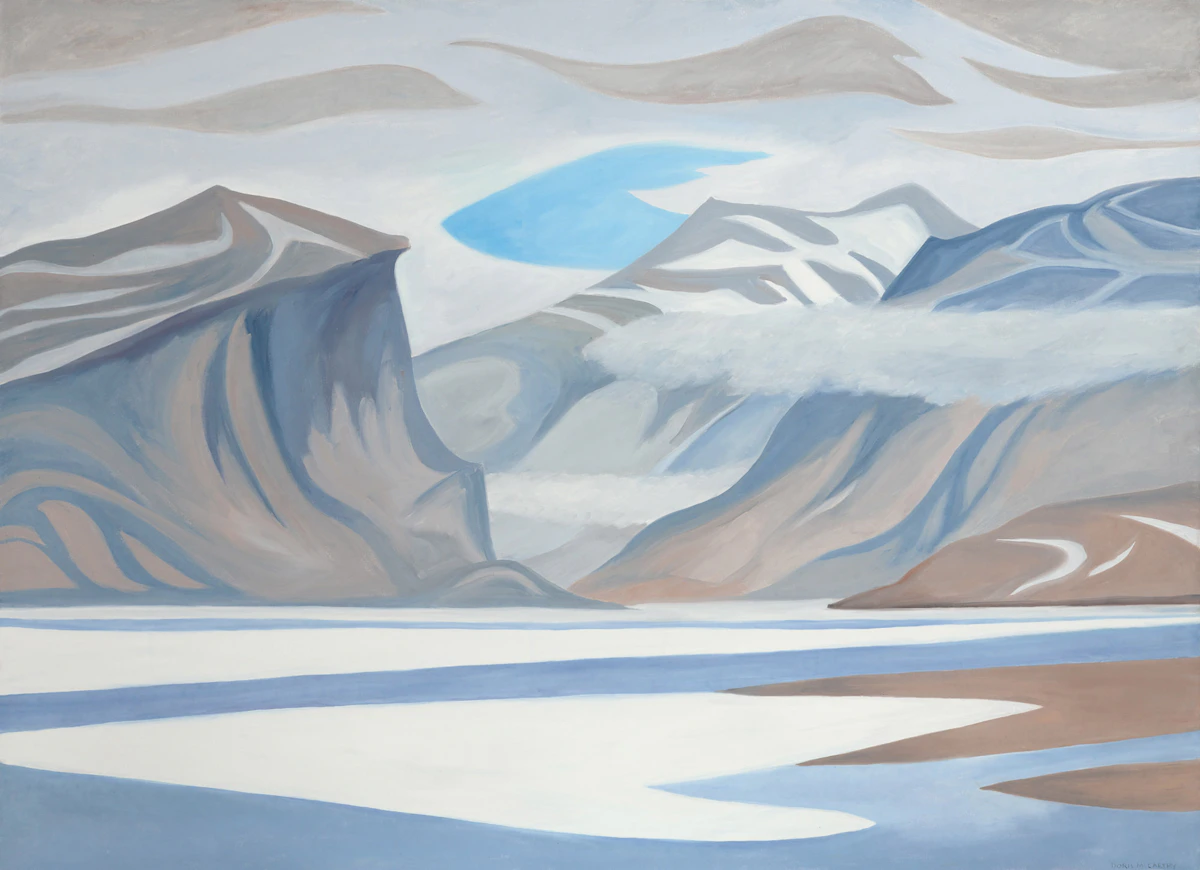
signed lower right; dated "050105" (1 May 2005) on the reverse
48 x 66 in (121.9 x 167.6 cm)
(including Buyer's Premium)
Acquired directly from the Artist, May 2005
Private Collection, Toronto
Doris McCarthy and Charis Wahl, Doris McCarthy: My Life, Toronto, 2006, page 204
Doris McCarthy returned to the Arctic in 1973, where she painted various locations on Baffin Island, including the hamlet of Pangnirtung. A small Inuit community in the Qikiqtaaluk Region of Nunavut, Pangnirtung is situated along a fjord surrounded by towering granite cliffs and glacier-fed waters. In her autobiography, the artist describes her first impressions of Pangnirtung: “The painting was terrific. Twice a day, the tide sent a flotilla of ice floes sailing up the fiord. As the tide ebbed, they went back to sea.” In her own writings, McCarthy described the silence, the light, and the spiritual vastness of the region as essential elements of her Arctic work. For McCarthy, the Arctic was not a desolate void, but a space of monumental beauty.
In Morning at Pangnirtung, McCarthy captures the serene clarity of the landscape through sweeping contours in a reduced palette of blues, whites, greys and earth tones. The curvilinear treatment of cliffs and snow suggests not only the physical geology of the North but also the subtle movements of light and atmosphere across its surfaces. Snow patterns and cloud formations are reduced to elegant, calligraphic shapes that lend a sense of movement to the otherwise still scene. The central blue void in the sky may represent a clearing in the clouds, a motif used to convey the ephemeral nature of Arctic weather.
Morning at Pangnirtung encapsulates McCarthy’s mature style, wherein she eschews minute detail in favour of broad, sculptural forms and rhythmic movement. This reduction of the Pangnirtung landscape is not a denial of its complexity, but a distillation of its essence—a meditation on light, form, and time.
