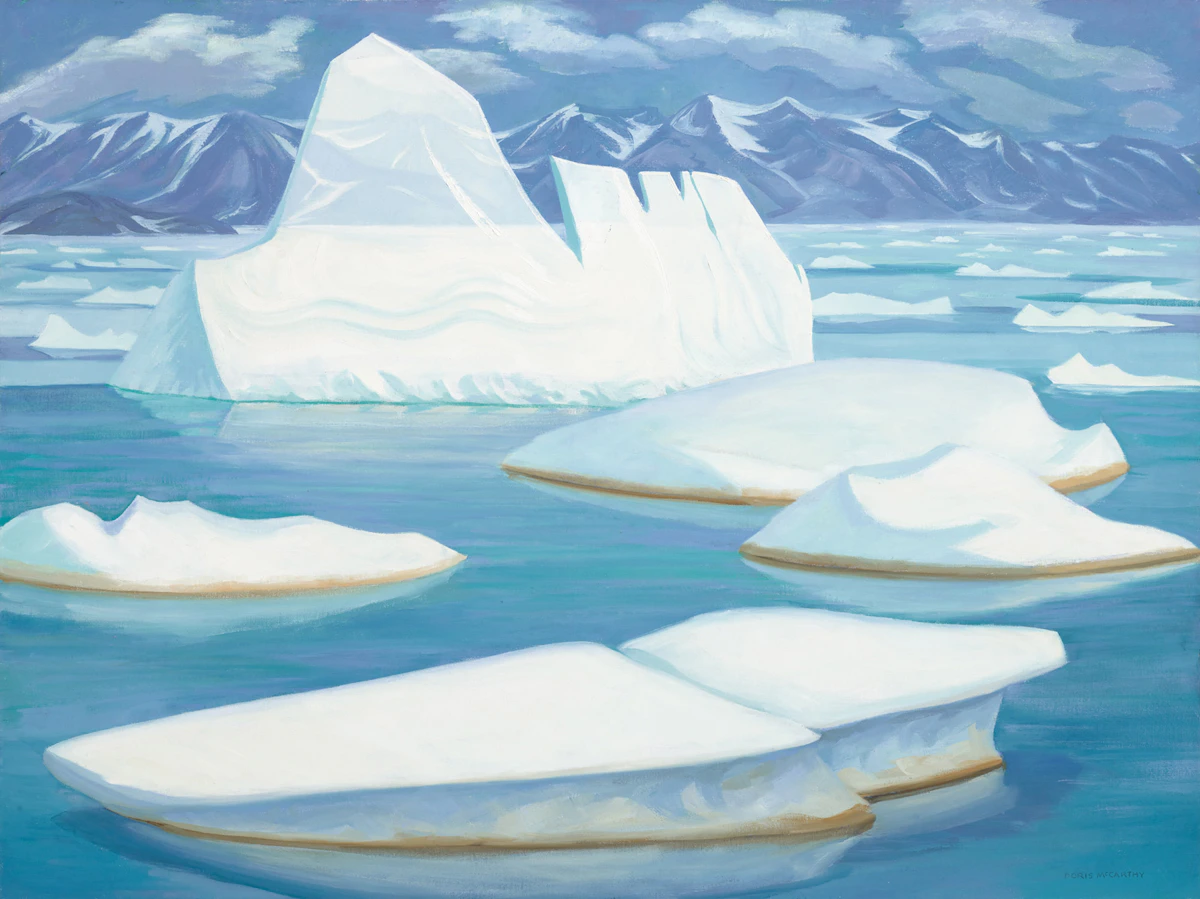
signed lower right; titled on a gallery label and dated "870117" (17 January 1987) on the reverse
36 x 48 in (91.4 x 121.9 cm)
(including Buyer's Premium)
Gift of the Artist
Private Collection, Ottawa
Doris McCarthy, The Good Wine: An Artist Comes of Age, Toronto, 1991, page 232
In her second autobiography, titled The Good Wine: An Artist Comes of Age, Doris McCarthy writes that she had travelled to the high Arctic seven times, as well as across other provinces and territories multiple times. This “wander-pattern” had taken root in her early days as an artist, following the example of Canada’s leading artists. McCarthy notes that the best way to experience the places she went was to paint them. “Painting demands a concentration and sensibility that grows into an intimacy with the country, greatly intensifying your awareness of it. You come to know it instead of just seeing it”.
Born in Calgary and raised in Toronto, Doris McCarthy is recognized as one of Canada’s foremost landscape painters. She taught frequently at the Central Technical School in downtown Toronto from 1932 until she retired in 1972. After retiring, McCarthy first visited the Arctic with her colleague Barbara Greene. That summer, they headed north, landing first at Resolute Bay before continuing to Eureka, Grise Fiord, and Pond Inlet. In the years that followed, icebergs became a recurring motif in McCarthy’s work and her most identifiable theme.
Although she managed a substantial amount of plein air painting, the conditions were often demanding. McCarthy could not use acrylics or watercolours because they would freeze, and even oils would eventually harden. Painting the Iceberg Fantasy series was a solution to the problem.
McCarthy’s Iceberg Fantasy paintings, of which there are roughly sixty, represent a personal and meditative response to her beloved Arctic landscape. These works evolved from simplified forms to fully realized three-dimensional compositions that balance abstraction and realism. In paintings such as Iceberg Fantasy #38, completed in 1987, McCarthy uses a bold, luminous palette to transform icebergs into monumental yet ethereal structures. Her approach invites viewers into a dreamlike Arctic, emphasizing not just its physical grandeur but its emotional and imaginative resonance.
