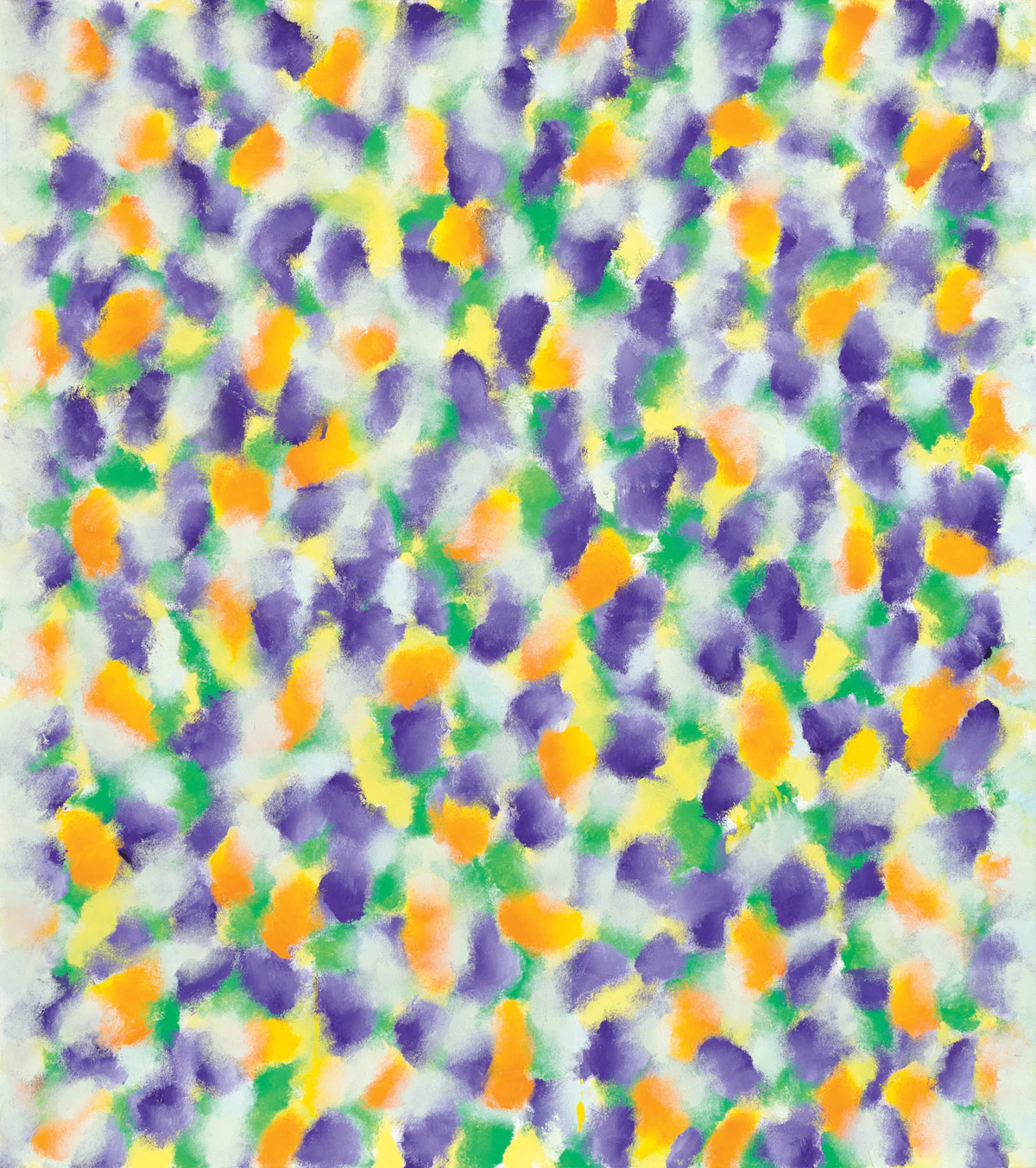
signed, titled and dated 1973 on the reverse
45 x 40 in (114.3 x 101.6 cm)
(including Buyer's Premium)
Moos Gallery, Toronto
Private Collection, Toronto
Born in Kielce, Poland, Gershon Iskowitz survived the Holocaust, enduring imprisonment in concentration camps including Auschwitz and Buchenwald. After the war, he studied art in Munich before immigrating to Canada in 1949. His early works of the 1950s and early 1960s are rooted in figurative expressionism, but by the end of the decade, Iskowitz had transitioned decisively toward abstraction, a move that marked the beginning of his mature style. He represented Canada at the Venice Biennale in 1972. By 1973, Iskowitz was at the height of his artistic maturity. His works of this period, such as Lizabeth’s Painting, are filled with vibrant, floating patches of colour suspended in luminous fields. This painting demonstrates Iskowitz’s hallmark precision: jewel-like dabs or veils of pigment hover across the canvas, creating the illusion of depth without conventional perspective.
