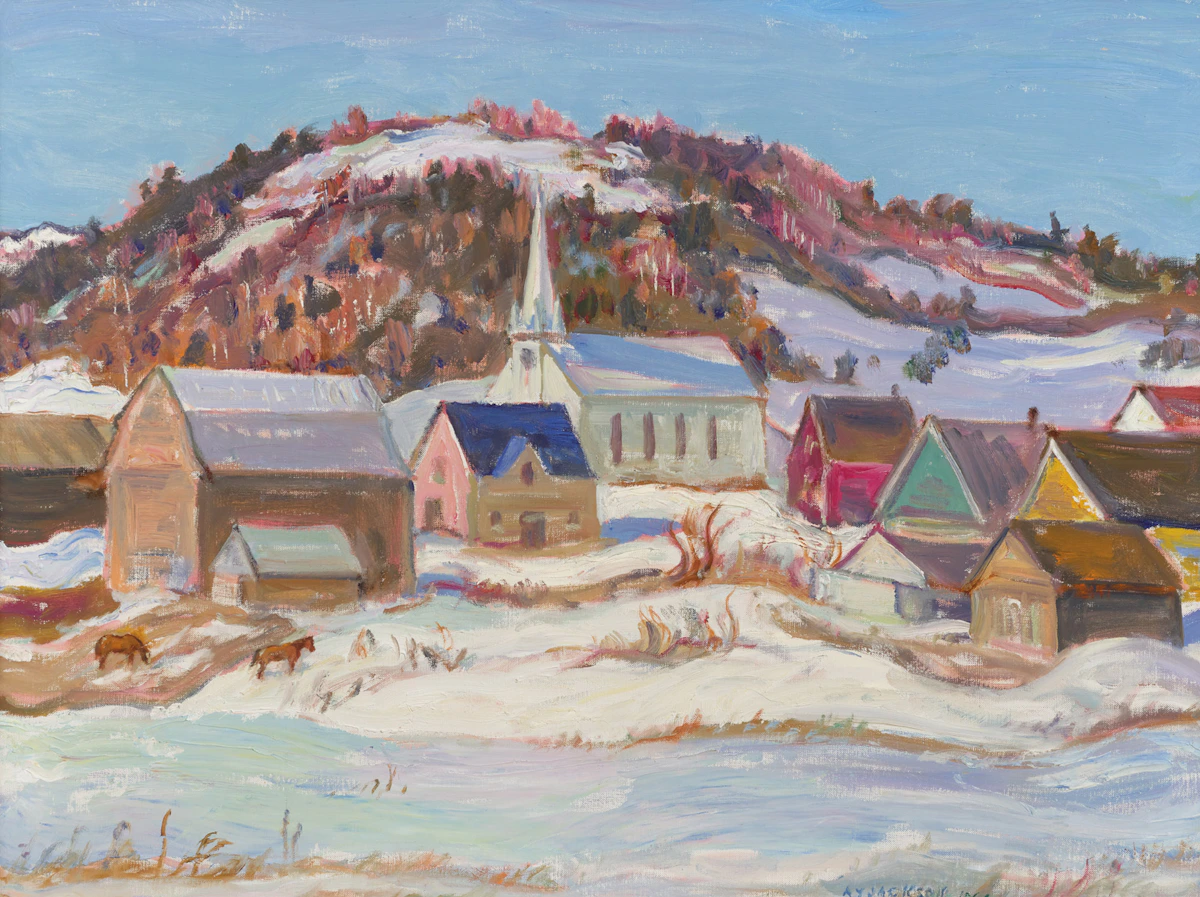
signed and dated 1964 lower right
25.25 x 33.25 in (64.1 x 84.5 cm)
(including Buyer's Premium)
Angus MacNaughton
By descent to the present Private Collection, Somerville, Massachusetts
This enchanting painting by A.Y. Jackson depicts a small Canadian village in winter, lively and animated with the artist’s distinctive rhythmic brushwork. In the foreground, we see a snowy landscape with uneven patches of earth and brush poking through, painted in loose, textured stroke
s. A frozen stream winds across the bottom edge. Clustered houses in muted but varied colours form the middle ground; their simple gabled shapes evoke modest rural life. A white church with a tall spire rises at the centre of the village, becoming the focal point of the composition. Behind the village, a wooded hill slopes upward, its surface dotted with dark evergreens and highlighted with touches of pink and violet. The sky is a cool blue with soft, wispy clouds, reinforcing the crisp clarity of a winter’s day.
Jackson was enamoured with snow’s ability to reflect light, how it holds colour even in shadow, and how shapes become simpler under snow. His winter scenes have crisp, clean air, sharp shadows, bright sky, and subtle hues in the snow that reflect blues, pinks, greys, and warm tones in sunset or dawn.
The oil painting presents a quintessential A.Y. Jackson subject: the charming “Christmas card country”, as he would describe these regions to fellow Group of Seven member J.E.H. MacDonald. The painter-sometimes journeying alone, other times with fellow artists, including Albert Henry Robinson, Arthur Lismer and Frederick Grant Banting-would travel throughout rural Quebec to paint the local scenery. Jackson would often board with families during stays in smaller communities, providing a deep examination of not only the land but also the daily life and culture of the residents.
Notre-Dame-de-la-Salette is a small village located in western Quebec, about sixty kilometres north of Ottawa along the Lièvre River. The area’s rolling terrain, clustered buildings, and winding river valleys offered the rural charm and natural rhythm that appealed to Jackson. In winter, places like Notre-Dame-de-la-Salette provided ideal subjects for his characteristic, lively brushwork and animated compositions. Jackson produced several works of the village both in oil paint and graphite, as it was an easy trip from Ottawa, where he lived in the late 1950s and 1960s.
