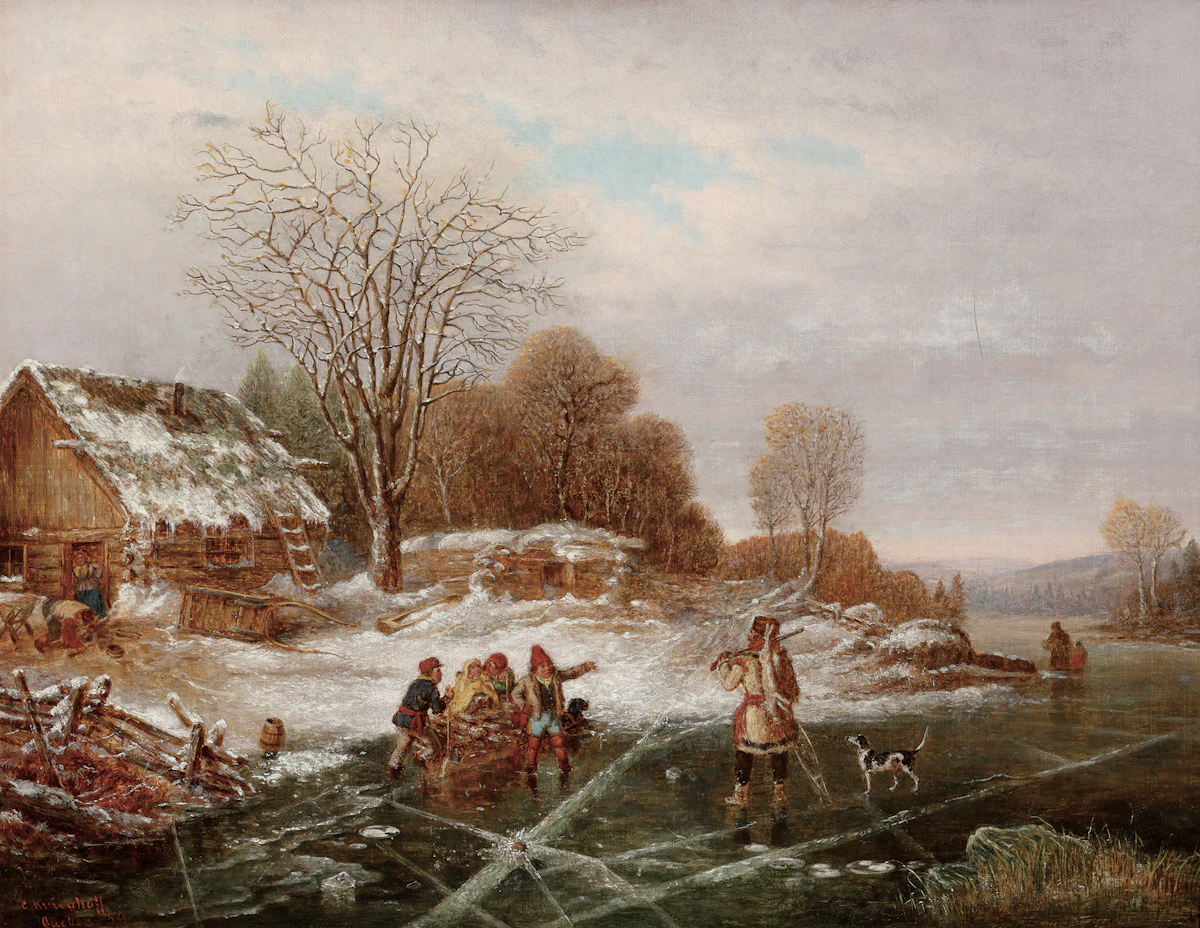
signed and dated "1859 Quebec" lower left; titled on a label on the reverse
14 × 18 in (35.6 × 45.7 cm)
Private Collection, Vancouver
Kaspar Gallery, Toronto
Private Collection, Toronto
By descent to the present Private Collection, Toronto
J. Russell Harper, Krieghoff, Toronto, 1979, page 44
Dennis Reid, Krieghoff, Images of Canada, Toronto, 1999, pages 58-61, 155-156, 163
Cornelius Krieghoff specialized in genre scenes depicting everyday life in nineteenth-century Quebec. His 1859 painting Returning from the Hunt offers a lively, anecdotal view of a rural settlement in the depths of winter, populated with amusing details and wry observations. While life on the frontier was often rugged and precarious, it also provided fertile subject matter for Krieghoff, who captured the resourcefulness, industry and character of its inhabitants.
In Returning from the Hunt, Krieghoff tells several stories: a hunter confidently stands in the foreground, gun in hand and a hare slung over his shoulder, accompanied by his loyal dog. Nearby, a family struggles to move a sleigh filled with logs across the ice. A man wearing a ceinture fléchée pushes the heavy load, assisted by a dog pulling the sleigh. Another man greets the hunter, or perhaps is giving him directions to the nearest town. In the background a plume of smoke rises from a log house. A couple tends to their chores—one man gathers logs while a woman stands in the doorway. This winter scene is recorded as taking place near Saint-Césaire and Chambly, what is now a suburb of Montreal.
Krieghoff remains somewhat enigmatic in Canadian art history, as little is known about his formal education or what motivated him to focus so intensely on the lives of everyday Canadians. Historian Ramsay Cook suggests a few possibilities: the artist may have been captivated by the uniqueness of Canadian life, or he may have tapped into a market among soldiers stationed in Quebec looking for souvenirs. Another possibility is that Krieghoff drew inspiration from Dutch genre painting, a style he would have been familiar with due to his Dutch-German background. Cook notes that genre painting was already a key part of 17th-century Dutch visual culture, and Krieghoff’s travels in America would have allowed him to study these works firsthand. It is clear that Krieghoff brought the genre painting tradition to Canada in the 1840s and practiced it with great success throughout his career.
Unlike other artists of his time, such as Antoine Plamondon, Théophile Hamel, or Joseph Légaré, Krieghoff focused on everyday, often overlooked subjects. Cook stipulates that Krieghoff’s goal was not to elevate his subjects, but to record and share the human condition. Krieghoff would have encountered these farmsteads up the St. Maurice and Shawinigan Rivers, in the hinterlands up the Montmorency and beyond Lake St. Francis.
