Marcelle Ferron was born in 1924 in Louiseville, Quebec, and raised in Sainte-Élisabeth in the Lanaudière region. Her father was a doctor, and her mother encouraged the arts. Marcelle was one of several creative siblings—her sister Madeleine Ferron became a noted writer. After contracting tuberculosis as a teenager, she left high school and later studied at the École des beaux-arts de Québec, but found its academic style stifling and left without graduating. Her frequent stays in a dim, drab hospital room during her illness sparked a deep appreciation for light and colour, which she infused into her abstract paintings. In Montreal in the 1940s, Ferron met Paul-Émile Borduas and became a member of the Automatistes group and a signatory of the "Refus Global" in 1948. Her first solo show was held in 1949 at the Librairie Tranquille on Sainte-Catherine Street in Montreal, one of the very few exhibition spaces at that time showing avant-garde art. Ferron’s paintings became progressively more forceful; vibrant colours and larger, fluid forms dominated the canvases.
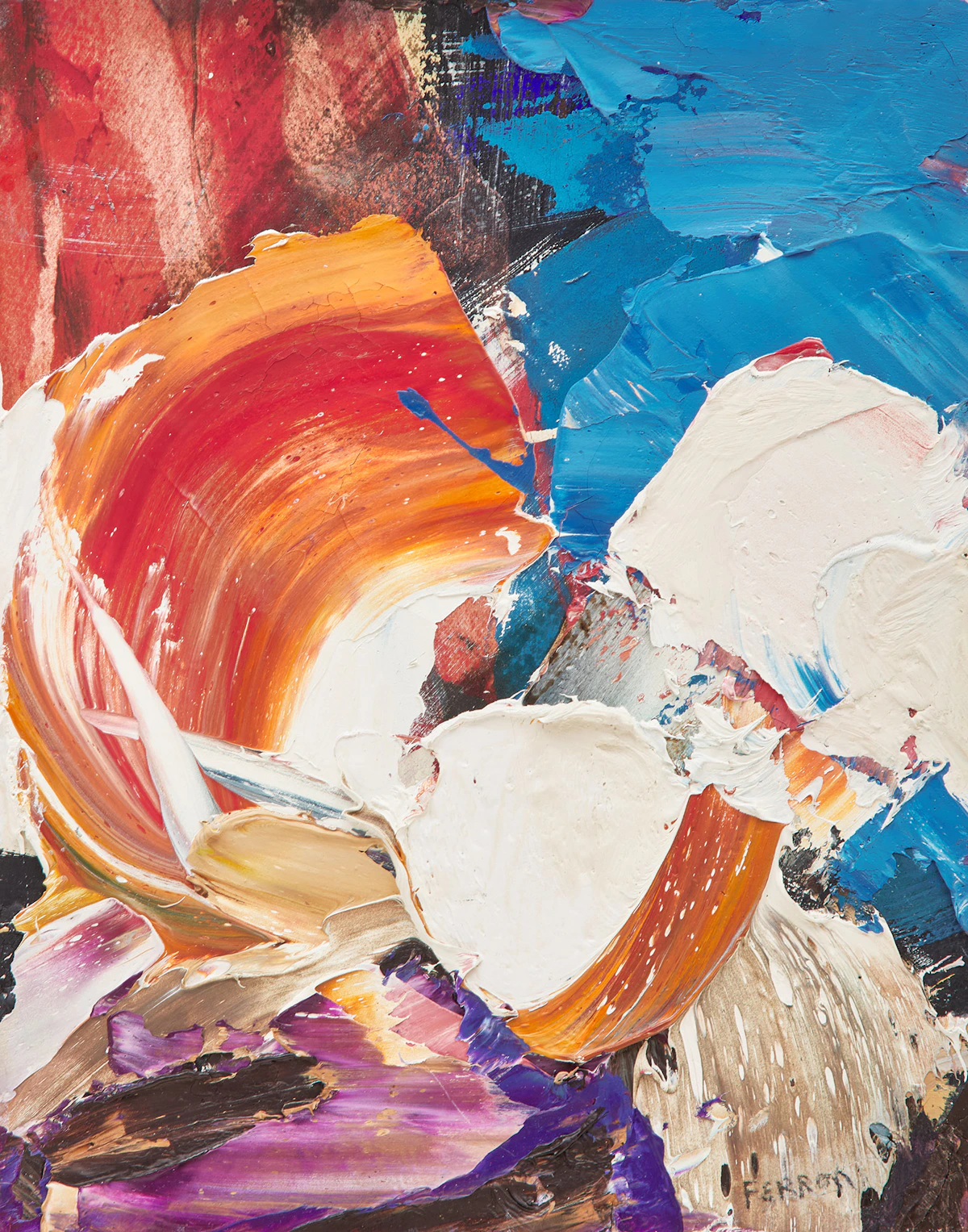
By the late 1950s and into the early 1960s, Ferron was creating some of her most acclaimed and widely recognized work. She held solo exhibitions at increasingly prominent galleries in Paris and Brussels and participated in group shows alongside artists such as Borduas and Jean Paul Riopelle. In 1959, her work was featured in the Third Biennial Exhibition of Canadian Art at the National Gallery of Canada, and in 1961 she represented Canada at the sixth São Paulo Biennial. She was made a member of the Royal Canadian Academy of Arts in 1972 and was awarded the Paul-Émile Borduas Prize, the Quebec government’s highest honour for achievement in the visual arts, in 1983. These two paintings are examples of her mature style consisting of bold pigments, thick impasto and violent brushstrokes, all contained within complementary modest-sized canvases.